





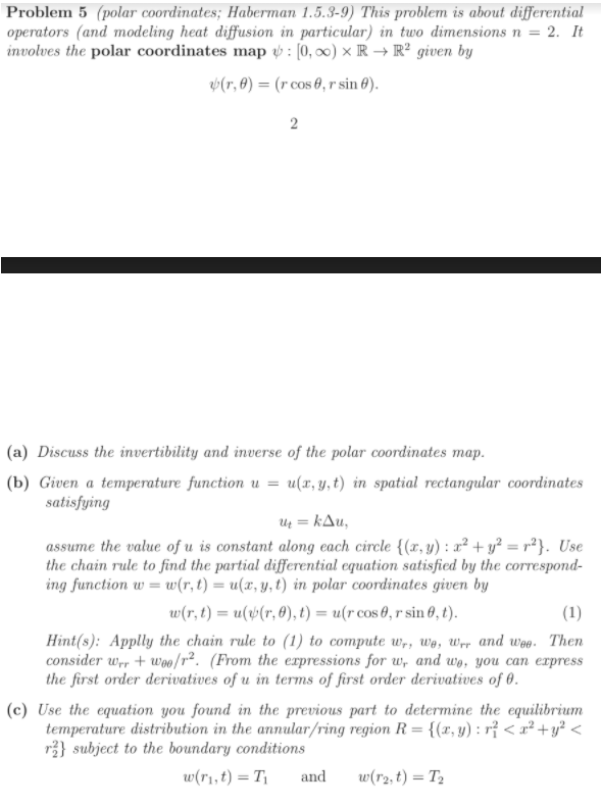
Question: fProblem 5 (polar coordinates; Haberman 1.5.3-9) This problem is about differential operators (and modeling heat diffusion in particular) in two dimensions n = 2. It
\fProblem 5 (polar coordinates; Haberman 1.5.3-9)\fProblem 5 (polar coordinates; Haberman 1.5.3-9)
\fProblem 5 (polar coordinates; Haberman 1.5.3-9) This problem is about differential operators (and modeling heat diffusion in particular) in two dimensions n = 2. It involves the polar coordinates map : [0, co) x R - R2 given by (r, 0) = (rcos 0, r sin #). 2 (a) Discuss the invertibility and inverse of the polar coordinates map. (b) Given a temperature function u = u(x, y, t) in spatial rectangular coordinates satisfying Ut = ku, assume the value of u is constant along each circle {(x, y) : x? + y? = r?}. Use the chain rule to find the partial differential equation satisfied by the correspond- ing function w = w(r, t) = u(x, y, t) in polar coordinates given by w(r, t) = u(v(r, 0), t) = u(r cos, r sine, t). (1) Hint(s): Applly the chain rule to (1) to compute wr, We, wer and wee. Then consider Wer + Wee/r2. (From the expressions for w, and we, you can express the first order derivatives of u in terms of first order derivatives of 0. (c) Use the equation you found in the previous part to determine the equilibrium temperature distribution in the annular/ring region R = {(x, y) : r

Step by Step Solution

There are 3 Steps involved in it

1 Expert Approved Answer
Step: 1 Unlock blur-text-image

Question Has Been Solved by an Expert!

Get step-by-step solutions from verified subject matter experts

Step: 2 Unlock
Step: 3 Unlock

Students Have Also Explored These Related Mathematics Questions!