







Question: FRAUD AT THE FOUNDATION If used outside source just make sure to provide the link (URL) and In-text citation. Readd the following and answerr completely.
FRAUD AT THE FOUNDATION
If used outside source just make sure to provide the link (URL) and In-text citation.
Readd the following and answerr completely.
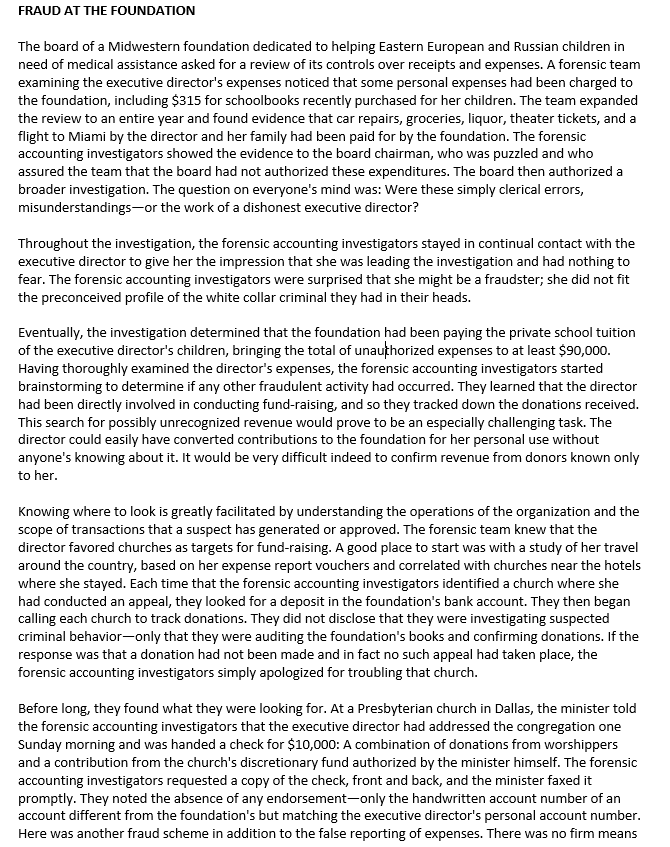
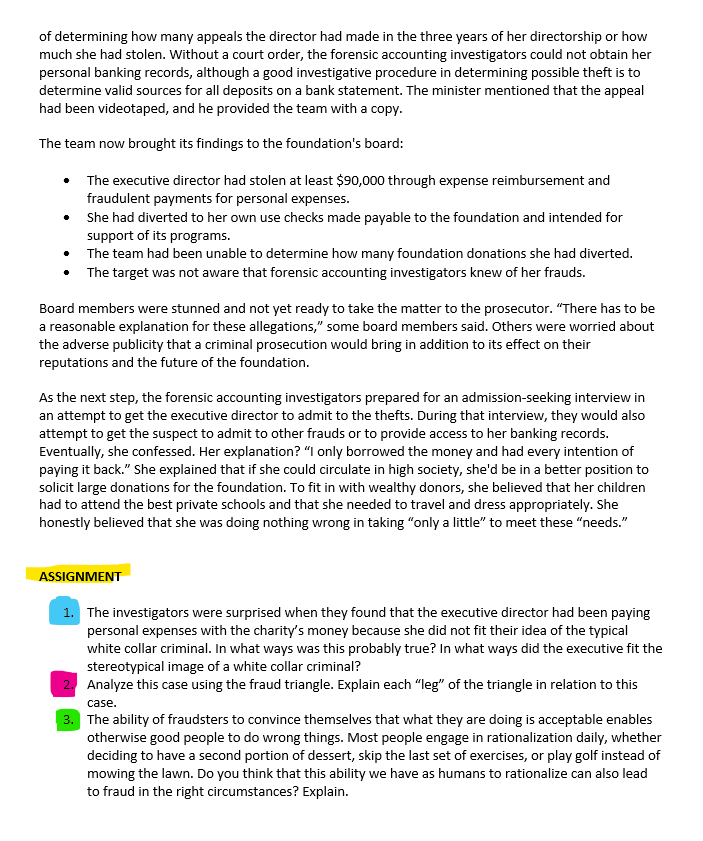
FRAUD AT THE FOUNDATION The board of a Midwestern foundation dedicated to helping Eastern European and Russian children in need of medical assistance asked for a review of its controls over receipts and expenses. A forensic team examining the executive director's expenses noticed that some personal expenses had been charged to the foundation, including $315 for schoolbooks recently purchased for her children. The team expanded the review to an entire year and found evidence that car repairs, groceries, liquor, theater tickets, and a flight to Miami by the director and her family had been paid for by the foundation. The forensic accounting investigators showed the evidence to the board chairman, who was puzzled and who assured the team that the board had not authorized these expenditures. The board then authorized a broader investigation. The guestion on everyone's mind was: Were these simply clerical errors, misunderstandingsor the work of a dishonest executive director? Throughout the investigation, the forensic accounting investigators stayed in continual contact with the executive director to give her the impression that she was leading the investigation and had nothing to fear. The forensic accounting investigators were surprised that she might be a fraudster; she did not fit the preconceived profile of the white collar criminal they had in their heads. Eventually, the investigation determined that the foundation had been paying the private school tuition of the executive director's children, bringing the total of unaukhurized expenses to at least $30,000. Having thoroughly examined the director's expenses, the forensic accounting investigators started brainstorming to determine if any other fraudulent activity had occurred. They learned that the director had been directly involved in conducting fund-raising, and so they tracked down the donations received. This search for possibly unrecognized revenue would prove to be an especially challenging task. The director could easily have converted contributions to the foundation for her personal use without anyone's knowing about it. It would be very difficult indeed to confirm revenue from donors known only to her. Knowing where to look is greatly facilitated by understanding the operations of the organization and the scope of transactions that a suspect has generated or approved. The forensic team knew that the director favored churches as targets for fund-raising. A good place to start was with a study of her travel around the country, based on her expense report vouchers and correlated with churches near the hotels where she stayed. Each time that the forensic accounting investigators identified a church where she had conducted an appeal, they looked for a deposit in the foundation's bank account. They then began calling each church to track donations. They did not disclose that they were investigating suspected criminal behavioronly that they were auditing the foundation's books and confirming donations. If the response was that a donation had not been made and in fact no such appeal had taken place, the forensic accounting investigators simply apologized for troubling that church. Before long, they found what they were looking for. At a Presbyterian church in Dallas, the minister told the forensic accounting investigators that the executive director had addressed the congregation one Sunday morning and was handed a check for $10,000: A combination of donations from worshippers and a contribution from the church's discretionary fund authorized by the minister himself. The forensic accounting investigators requested a copy of the check, front and back, and the minister faxed it promptly. They noted the absence of any endorsementaonly the handwritten account number of an account different from the foundation's but matching the executive director's personal account number. Here was another fraud scheme in addition to the false reporting of expenses. There was no firm means of determining how many appeals the director had made in the three years of her directorship or how much she had stolen. Without a court order, the forensic accounting investigators could not obtain her personal banking records, although a good investigative procedure in determining possible theft is to determine valid sources for all deposits on a bank statement. The minister mentioned that the appeal had been videotaped, and he provided the team with a copy. The team now brought its findings to the foundation's board: + The executive director had stolen at least 530,000 through expense reimbursement and fraudulent payments for personal expenses. * She had diverted to her own use checks made payable to the foundation and intended for support of its programs. * The team had been unable to determine how many foundation donations she had diverted. * The target was not aware that forensic accounting investigators knew of her frauds. Board members were stunned and not yet ready to take the matter to the prosecutor. \"There has to be a reasonable explanation for these allegations,\" some board members said. Others were worried about the adverse publicity that a criminal prosecution would bring in addition to its effect on their reputations and the future of the foundation. As the next step, the forensic accounting investigators prepared for an admission-seeking interview in an attempt to get the executive director to admit to the thefts. During that interview, they would also attempt to get the suspect to admit to other frauds or to provide access to her banking records. Eventually, she confessed. Her explanation? \"l only borrowed the money and had every intention of paying it back.\" She explained that if she could circulate in high society, she'd be in a better position to solicit large donations for the foundation. To fit in with wealthy donors, she believed that her children had to attend the best private schools and that she needed to travel and dress appropriately. She honestly believed that she was doing nothing wrong in taking \"only a little\" to meet these \"needs.\" ASSIGNMENT 1. The investigators were surprised when they found that the executive director had been paying personal expenses with the charity''s money because she did not fit their idea of the typical white collar criminal. In what ways was this probably true? In what ways did the executive fit the stereotypical image of a white collar criminal? . Analyze this case using the fraud triangle. Explain each \"leg\" of the triangle in relation to this case. 3. | The ability of fraudsters to convince themselves that what they are doing is acceptable enables otherwise good people to do wrong things. Most people engage in rationalization daily, whether deciding to have a second portion of dessert, skip the last set of exercises, or play golf instead of mowing the lawn. Do you think that this ability we have as humans to rationalize can also lead to fraud in the right circumstances? Explain
Step by Step Solution
There are 3 Steps involved in it

Get step-by-step solutions from verified subject matter experts
 Study Help