



Question: Fraud, Internal Control, and Cash and Reporting and Analyzing Receivables At December 31, 2019, SoundMaster Company reported this information on its balance sheet. Accounts receivable
Fraud, Internal Control, and Cash and Reporting and Analyzing Receivables
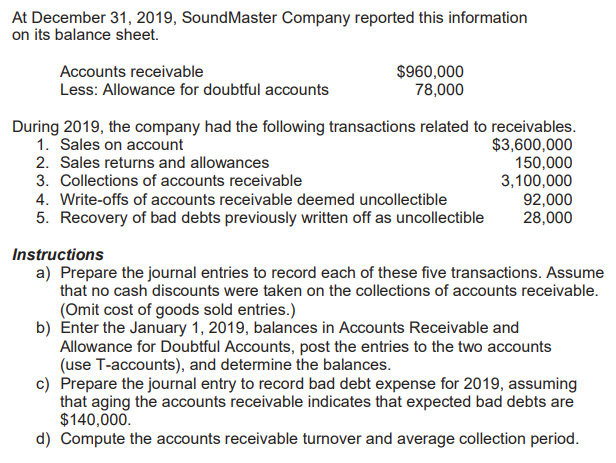
At December 31, 2019, SoundMaster Company reported this information on its balance sheet. Accounts receivable $960,000 Less: Allowance for doubtful accounts 78,000 During 2019, the company had the following transactions related to receivables. 1. Sales on account $3,600,000 2. Sales returns and allowances 150,000 3. Collections of accounts receivable 3,100,000 4. Write-offs of accounts receivable deemed uncollectible 92,000 5. Recovery of bad debts previously written off as uncollectible 28,000 Instructions a) Prepare the journal entries to record each of these five transactions. Assume that no cash discounts were taken on the collections of accounts receivable. (Omit cost of goods sold entries.) b) Enter the January 1, 2019, balances in Accounts Receivable and Allowance for Doubtful Accounts, post the entries to the two accounts (use T-accounts), and determine the balances. c) Prepare the journal entry to record bad debt expense for 2019, assuming that aging the accounts receivable indicates that expected bad debts are $140,000. d) Compute the accounts receivable turnover and average collection period
Step by Step Solution
There are 3 Steps involved in it

Get step-by-step solutions from verified subject matter experts