







Question: Free Fall https://semmedia.mhhe.com/physics_vl/physics_elabs_070720/eLabs/help/help.html For this particular lab, our goal is to find the acceleration due to gravity (g=9.8 m/s2) experimentally using the apple in the
Free Fall
https://semmedia.mhhe.com/physics_vl/physics_elabs_070720/eLabs/help/help.html
For this particular lab, our goal is to find the acceleration due to gravity (g=9.8 m/s2) experimentally using the apple in the video.
1. Need a position vs time table. To do this you'll need the y-coordinates and frame numbers. The time between each frame is given. The origin in the video is lower left corner and you'll only need the y coordinates, ignore x. There are 30 frames but as you'll see the first frames will not give you much information, things will happen quickly towards the end. I'd say 10 data points should be enough.
2. Plot y versus t. Now when you do this you have options: You can either keep your y-values as they are - meaning the origin (y=0) is bottom of the page or you can change the origin to where the person drops the apple. Both work fine and I leave it to you to pick the one you like. The resulting plots should more or less look like these:
3. Now this would be enough to extract g, but we will add one more step to it (classical way, see step 4). In Excel or your other favorite plotting software fit a QUADRATIC CURVE to your plot. In Excel this is done by right clicking any of the data points and selecting "add trendline". Since we know that the displacement formula is Delta y = v_initial t + (1/2) a t2, the acceleration will be the twice the number in front of t2 in your fit.
4. Here's a more traditional method, which we used when computer polynomial(quadratic) curve fitting was not available to us. LINEARIZE your plot, meaning instead of plotting y vs t, plot y vs t2. Then your plot will be a STRAIGHT LINE. Find the slope of the line and the slope will be half of the acceleration.
5. Having found your experimental g (g_exp), now calculate the PERCENT ERROR using this formula:
6. What is the percentage error? Is it small? I am not expecting anything larger than 20 percent so check your calculations if you get a big error. Once you are done with this and found a reasonable g value, think about possible things that can go wrong in a real world situation. If you were in a lab how would you do this experiment? What if video recording was not available? Are there any devices out there that can help you to track the motion of falling objects? Can you use an inclined plane instead? This will be your conclusion part.
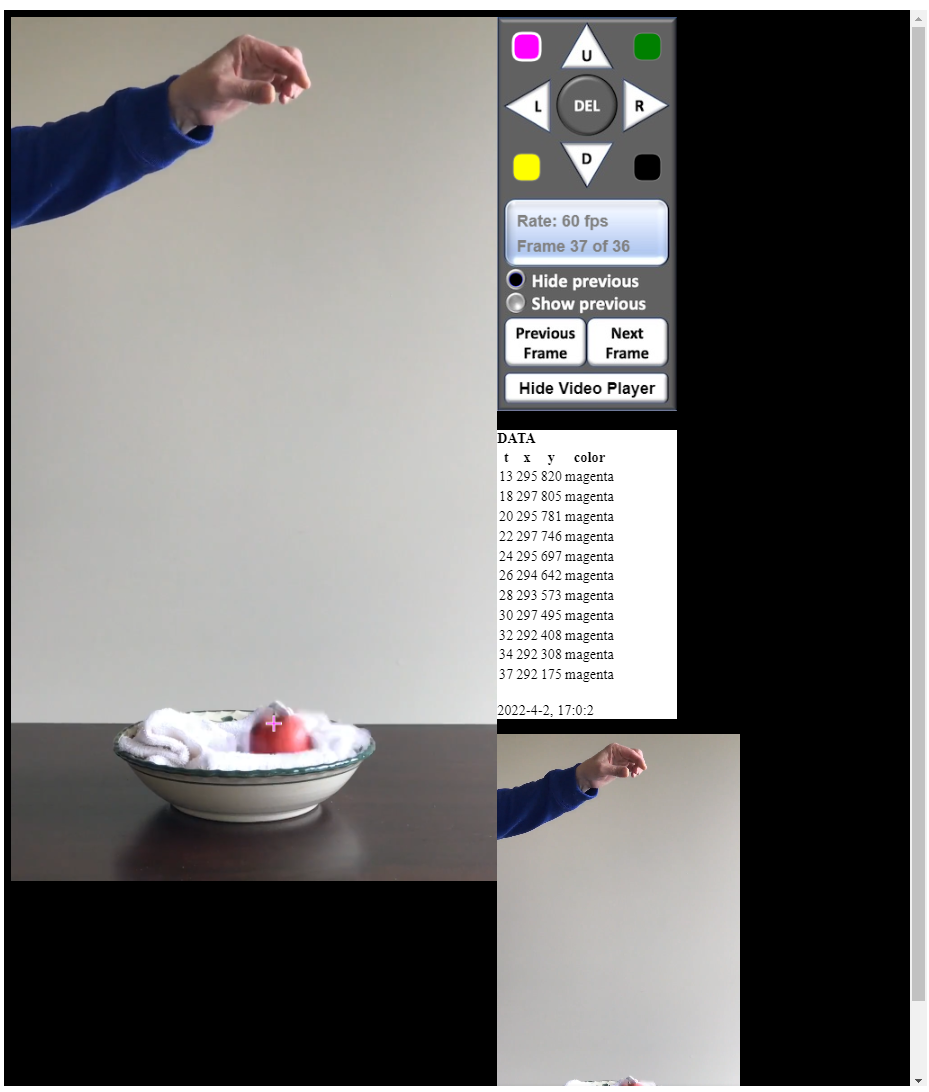
U DEL R D Rate: 60 fps Frame 37 of 36 Hide previous Show previous Previous Next Frame Frame Hide Video Player DATA t x y color 13 295 820 magenta 18 297 805 magenta 20 295 781 magenta 22 297 746 magenta 24 295 697 magenta 26 294 642 magenta 28 293 573 magenta 30 297 495 magenta 32 292 408 magenta 34 292 308 magenta 37 292 175 magenta 2022-4-2, 17:0:2
Step by Step Solution
There are 3 Steps involved in it

Get step-by-step solutions from verified subject matter experts
 Study Help