Question: from a structural frame perspective what is wrong with ABCO? what principals of basic assumptions and elements of structural frame/scientific management theories/bureaucratic models were being
from a structural frame perspective what is wrong with ABCO?
what principals of basic assumptions and elements of structural frame/scientific management theories/bureaucratic models were being violated?
how might it have been done instead , using organization structure and frame.
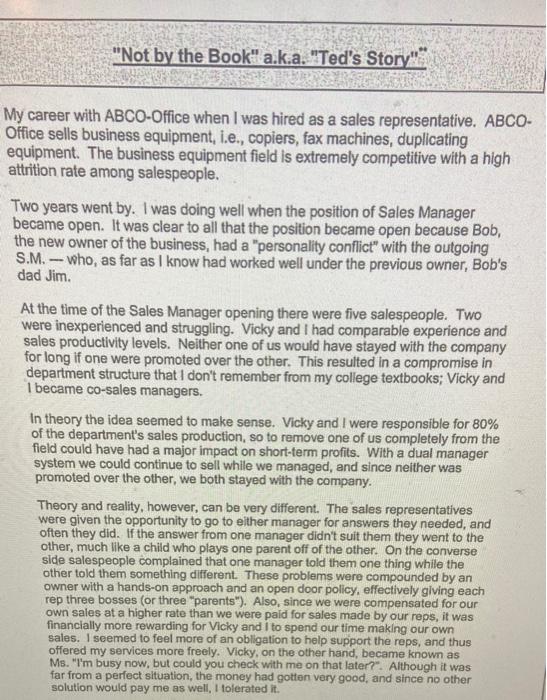
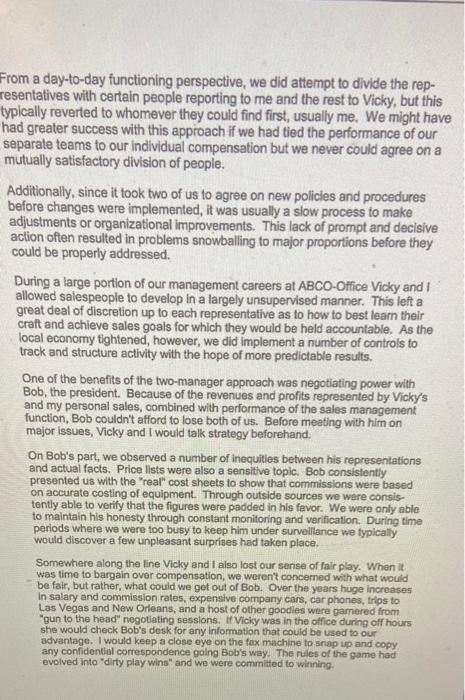
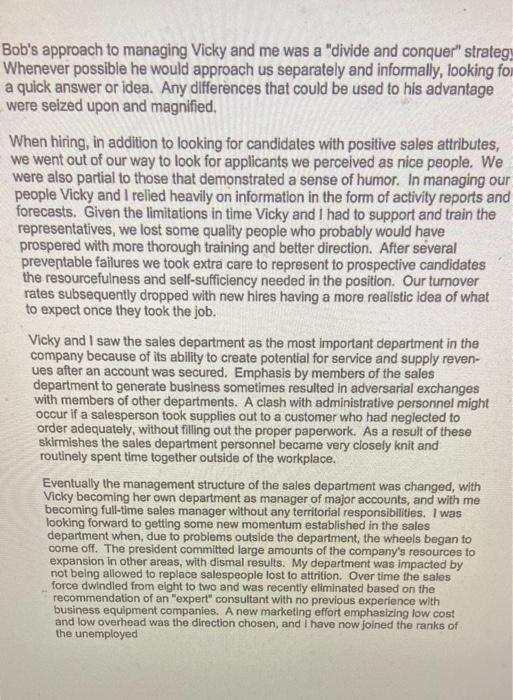
"Not by the Book" a.k.a. "Ted's Story a My career with ABCO-Office when I was hired as a sales representative. ABCO- Office sells business equipment, i.e., copiers, fax machines, duplicating equipment. The business equipment field is extremely competitive with a high attrition rate among salespeople. Two years went by. I was doing well when the position of Sales Manager became open. It was clear to all that the position became open because Bob, the new owner of the business, had a "personality conflict with the outgoing S.M. -- who, as far as I know had worked well under the previous owner, Bob's dad Jim. At the time of the Sales Manager opening there were five salespeople. Two were inexperienced and struggling. Vicky and I had comparable experience and sales productivity levels. Neither one of us would have stayed with the company for long if one were promoted over the other. This resulted in a compromise in department structure that I don't remember from my college textbooks; Vicky and I became co-sales managers. In theory the idea seemed to make sense. Vicky and I were responsible for 80% of the department's sales production, so to remove one of us completely from the field could have had a major impact on short-term profits. With a dual manager system we could continue to sell while we managed, and since neither was promoted over the other, we both stayed with the company. Theory and reality, however, can be very different. The sales representatives were given the opportunity to go to either manager for answers they needed, and often they did. If the answer from one manager didn't suit them they went to the other, much like a child who plays one parent off of the other. On the converse side salespeople complained that one manager told them one thing while the other told them something different. These problems were compounded by an owner with a hands-on approach and an open door policy, effectively giving each rep three bosses (or three "parents"). Also, since we were compensated for our own sales at a higher rate than we were paid for sales made by our reps, it was financially more rewarding for Vicky and I to spend our time making our own sales. I seemed to feel more of an obligation to help support the reps, and thus offered my services more freely. Vicky, on the other hand, became known as Ms. "I'm busy now, but could you check with me on that later?". Although it was far from a perfect situation, the money had gotten very good, and since no other solution would pay me as well, I tolerated it. From a day-to-day functioning perspective, we did attempt to divide the rep- resentatives with certain people reporting to me and the rest to Vicky, but this typically reverted to whomever they could find first, usually me. We might have had greater success with this approach if we had tied the performance of our separate teams to our individual compensation but we never could agree on a mutually satisfactory division of people. Additionally, since it took two of us to agree on new policies and procedures before changes were implemented, it was usually a slow process to make adjustments or organizational improvements. This lack of prompt and decisive action often resulted in problems snowballing to major proportions before they could be properly addressed. During a large portion of our management careers at ABCO-Office Vicky and I allowed salespeople to develop in a largely unsupervised manner. This left a great deal of discretion up to each representative as to how to best learn their craft and achieve sales goals for which they would be held accountable. As the local economy tightened, however, we did implement a number of controls to track and structure activity with the hope of more predictable results. One of the benefits of the two-manager approach was negotiating power with Bob, the president. Because of the revenues and profits represented by Vicky's and my personal sales, combined with performance of the sales management function, Bob couldn't afford to lose both of us. Before meeting with him on major issues, Vicky and I would talk strategy beforehand. On Bob's part, we observed a number of inequities between his representations and actual facts. Price lists were also a sensitive topic. Bob consistently presented us with the "real" cost sheets to show that commissions were based on accurate costing of equipment. Through outside sources we were consis- tently able to verify that the figures were padded in his favor. We were only able to maintain his honesty through constant monitoring and verification. During time periods where we were too busy to keep him under surveillance we typically would discover a few unpleasant surprises had taken place. Somewhere along the line Vicky and I also lost our sense of fair play. When it was time to bargain over compensation, we weren't concerned with what would be fair, but rather, what could we get out of Bob. Over the years huge increases In salary and commission rates, expensive company cars, car phones, trips to Las Vegas and New Orleans, and a host of other goodies were gamered from "gun to the head" negotiating sessions. If Vicky was in the office during off hours she would check Bob's desk for any information that could be used to our advantage. I would keep a close eye on the fax machine to snap up and copy any confidential correspondence going Bob's way. The rules of the game had evolved into "dirty play wins" and we were committed to winning. Bob's approach to managing Vicky and me was a "divide and conquer" strategy Whenever possible he would approach us separately and informally, looking for a quick answer or idea. Any differences that could be used to his advantage were seized upon and magnified, When hiring, in addition to looking for candidates with positive sales attributes, we went out of our way to look for applicants we perceived as nice people. We were also partial to those that demonstrated a sense of humor. In managing our people Vicky and I relied heavily on information in the form of activity reports and forecasts. Given the limitations in time Vicky and I had to support and train the representatives, we lost some quality people who probably would have prospered with more thorough training and better direction. After several preventable failures we took extra care to represent to prospective candidates the resourcefulness and self-sufficiency needed in the position. Our turnover rates subsequently dropped with new hires having a more realistic idea of what to expect once they took the job. Vicky and I saw the sales department as the most important department in the company because of its ability to create potential for service and supply reven- ues after an account was secured. Emphasis by members of the sales department to generate business sometimes resulted in adversarial exchanges with members of other departments. A clash with administrative personnel might occur if a salesperson took supplies out to a customer who had neglected to order adequately, without filling out the proper paperwork. As a result of these skirmishes the sales department personnel became very closely knit and routinely spent time together outside of the workplace. Eventually the management structure of the sales department was changed, with Vicky becoming her own department as manager of major accounts, and with me becoming full-time sales manager without any territorial responsibilities. I was looking forward to getting some new momentum established in the sales department when, due to problems outside the department, the wheels began to come off. The president committed large amounts of the company's resources to expansion in other areas, with dismal results. My department was impacted by not being allowed to replace salespeople lost to attrition. Over time the sales force dwindled from eight to two and was recently eliminated based on the recommendation of an "expert" consultant with no previous experience with business equipment companies. A new marketing effort emphasizing low cost and low overhead was the direction chosen, and I have now joined the ranks of the unemployed









 Study Help