Question: From: TeleQ CEO, Henrietta Jung RE: Developing a Vision Statement I first want to thank you for your hard work and dedication to share our
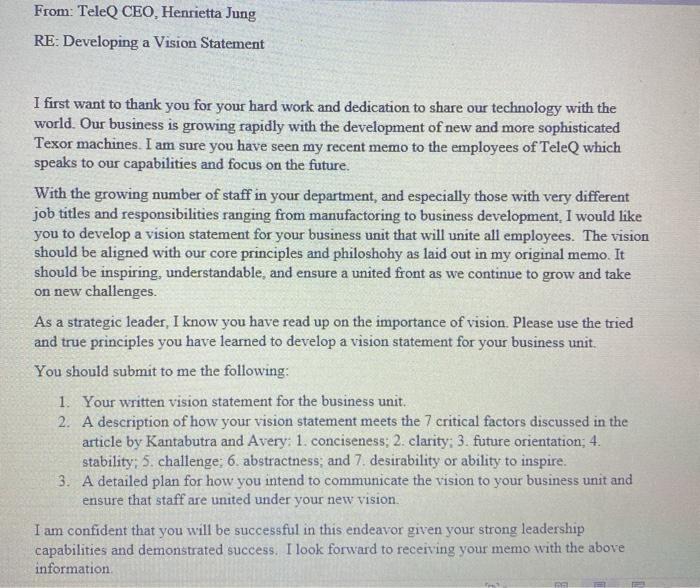
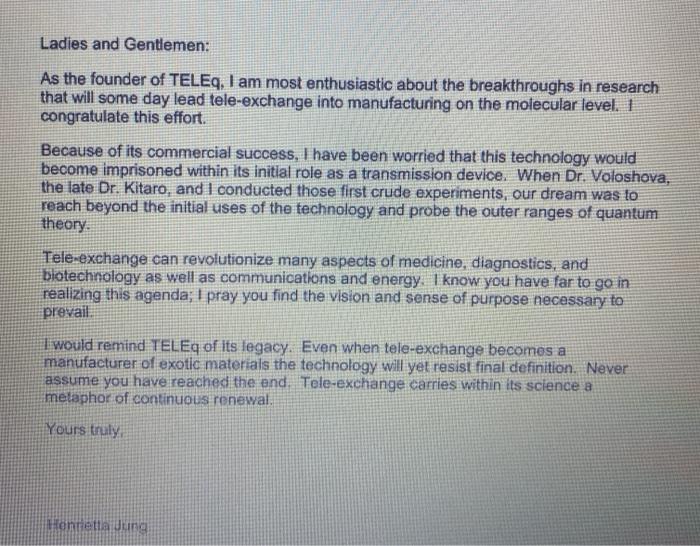
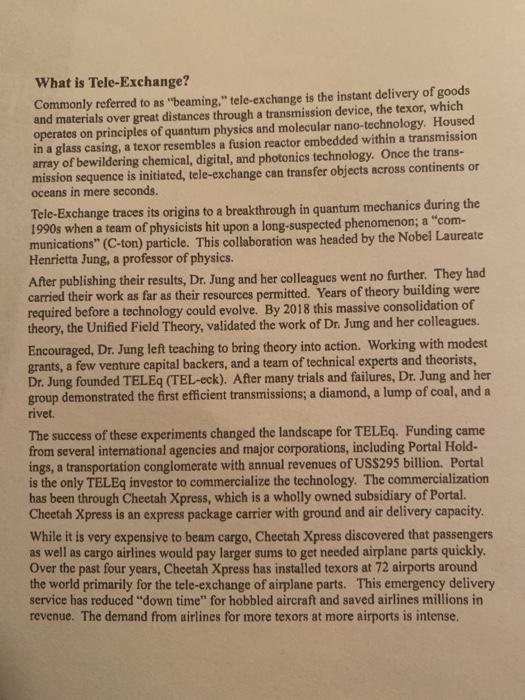
From: TeleQ CEO, Henrietta Jung RE: Developing a Vision Statement I first want to thank you for your hard work and dedication to share our technology with the world. Our business is growing rapidly with the development of new and more sophisticated Texor machines. I am sure you have seen my recent memo to the employees of TeleQ which speaks to our capabilities and focus on the future. With the growing number of staff in your department, and especially those with very different job titles and responsibilities ranging from manufactoring to business development. I would like you to develop a vision statement for your business unit that will unite all employees. The vision should be aligned with our core principles and philoshohy as laid out in my original memo. It should be inspiring, understandable, and ensure a united front as we continue to grow and take on new challenges. As a strategic leader, I know you have read up on the importance of vision. Please use the tried and true principles you have learned to develop a vision statement for your business unit. You should submit to me the following: 1. Your written vision statement for the business unit. 2. A description of how your vision statement meets the 7 critical factors discussed in the article by Kantabutra and Avery: 1. conciseness; 2. clarity: 3. future orientation: 4. stability: 5. challenge: 6. abstractness; and 7. desirability or ability to inspire. 3. A detailed plan for how you intend to communicate the vision to your business unit and ensure that staff are united under your new vision I am confident that you will be successful in this endeavor given your strong leadership capabilities and demonstrated success. I look forward to receiving your memo with the above information Ladies and Gentlemen: As the founder of TELEQ, I am most enthusiastic about the breakthroughs in research that will some day lead tele-exchange into manufacturing on the molecular level. I congratulate this effort. Because of its commercial success, I have been worried that this technology would become imprisoned within its initial role as a transmission device. When Dr. Voloshova, the late Dr. Kitaro, and I conducted those first crude experiments, our dream was to reach beyond the initial uses of the technology and probe the outer ranges of quantum theory Tele-exchange can revolutionize many aspects of medicine, diagnostics, and biotechnology as well as communications and energy. I know you have far to go in realizing this agenda; I pray you find the vision and sense of purpose necessary to prevail I would remind TELEq of its legacy. Even when tele-exchange becomes a manufacturer of exotic materials the technology will yet resist final definition. Never assume you have reached the end. Tele-exchange carries within its science a metaphor of continuous renewal. Yours truly Hennetla Jung What is Tele-Exchange? Commonly referred to as "beaming." telo-exchange is the instant delivery of goods and materials over great distances through a transmission device, the texor, which operates on principles of quantum physics and molecular nano-technology. Housed in a glass casing, a texor resembles a fusion reactor embedded within a transmission array of bewildering chemical, digital, and photonics technology. Once the trans- mission sequence is initiated, tele-exchange can transfer objects across continents or oceans in mere seconds. Tele-Exchange traces its origins to a breakthrough in quantum mechanics during the 1990s when a team of physicists hit upon a long-suspected phenomenon; a "com- munications" (C-ton) particle. This collaboration was headed by the Nobel Laureate Henrietta Jung, a professor of physics. After publishing their results, Dr. Jung and her colleagues went no further. They had carried their work as far as their resources permitted. Years of theory building were required before a technology could evolve. By 2018 this massive consolidation of theory, the Unified Field Theory, validated the work of Dr. Jung and her colleagues. Encouraged, Dr. Jung left teaching to bring theory into action. Working with modest grants, a few venture capital backers, and a team of technical experts and theorists, Dr. Jung founded TELE (TEL-eck). After many trials and failures, Dr. Jung and her group demonstrated the first efficient transmissions; a diamond, a lump of coal, and a rivet The success of these experiments changed the landscape for TELEq. Funding came from several international agencies and major corporations, including Portal Hold- ings, a transportation conglomerate with annual revenues of US$295 billion. Portal is the only TELE investor to commercialize the technology. The commercialization has been through Cheetah Xpress, which is a wholly owned subsidiary of Portal. Cheetah Xpress is an express package carrier with ground and air delivery capacity. While it is very expensive to beam cargo, Cheetah Xpress discovered that passengers as well as cargo airlines would pay larger sums to get needed airplane parts quickly. Over the past four years, Cheetah Xpress has installed texors at 72 airports around the world primarily for the tele-exchange of airplane parts. This emergency delivery service has reduced "down time" for hobbled aircraft and saved airlines millions in revenue. The demand from airlines for more texors at more airports is intense









 Study Help