Question: from the article, answer the question below : 1- Explain exploration for and evaluation of mineral resources in accordance with IFRS 6. 2-
from the article, answer the question below :
1- Explain "exploration for and evaluation of mineral resources" in accordance with IFRS 6.
2- Describe howexploration and evaluation assetsshould be presented and disclosed in a company's financial statements in accordance with IFRS 6.
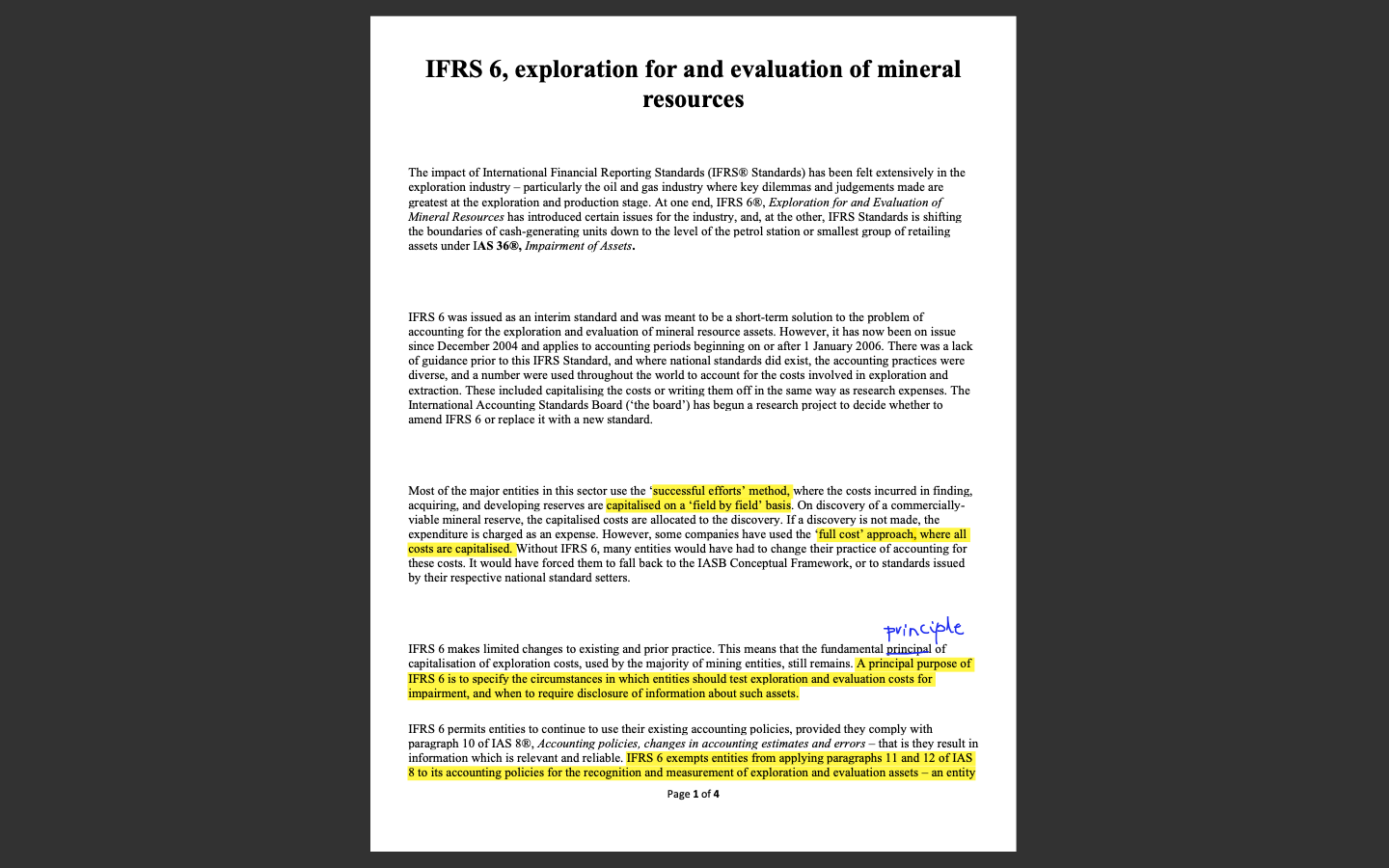
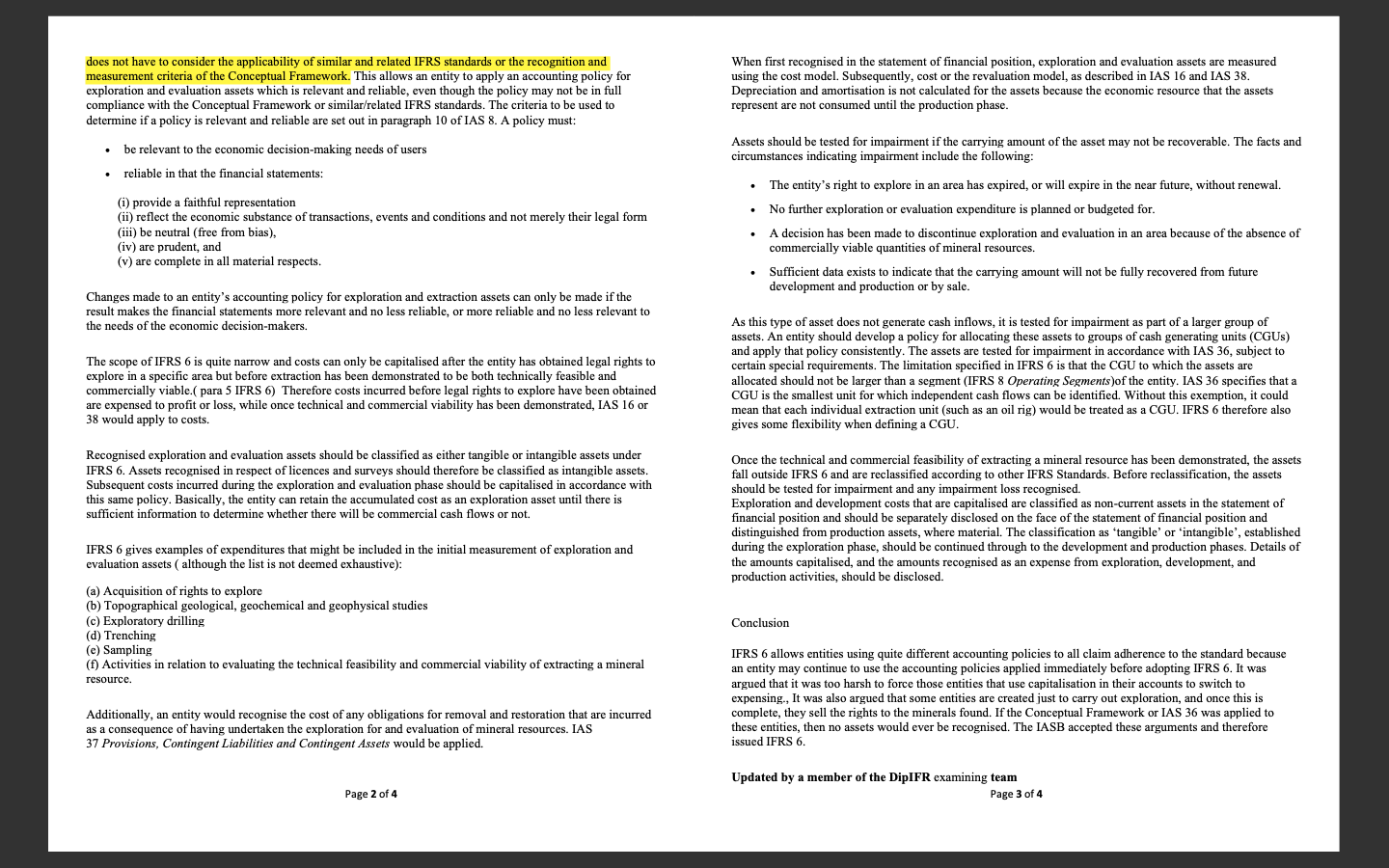
IFRS 6, exploration for and evaluation of mineral resources The impact of International Financial Reporting Standards (IFRS@ Standards) has been felt extensively in the exploration industry - particularly the oil and gas industry where key dilemmas and judgements made are greatest at the exploration and production stage. At one end, IFRS 6@, Exploration for and Evaluation of Mineral Resources has introduced certain issues for the industry, and, at the other, IFRS Standards is shifting the boundaries of cash-generating units down to the level of the petrol station or smallest group of retailing assets under IAS 360, Impairment of Assets. IFRS 6 was issued as an interim standard and was meant to be a short-term solution to the problem of accounting for the exploration and evaluation of mineral resource assets. However, it has now been on issue since December 2004 and applies to accounting periods beginning on or after 1 January 2006. There was a lack of guidance prior to this IFRS Standard, and where national standards did exist, the accounting practices were diverse, and a number were used throughout the world to account for the costs involved in exploration and extraction. These included capitalising the costs or writing them off in the same way as research expenses. The International Accounting Standards Board ("the board') has begun a research project to decide whether to amend IFRS 6 or replace it with a new standard. Most of the major entities in this sector use the "successful efforts' method, where the costs incurred in finding, acquiring, and developing reserves are capitalised on a 'field by field' basis. On discovery of a commercially- viable mineral reserve, the capitalised costs are allocated to the discovery. If a discovery is not made, the expenditure is charged as an expense. However, some companies have used the (full cost' approach, where all costs are capitalised. Without IFRS 6, many entities would have had to change their practice of accounting for these costs. It would have forced them to fall back to the IASB Conceptual Framework, or to standards issued by their respective national standard setters. principle IFRS 6 makes limited changes to existing and prior practice. This means that the fundamental principal of capitalisation of exploration costs, used by the majority of mining entities, still remains. A principal purpose of IFRS 6 is to specify the circumstances in which entities should test exploration and evaluation costs for impairment, and when to require disclosure of information about such assets. IFRS 6 permits entities to continue to use their existing accounting policies, provided they comply with paragraph 10 of IAS 8@, Accounting policies, changes in accounting estimates and errors - that is they result in information which is relevant and reliable. IFRS 6 exempts entities from applying paragraphs 11 and 12 of LAS 8 to its accounting policies for the recognition and measurement of exploration and evaluation assets - an entity Page 1 of 4does not have to consider the applicability of similar and related IFRS standards or the recognition and When first recognised in the statement of financial position, exploration and evaluation assets are measured measurement criteria of the Conceptual Framework. This allows an entity to apply an accounting policy for using the cost model. Subsequently, cost or the revaluation model, as described in IAS 16 and IAS 38. exploration and evaluation assets which is relevant and reliable, even though the policy may not be in full Depreciation and amortisation is not calculated for the assets because the economic resource that the assets compliance with the Conceptual Framework or similar/related IFRS standards. The criteria to be used to represent are not consumed until the production phase. determine if a policy is relevant and reliable are set out in paragraph 10 of IAS 8. A policy must: be relevant to the economic decision-making needs of users Assets should be tested for impairment if the carrying amount of the asset may not be recoverable. The facts and circumstances indicating impairment include the following: reliable in that the financial statements: The entity's right to explore in an area has expired, or will expire in the near future, without renewal. (i) provide a faithful representation . (ii) reflect the economic substance of transactions, events and conditions and not merely their legal form No further exploration or evaluation expenditure is planned or budgeted for. (iii) be neutral (free from bias), A decision has been made to discontinue exploration and evaluation in an area because of the absence of (iv) are prudent, and commercially viable quantities of mineral resources. (v) are complete in all material respects. Sufficient data exists to indicate that the carrying amount will not be fully recovered from future development and production or by sale. Changes made to an entity's accounting policy for exploration and extraction assets can only be made if the result makes the financial statements more relevant and no less reliable, or more reliable and no less relevant to the needs of the economic decision-makers. As this type of asset does not generate cash inflows, it is tested for impairment as part of a larger group of assets. An entity should develop a policy for allocating these assets to groups of cash generating units (CGUs) and apply that policy consistently. The assets are tested for impairment in accordance with IAS 36, subject to The scope of IFRS 6 is quite narrow and costs can only be capitalised after the entity has obtained legal rights to certain special requirements. The limitation specified in IFRS 6 is that the CGU to which the assets are explore in a specific area but before extraction has been demonstrated to be both technically feasible and allocated should not be larger than a segment (IFRS 8 Operating Segments ) of the entity. IAS 36 specifies that a commercially viable.( para 5 IFRS 6) Therefore costs incurred before legal rights to explore have been obtained CGU is the smallest unit for which independent cash flows can be identified. Without this exemption, it could are expensed to profit or loss, while once technical and commercial viability has been demonstrated, IAS 16 or mean that each individual extraction unit (such as an oil rig) would be treated as a CGU. IFRS 6 therefore also 8 would apply to costs. gives some flexibility when defining a CGU. Recognised exploration and evaluation assets should be classified as either tangible or intangible assets under Once the technical and commercial feasibility of extracting a mineral resource has been demonstrated, the assets IFRS 6. Assets recognised in respect of licences and surveys should therefore be classified as intangible assets. fall outside IFRS 6 and are reclassified according to other IFRS Standards. Before reclassification, the assets Subsequent costs incurred during the exploration and evaluation phase should be capitalised in accordance with should be tested for impairment and any impairment loss recognised. this same policy. Basically, the entity can retain the accumulated cost as an exploration asset until there is Exploration and development costs that are capitalised are classified as non-current assets in the statement of sufficient information to determine whether there will be commercial cash flows or not. inancial position and should be separately disclosed on the face of the statement of financial position and distinguished from production assets, where material. The classification as 'tangible' or 'intangible', established IFRS 6 gives examples of expenditures that might be included in the initial measurement of exploration and during the exploration phase, should be continued through to the development and production phases. Details of evaluation assets ( although the list is not deemed exhaustive) the amounts capitalised, and the amounts recognised as an expense from exploration, development, and production activities, should be disclosed. (a) Acquisition of rights to explore (b) Topographical geological, geochemical and geophysical studies (c) Exploratory drilling Conclusion d) Trenching (e) Sampling IFRS 6 allows entities using quite different accounting policies to all claim adherence to the standard because (f) Activities in relation to evaluating the technical feasibility and commercial viability of extracting a mineral an entity may continue to use the accounting policies applied immediately before adopting IFRS 6. It was resource. argued that it was too harsh to force those entities that use capitalisation in their accounts to switch to expensing., It was also argued that some entities are created just to carry out exploration, and once this is Additionally, an entity would recognise the cost of any obligations for removal and restoration that are incurred complete, they sell the rights to the minerals found. If the Conceptual Framework or IAS 36 was applied to as a consequence of having undertaken the exploration for and evaluation of mineral resources. IAS these entities, then no assets would ever be recognised. The IASB accepted these arguments and therefore 37 Provisions, Contingent Liabilities and Contingent Assets would be applied. issued IFRS 6. Updated by a member of the DipIFR examining team Page 2 of 4 Page 3 of 4
Step by Step Solution
There are 3 Steps involved in it
1 Expert Approved Answer
Step: 1 Unlock
Question Has Been Solved by an Expert!
Get step-by-step solutions from verified subject matter experts
Step: 2 Unlock
Step: 3 Unlock
Students Have Also Explored These Related Accounting Questions!









 Study Help