







Question: From the article: Elephantids are a particularly good model system to investigate the effects of temperature on Hb structure-function relationships as they possess both warm-
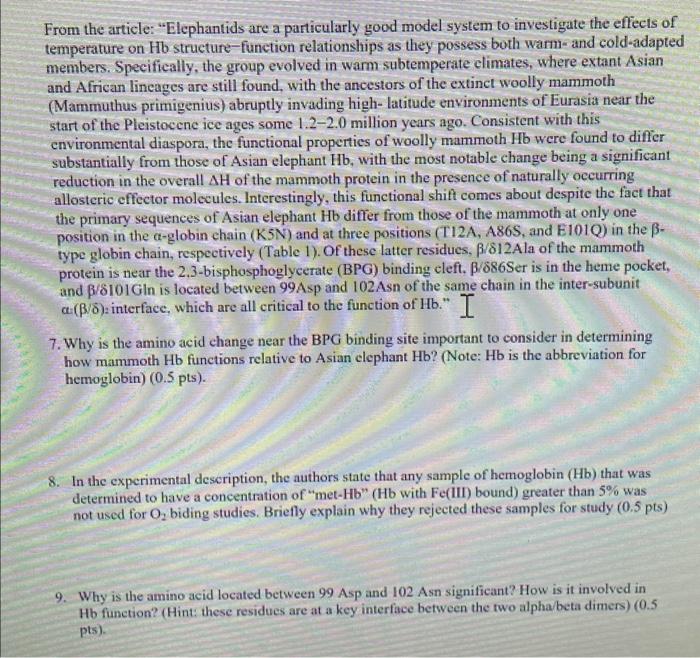
From the article: "Elephantids are a particularly good model system to investigate the effects of temperature on Hb structure-function relationships as they possess both warm- and cold-adapted members. Specifically, the group evolved in warm subtemperate climates, where extant Asian and African lineages are still found, with the ancestors of the extinct woolly mammoth (Mammuthus primigenius) abruptly invading high- latitude environments of Eurasia near the start of the Pleistocene ice ages some 1.2-2.0 million years ago. Consistent with this environmental diaspora, the functional properties of woolly mammoth Hb were found to differ substantially from those of Asian elephant Hb, with the most notable change being a significant reduction in the overall H of the mammoth protein in the presence of naturally oceurring allosteric effector molecules. Interestingly, this functional shift comes about despite the fact that the primary sequences of Asian elephant Hb differ from those of the mammoth at only one position in the -globin chain (K5N) and at three positions (T12A,A86S, and E101Q ) in the type globin chain, respectively (Table 1). Of these latter residues, /12Ala of the mammoth protein is near the 2.3-bisphosphoglycerate (BPG) binding cleft, /86Ser is in the heme pocket, and /8101G is located between 99Asp and 102 Asn of the same chain in the inter-subunit (/) : interface, which are all critical to the function of Hb." 7. Why is the amino acid change near the BPG binding site important to consider in determining how mammoth Hb functions relative to A sian elephant Hb ? (Note: Hb is the abbreviation for hemoglobin) (0.5pts). 8. In the experimental description, the authors state that any sample of hemoglobin (Hb) that was determined to have a concentration of "met- Hb " ( Hb with Fe (III) bound) greater than 5% was not used for O2 biding studies. Briefly explain why they rejected these samples for study (0.5pts) 9. Why is the amino acid located between 99 Asp and 102 Asn significant? How is it involved in Hb function? (Hint: these residues are at a key interface between the two alpha/beta dimers) (0.5 pts)
Step by Step Solution
There are 3 Steps involved in it

Get step-by-step solutions from verified subject matter experts
 Study Help