







Question: From the attached article on soccer games: Anger management: study suggest lack of fans made player calmer The study model, the Analysis System for Emotional
From the attached article on soccer games: Anger management: study suggest lack of fans made player calmer
"The study model, the Analysis System for Emotional Behavior in Football, observed players non-verbal behavior and physical cues and attached emotional values to them"
Do you feel attaching "emotional values" is an effective scientific approach here?
And in your view, does this study explain" "..a stark decline in "home advantage" with the percentage of games won by the home team falling by almost half'?
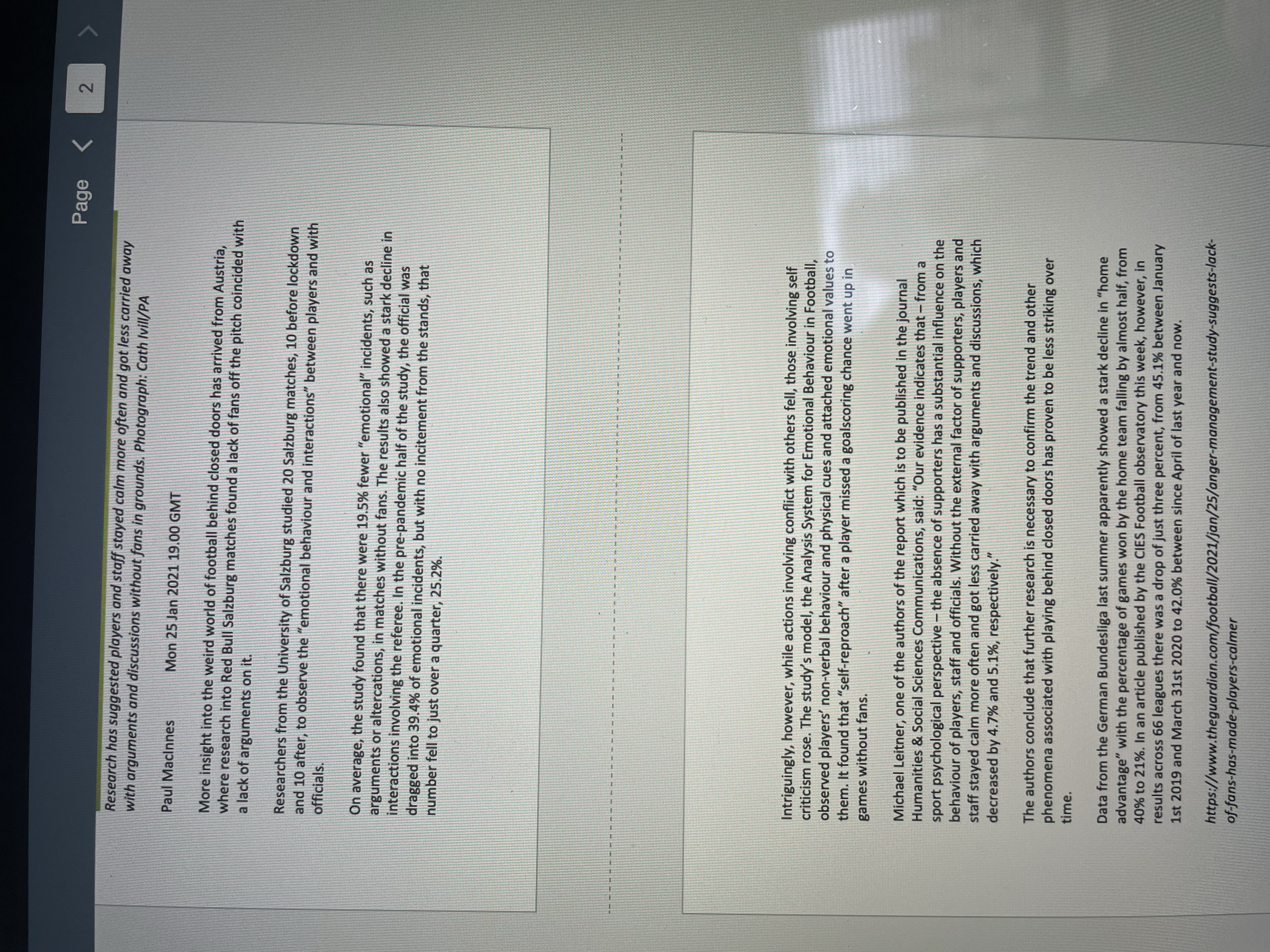
Page Research has suggested players and staff stayed calm more often and got less carried away with arguments and discussions without fans in grounds. Photograph: Cath Ivill/PA Paul Macinnes Mon 25 Jan 2021 19.00 GMT More insight into the weird world of football behind closed doors has arrived from Austria, where research into Red Bull Salzburg matches found a lack of fans off the pitch coincided with a lack of arguments on it Researchers from the University of Salzburg studied 20 Salzburg matches, 10 before lockdown and 10 after, to observe the "emotional behaviour and interactions" between players and with officials. On average, the study found that there were 19.5% fewer "emotional" incidents, such as arguments or altercations, in matches without fans. The results also showed a stark decline in interactions involving the referee. In the pre-pandemic half of the study, the official was dragged into 39.4% of emotional incidents, but with no incitement from the stands, that number fell to just over a quarter, 25.2%. Intriguingly, however, while actions involving conflict with others fell, those involving self criticism rose. The study's model, the Analysis System for Emotional Behaviour in Football, observed players' non-verbal behaviour and physical cues and attached emotional values to them. It found that "self-reproach" after a player missed a goalscoring chance went up in games without fans Michael Leitner, one of the authors of the report which is to be published in the journal Humanities & Social Sciences Communications, said: "Our evidence indicates that - from a sport psychological perspective - the absence of supporters has a substantial influence on the behaviour of players, staff and officials. Without the external factor of supporters, players and staff stayed calm more often and got less carried away with arguments and discussions, which decreased by 4.7% and 5.1%, respectively.' The authors conclude that further research is necessary to confirm the trend and other phenomena associated with playing behind closed doors has proven to be less striking over time. Data from the German Bundesliga last summer apparently showed a stark decline in "home advantage" with the percentage of games won by the home team falling by almost half, from 40% to 21%. In an article published by the CIES Football observatory this week, however, in results across 66 leagues there was a drop of just three percent, from 45.1% between January 1st 2019 and March 31st 2020 to 42.0% between since April of last year and now. https://www.theguardian.com/football/2021/jan/25/anger-management-study-suggests-lack- of-fans-has-made-players-calmer
Step by Step Solution
There are 3 Steps involved in it

Get step-by-step solutions from verified subject matter experts
 Study Help