







Question: From the book:( Introduction to Programing Languages Programing in C,C++,Scheme,Prolog,C#,and SOA ) I do not understand 1.2, 1.5,1.6,1.7 and 1.8. 1.7 Homework and programming exercises
From the book:(Introduction to Programing Languages
Programing in C,C++,Scheme,Prolog,C#,and SOA)
I do not understand 1.2, 1.5,1.6,1.7 and 1.8.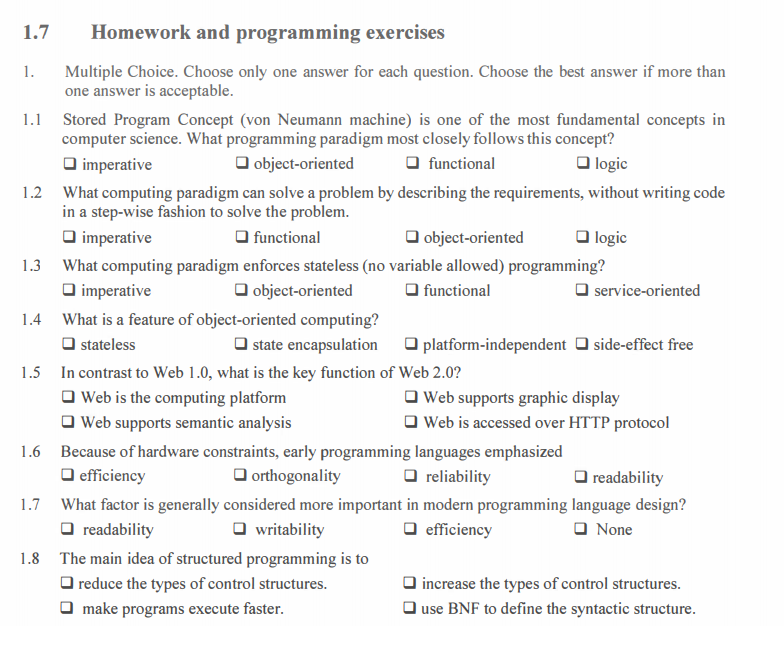
1.7 Homework and programming exercises 1. Multiple Choice. Choose only one answer for each question. Choose the best answer if more than one answer is acceptable. 1.1 Stored Program Concept (von Neumann machine) is one of the most fundamental concepts in computer science. What programming paradigm most closely follows this concept? imperative object-oriented functional logic 1.2 What computing paradigm can solve a problem by describing the requirements, without writing code in a step-wise fashion to solve the problem. imperative functional object-oriented logic 1.3 What computing paradigm enforces stateless (no variable allowed) programming? imperative object-oriented functional service-oriented 1.4 What is a feature of object-oriented computing? stateless state encapsulation platform-independent side-effect free 1.5 In contrast to Web 1.0, what is the key function of Web 2.0? Web is the computing platform Web supports graphic display Web supports semantic analysis Web is accessed over HTTP protocol 1.6 Because of hardware constraints, early programming languages emphasized efficiency orthogonality reliability readability 1.7 What factor is generally considered more important in modern programming language design? readability writability efficiency None 1.8 The main idea of structured programming is to reduce the types of control structures. increase the types of control structures. make programs execute faster. use BNF to define the syntactic structure
Step by Step Solution
There are 3 Steps involved in it

Get step-by-step solutions from verified subject matter experts
 Study Help