



Question: From the Case Study: Kleinrivier Farm - Possibilities and Constraints in the Operation Management: Global and Southern African perspectives (pages. 287 - 289), please could
From the Case Study: Kleinrivier Farm - Possibilities and Constraints in the Operation Management: Global and Southern African perspectives (pages. 287 - 289), please could you help answer the following three questions:
(1) Riedwaan and Wilma would like to expand their agrotourism business. What capacity constraints to they have to overcome in order to achieve this?
(2) With their current capacity constraints, identify at least two other ways that Riedwaan and Wilma could increase their agritourism income.
(3) What factors would Wilma need to consider before increasing her flock and diary operation? What other information would she need before she invested large amounts of capital in expanding this side of the business?
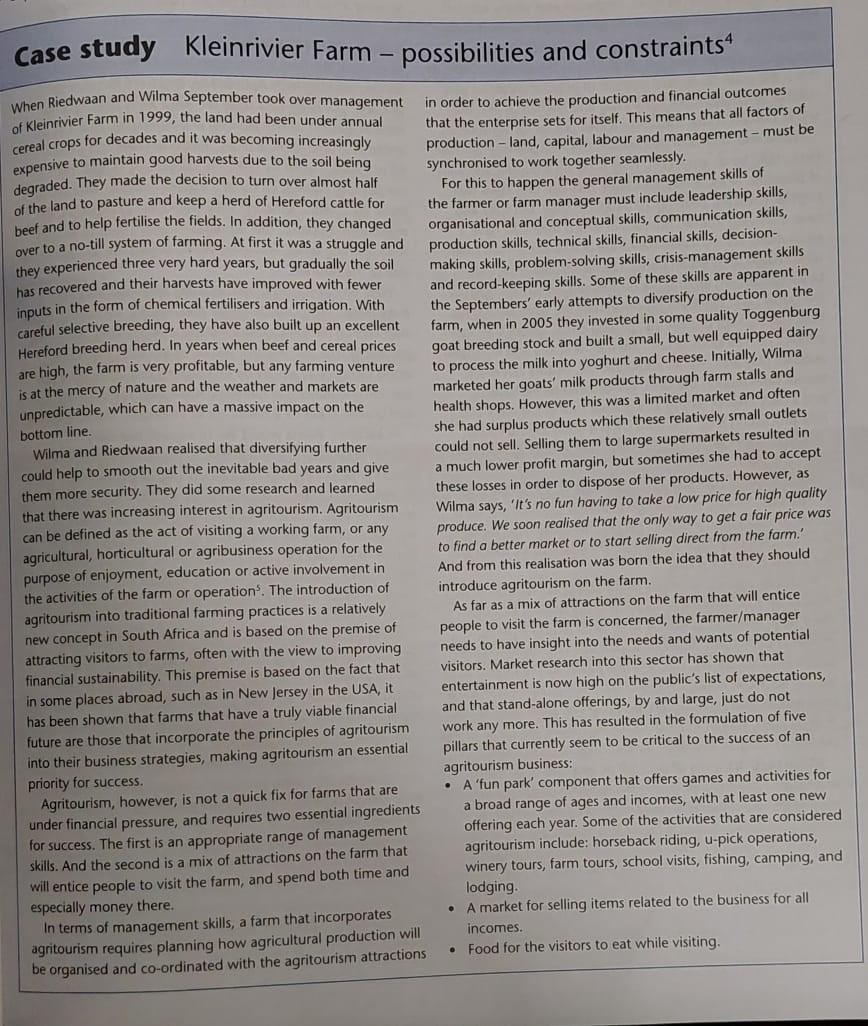
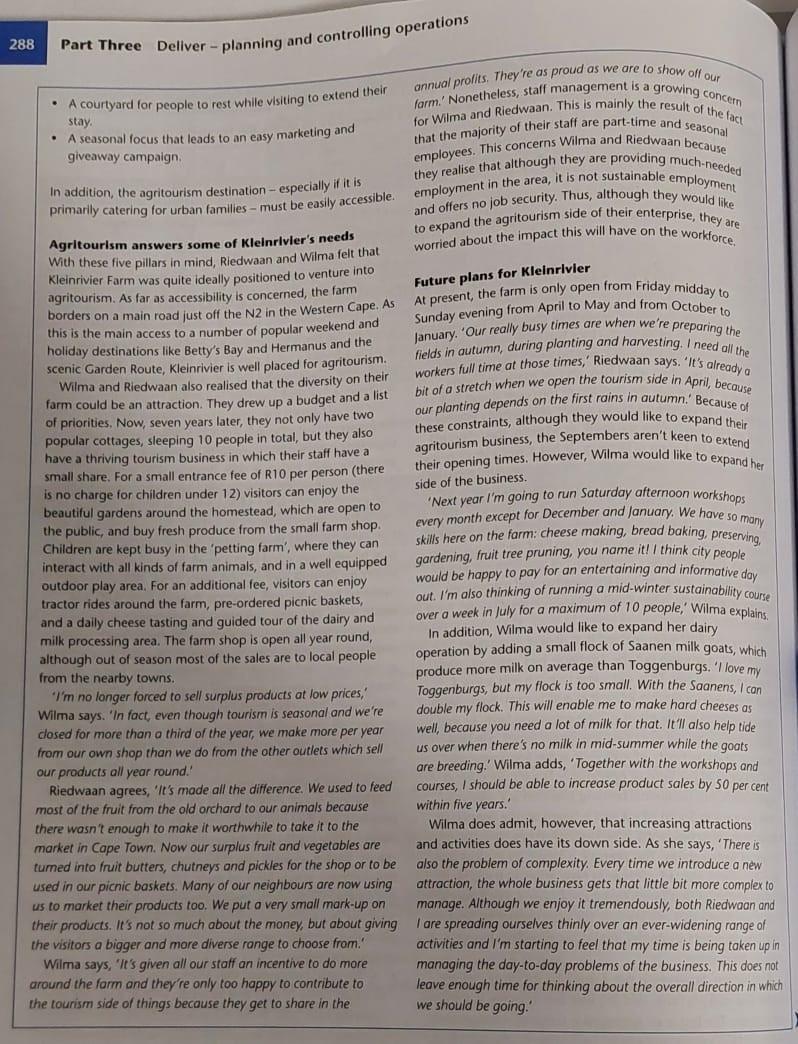
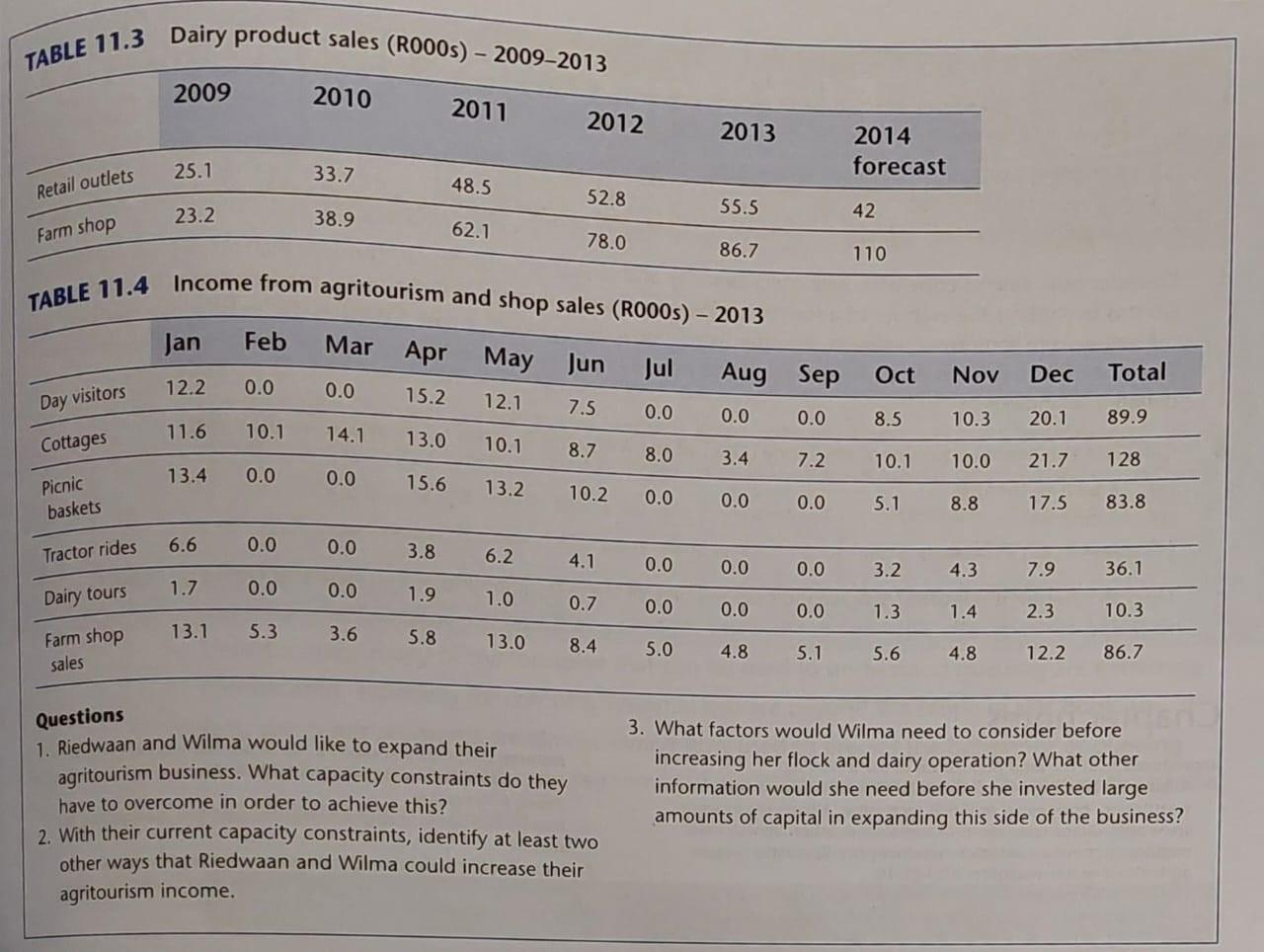
Case study Kleinrivier Farm - possibilities and constraints* When Riedwaan and Wilma September took over management of Kleinrivier Farm in 1999, the land had been under annual cereal crops for decades and it was becoming increasingly expensive to maintain good harvests due to the soil being degraded. They made the decision to turn over almost half of the land to pasture and keep a herd of Hereford cattle for beef and to help fertilise the fields. In addition, they changed over to a no-till system of farming. At first it was a struggle and they experienced three very hard years, but gradually the soil has recovered and their harvests have improved with fewer inputs in the form of chemical fertilisers and irrigation. With careful selective breeding, they have also built up an excellent Hereford breeding herd. In years when beef and cereal prices are high, the farm is very profitable, but any farming venture is at the mercy of nature and the weather and markets are unpredictable, which can have a massive impact on the bottom line. Wilma and Riedwaan realised that diversifying further could help to smooth out the inevitable bad years and give them more security. They did some research and learned that there was increasing interest in agritourism. Agritourism can be defined as the act of visiting a working farm, or any agricultural, horticultural or agribusiness operation for the purpose of enjoyment, education or active involvement in the activities of the farm or operations. The introduction of agritourism into traditional farming practices is a relatively new concept in South Africa and is based on the premise of attracting visitors to farms, often with the view to improving financial sustainability. This premise is based on the fact that in some places abroad, such as in New Jersey in the USA, it has been shown that farms that have a truly viable financial future are those that incorporate the principles of agritourism into their business strategies, making agritourism an essential priority for success. Agritourism, however, is not a quick fix for farms that are under financial pressure, and requires two essential ingredients for success. The first is an appropriate range of management skills. And the second is a mix of attractions on the farm that will entice people to visit the farm, and spend both time and especially money there. In terms of management skills, a farm that incorporates agritourism requires planning how agricultural production will be organised and co-ordinated with the agritourism attractions in order to achieve the production and financial outcomes that the enterprise sets for itself. This means that all factors of production - land, capital, labour and management - must be synchronised to work together seamlessly. For this to happen the general management skills of the farmer or farm manager must include leadership skills, organisational and conceptual skills, communication skills, production skills, technical skills, financial skills, decision- making skills, problem-solving skills, crisis-management skills and record-keeping skills. Some of these skills are apparent in the Septembers' early attempts to diversify production on the farm, when in 2005 they invested in some quality Toggenburg goat breeding stock and built a small, but well equipped dairy to process the milk into yoghurt and cheese. Initially, Wilma marketed her goats' milk products through farm stalls and limited market and often health shops. However, this was she had surplus products which these relatively small outlets could not sell. Selling them to large supermarkets resulted in a much lower profit margin, but sometimes she had to accept these losses in order to dispose of her products. However, as Wilma says, 'It's no fun having to take a low price for high quality produce. We soon realised that the only way to get a fair price was to find a better market or to start selling direct from the farm." And from this realisation was born the idea that they should introduce agritourism on the farm. As far as a mix of attractions on the farm that will entice. people to visit the farm is concerned, the farmer/manager needs to have insight into the needs and wants of potential visitors. Market research into this sector has shown that entertainment is now high on the public's list of expectations, and that stand-alone offerings, by and large, just do not work any more. This has resulted in the formulation of five pillars that currently seem to be critical to the success of an agritourism business: A 'fun park' component that offers games and activities for a broad range of ages and incomes, with at least one new offering each year. Some of the activities that are considered agritourism include: horseback riding, u-pick operations, winery tours, farm tours, school visits, fishing, camping, and lodging. A market for selling items related to the business for all incomes. Food for the visitors to eat while visiting. 288 Part Three Deliver - planning and controlling operations A courtyard for people to rest while visiting to extend their stay. A seasonal focus that leads to an easy marketing and giveaway campaign. In addition, the agritourism destination - especially if it is primarily catering for urban families must be easily accessible. Agritourism answers some of Kleinrivier's needs With these five pillars in mind, Riedwaan and Wilma felt that Kleinrivier Farm was quite ideally positioned to venture into agritourism. As far as accessibility is concerned, the farm borders on a main road just off the N2 in the Western Cape. As this is the main access to a number of popular weekend and holiday destinations like Betty's Bay and Hermanus and the scenic Garden Route, Kleinrivier is well placed for agritourism. Wilma and Riedwaan also realised that the diversity on their farm could be an attraction. They drew up a budget and a list of priorities. Now, seven years later, they not only have two popular cottages, sleeping 10 people in total, but they also have a thriving tourism business in which their staff have a small share. For a small entrance fee of R10 per person (there is no charge for children under 12) visitors can enjoy the beautiful gardens around the homestead, which are open to the public, and buy fresh produce from the small farm shop. Children are kept busy in the 'petting farm', where they can interact with all kinds of farm animals, and in a well equipped outdoor play area. For an additional fee, visitors can enjoy tractor rides around the farm, pre-ordered picnic baskets, and a daily cheese tasting and guided tour of the dairy and milk processing area. The farm shop is open all year round, although out of season most of the sales are to local people from the nearby towns. "I'm no longer forced to sell surplus products at low prices, Wilma says. "In fact, even though tourism is seasonal and we're closed for more than a third of the year, we make more per year from our own shop than we do from the other outlets which sell our products all year round. annual profits. They're as proud as we are to show off our farm.' Nonetheless, staff management is a growing concern for Wilma and Riedwaan. This is mainly the result of the fact that the majority of their staff are part-time and seasonal employees. This concerns Wilma and Riedwaan because they realise that although they are providing much-needed employment in the area, it is not sustainable employment and offers no job security. Thus, although they would like to expand the agritourism side of their enterprise, they are worried about the impact this will have on the workforce. Future plans for Kleinrivier At present, the farm is only open from Friday midday to Sunday evening from April to May and from October to January. 'Our really busy times are when we're preparing the fields in autumn, during planting and harvesting. I need all the workers full time at those times,' Riedwaan says. "It's already a bit of a stretch when we open the tourism side in April, because our planting depends on the first rains in autumn.' Because of these constraints, although they would like to expand their agritourism business, the Septembers aren't keen to extend their opening times. However, Wilma would like to expand her side of the business. 'Next year I'm going to run Saturday afternoon workshops every month except for December and January. We have so many skills here on the farm: cheese making, bread baking, preserving, gardening, fruit tree pruning, you name it! I think city people would be happy to pay for an entertaining and informative day out. I'm also thinking of running a mid-winter sustainability course over a week in July for a maximum of 10 people,' Wilma explains. In addition, Wilma would like to expand her dairy operation by adding a small flock of Saanen milk goats, which produce more milk on average than Toggenburgs. "I love my Toggenburgs, but my flock is too small. With the Saanens, I can double my flock. This will enable me to make hard cheeses as well, because you need a lot of milk for that. It'll also help tide us over when there's no milk in mid-summer while the goats are breeding.' Wilma adds, 'Together with the workshops and courses, I should be able to increase product sales by 50 per cent within five years.' Riedwaan agrees, 'It's made all the difference. We used to feed most of the fruit from the old orchard to our animals because there wasn't enough to make it worthwhile to take it to the market in Cape Town. Now our surplus fruit and vegetables are turned into fruit butters, chutneys and pickles for the shop or to be used in our picnic baskets. Many of our neighbours are now using us to market their products too. We put a very small mark-up on their products. It's not so much about the money, but about giving the visitors a bigger and more diverse range to choose from." Wilma says, 'It's given all our staff an incentive to do more around the farm and they're only too happy to contribute to the tourism side of things because they get to share in the Wilma does admit, however, that increasing attractions and activities does have its down side. As she says, 'There is also the problem of complexity. Every time we introduce a new attraction, the whole business gets that little bit more complex to manage. Although we enjoy it tremendously, both Riedwaan and I are spreading ourselves thinly over an ever-widening range of activities and I'm starting to feel that my time is being taken up in managing the day-to-day problems of the business. This does not leave enough time for thinking about the overall direction in which we should be going." TABLE 11.3 Dairy product sales (R000s) - 2009-2013 Retail outlets Farm shop 2009 Day visitors Cottages Picnic baskets Tractor rides Dairy tours Farm shop sales 25.1 23.2 Jan Feb 12.2 0.0 11.6 10.1 13.4 0.0 2010 6.6 0.0 1.7 0.0 13.1 5.3 33.7 38.9 0.0 0.0 3.6 2011 3.8 1.9 5.8 48.5 TABLE 11.4 Income from agritourism and shop sales (R000s) - 2013 Mar Apr May Jun Jul Aug 0.0 15.2 12.1 7.5 0.0 0.0 14.1 13.0 10.1 8.7 3.4 0.0 15.6 13.2 62.1 6.2 2012 1.0 13.0 52.8 78.0 10.2 4.1 0.7 8.4 Questions 1. Riedwaan and Wilma would like to expand their agritourism business. What capacity constraints do they have to overcome in order to achieve this? 2. With their current capacity constraints, identify at least two other ways that Riedwaan and Wilma could increase their agritourism income. 8.0 0.0 0.0 0.0 2013 5.0 55.5 86.7 0.0 0.0 Sep 0.0 7.2 0.0 0.0 0.0 0.0 4.8 5.1 2014 forecast 42 110 Oct 8.5 10.1 5.1 3.2 1.3 5.6 Nov Total 10.3 20.1 89.9 10.0 21.7 128 17.5 83.8 8.8 4.3 1.4 4.8 Dec 7.9 2.3 36.1 10.3 12.2 86.7 3. What factors would Wilma need to consider before increasing her flock and dairy operation? What other information would she need before she invested large amounts of capital in expanding this side of the businessStep by Step Solution
There are 3 Steps involved in it

Get step-by-step solutions from verified subject matter experts