







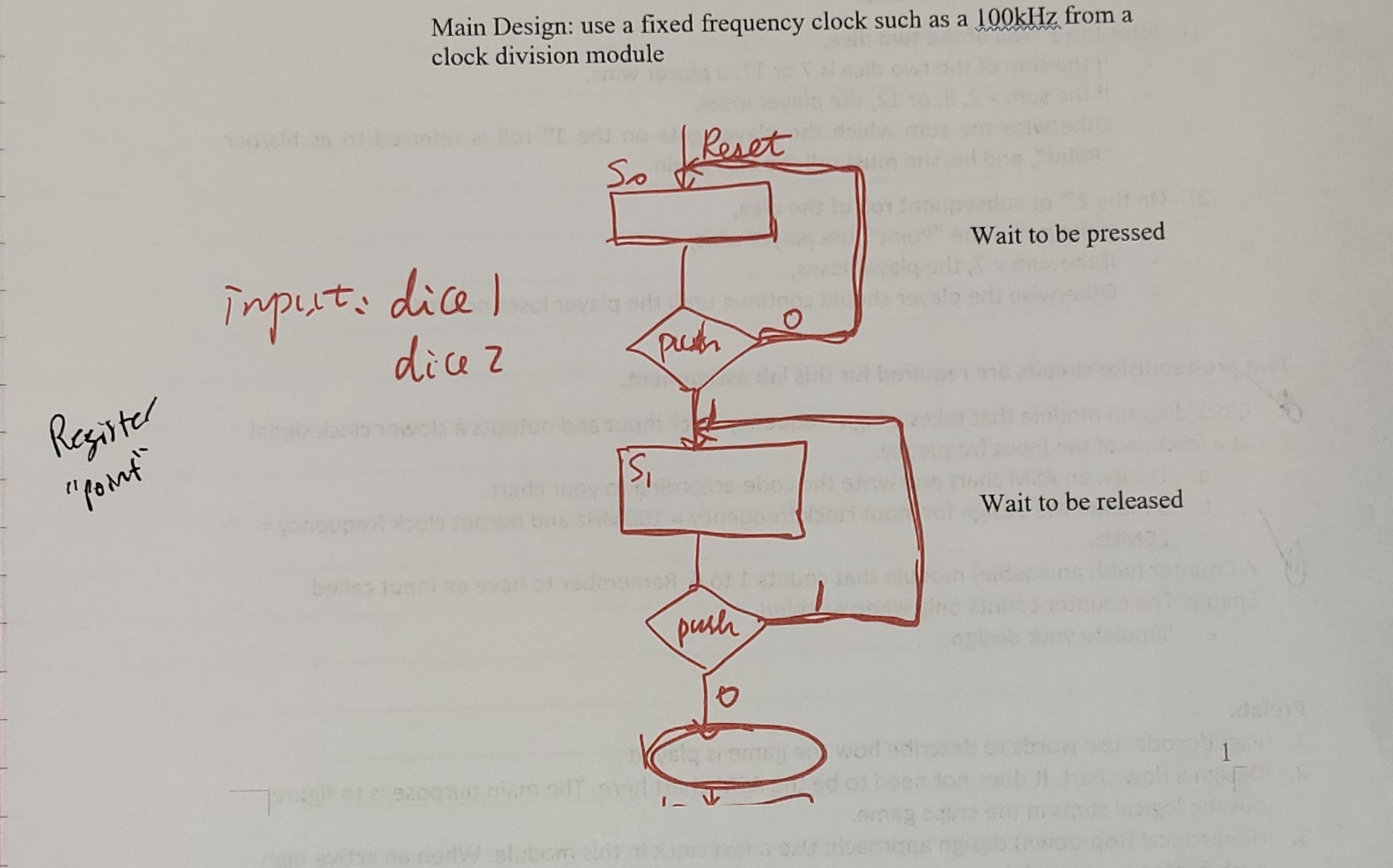
Question: From the given information and the picture provided. Continue with the ASM chart design and create a full ASM chart, follow steps 5 and 6
From the given information and the picture provided. Continue with the ASM chart design and create a full ASM chart, follow steps and for details on what to implement in ASM. The two prerequistes have already been made but I am unsure how they would be implemented into an ASM chart.
Game of craps: The rules are as follows:
After the st roll of the two dice, If the sum of the two dice is or a player wins, If the sum or the player loses, Otherwise the sum which the player gets on the st roll is referred to as hisher Point and heshe must roll the dice again.
On the nd or subsequent roll of the dice, If the sum the Point the player wins, If the sum the player loses, Otherwise the player should continue until the player loses or wins.
Two prerequisite circuits are required for this lab assignment.
Clock division module that takes a high frequency clock input and outputs a slower clock signal at a fraction of the input frequency. a Design an ASM chart and write the code according to your chart. b Simulate the design for input clock frequency MHz and output clock frequency MHz
A Counter with an Enable module that counts to Remember to have an input called Enable. The counter counts only when enabled. a Simulate your design.
Problem solving step : analysis
a Inputs
b Outputs
c registers
ASM chart for the craps game: identify registers. Use to indicate RTL operations.
a When you need to make revisions to your ASM chart, do not erase and write over the existing one. Do it on another sheet of paper.
Add bells and whistles: embellish your design to enhance user experience. For example,
a Show different characters at different statesstages of the game
b Use colored LED to show winning and losing
c Blink something
Main Design: use a fixed frequency clock such as a kHz from a
clock division module
Lab #
Prelab needs to be completed prior to lab session on lab day.
An Electronic Craps Game
Game of craps: The rules are as follows:
After the t roll of the two dice,
If the sum of the two dice is or a player wins,
If the sum or the player loses,
Otherwise the sum which the player gets on the text st roll is referred to as hisher "Point", and heshe must roll the dice again.
On the mathbftext nd or subsequent roll of the dice,
If the sum the "Point", the player wins,
If the sum the player loses,
Otherwise the player should continue until the player loses or wins.
Two prerequisite circuits are required for this lab assignment.
Clock division module that takes a high frequency clock input and outputs a slower clock signal at a fraction of the input frequency.
a Design an ASM chart and write the code according to your chart.
b Simulate the design for input clock frequency mathrmMHz and output clock frequency MHz
A Counter with an Enable module that counts to Remember to have an input called Enable. The counter counts only when enabled.
a Simulate your design.
Prelab:
Pseudocode: use words to describe how the game is played
Design a flow chart. It does not need to be the ASM chart here. The main purpose is to figure out the logical steps in the craps game.
Hierarchical topdown design approach: Use a fast clock in this module. When an active high push button is pressed, two counters, representing two dice, are enabled and keep counting at high speed at different clock frequencies When the button is released, the counters are disabled. Since the push button can be released at a random time, this simulates a random roll of the dice. These two dice values are inputs to the main module for the craps game.
Problem solving step : analysis
a Inputs
b Outputs
c registers
ASM chart for the craps game: identify registers. Use leftarrow to indicate RTL operations.
a When you need to make revisions to your ASM chart, do not erase and write over the existing one. Do it on another sheet of paper.
Add bells and whistles: embellish your design to enhance user experience. For example,
a Show different characters at different statesstages of the game
b Use colored LED to show winning and losing
c Blink something
Step by Step Solution
There are 3 Steps involved in it
1 Expert Approved Answer
Step: 1 Unlock

Question Has Been Solved by an Expert!
Get step-by-step solutions from verified subject matter experts
Step: 2 Unlock
Step: 3 Unlock
 Study Help