







Question: From this book ( Basic concepts computational physics) ch1 a) Give the standard (IEEE) single precision binary representation of the machine approximation for 1/3. b)
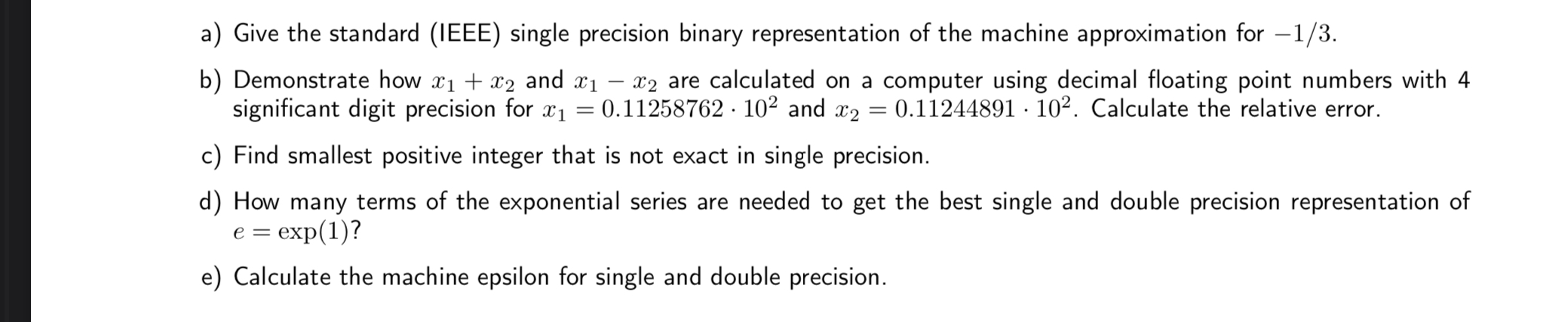 From this book ( Basic concepts computational physics) ch1
a) Give the standard (IEEE) single precision binary representation of the machine approximation for 1/3. b) Demonstrate how x1 + x2 and X X2 are calculated on a computer using decimal floating point numbers with 4 significant digit precision for x1 = 0.11258762 102 and x2 = 0.11244891 102. Calculate the relative error. c) Find smallest positive integer that is not exact in single precision. d) How many terms of the exponential series are needed to get the best single and double precision representation of e = exp(1)? e) Calculate the machine epsilon for single and double precision. a) Give the standard (IEEE) single precision binary representation of the machine approximation for 1/3. b) Demonstrate how x1 + x2 and X X2 are calculated on a computer using decimal floating point numbers with 4 significant digit precision for x1 = 0.11258762 102 and x2 = 0.11244891 102. Calculate the relative error. c) Find smallest positive integer that is not exact in single precision. d) How many terms of the exponential series are needed to get the best single and double precision representation of e = exp(1)? e) Calculate the machine epsilon for single and double precision
Step by Step Solution
There are 3 Steps involved in it

Get step-by-step solutions from verified subject matter experts
 Study Help