







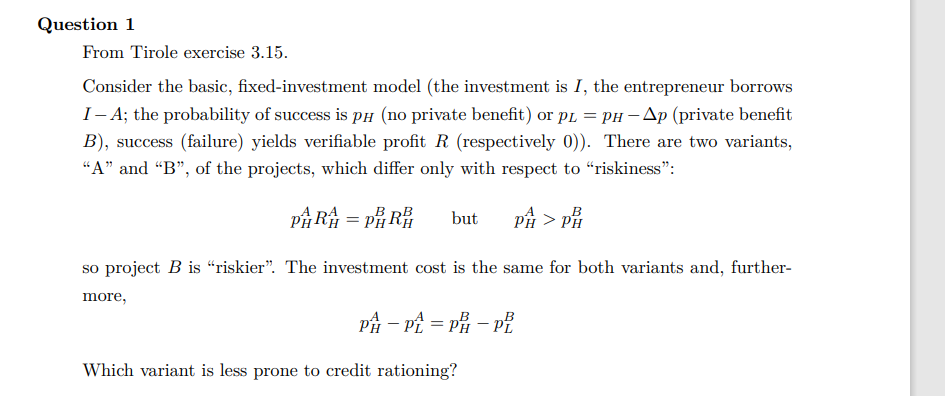
Question: From Tirole exercise 3 . 1 5 . Consider the basic, fixed - investment model ( the investment is I, the entrepreneur borrows I A;
From Tirole exercise
Consider the basic, fixedinvestment model the investment is I, the entrepreneur borrows
I A; the probability of success is pH no private benefit or pL pH p private benefit
B success failure yields verifiable profit R respectively There are two variants,
A and B of the projects, which differ only with respect to riskiness:
p
A
HR
A
H p
B
HR
B
H but p
A
H pB
H
so project B is riskier The investment cost is the same for both variants and, furthermore,
p
A
H p
A
L p
B
H p
B
L
Which variant is less prone to credit rationing?Question
From Tirole exercise
Consider the basic, fixedinvestment model the investment is I, the entrepreneur borrows
; the probability of success is no private benefit or private benefit
success failure yields verifiable profit respectively There are two variants,
A and B of the projects, which differ only with respect to "riskiness":
but
so project is "riskier". The investment cost is the same for both variants and, further
more,
Which variant is less prone to credit rationing?
Step by Step Solution
There are 3 Steps involved in it
1 Expert Approved Answer
Step: 1 Unlock

Question Has Been Solved by an Expert!
Get step-by-step solutions from verified subject matter experts
Step: 2 Unlock
Step: 3 Unlock
 Study Help