







Question: Full binary trees - leaves versus internal nodes. A full binary tree is a tree with a squareroot, such that every vertex has either 0
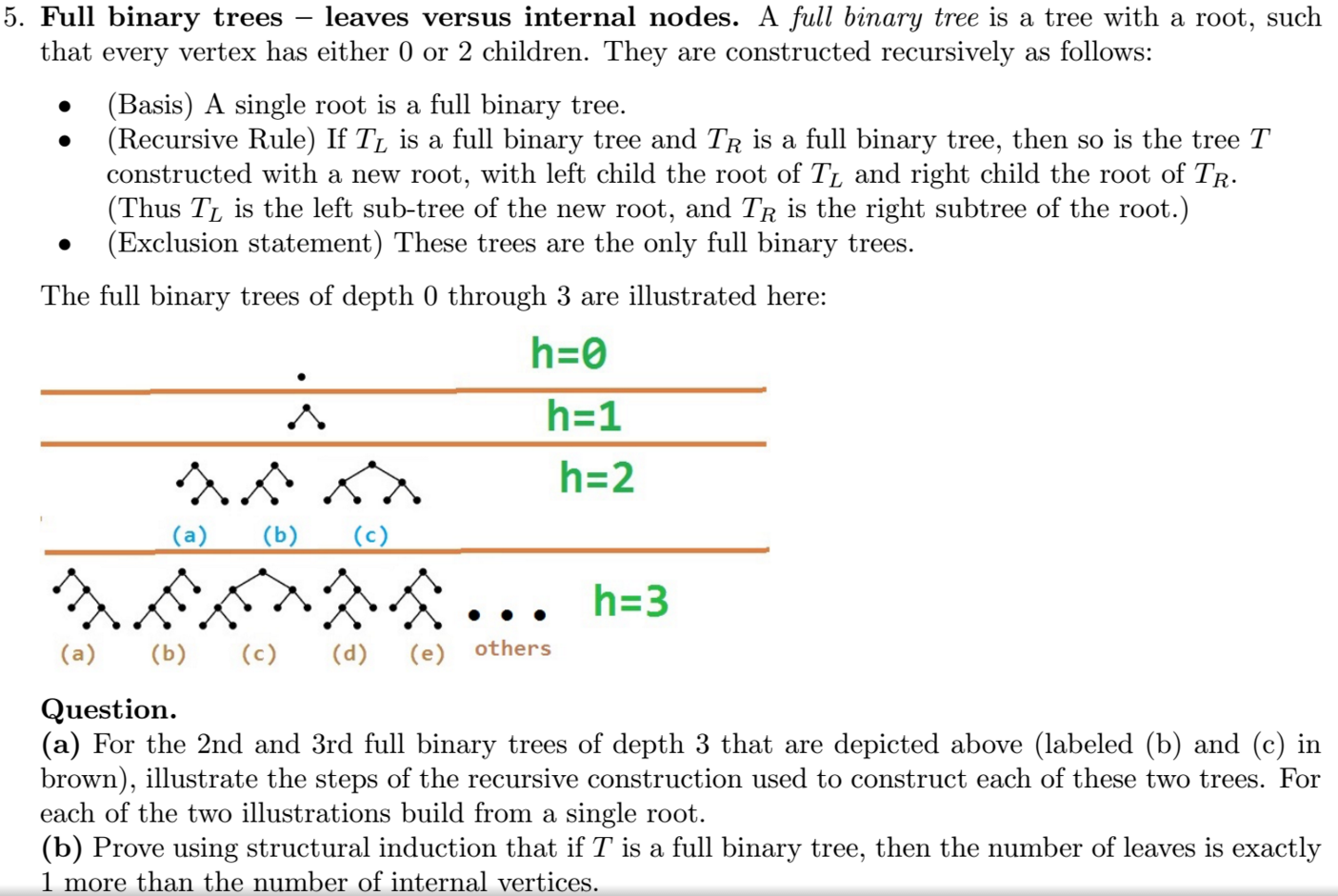
Full binary trees - leaves versus internal nodes. A full binary tree is a tree with a squareroot, such that every vertex has either 0 or 2 children. They are constructed recursively as follows: (Basis) A single squareroot is a full binary tree. (Recursive Rule) If T_L is a full binary tree and T_R is a full binary tree, then so is the tree T constructed with a new squareroot, with left child the squareroot of T_L and right child the squareroot ofT_R. (Thus T_L is the left sub-tree of the new squareroot, and T_R is the right subtree of the squareroot.) (Exclusion statement) These trees are the only full binary trees. The full binary trees of depth 0 through 3 are illustrated here: For the 2nd and 3rd full binary trees of depth 3 that are depicted above (labeled (b) and (c) in brown), illustrate the steps of the recursive construction used to construct each of these two trees. For each of the two illustrations build from a single squareroot. Prove using structural induction that if T is a full binary tree, then the number of leaves is exactly 1 more than the number of internal vertices
Step by Step Solution
There are 3 Steps involved in it

Get step-by-step solutions from verified subject matter experts
 Study Help