Question: Fullers Assertion Reply to Classmate Reflection Juiliana Wilson When looking at Fullers' assertion I can say that I agree with his concept. Fuller claims that
Fullers Assertion Reply to Classmate Reflection
Juiliana Wilson
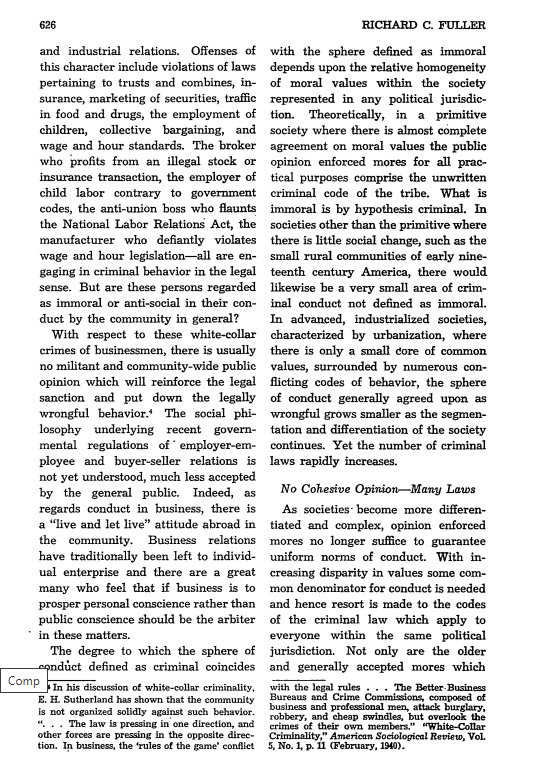
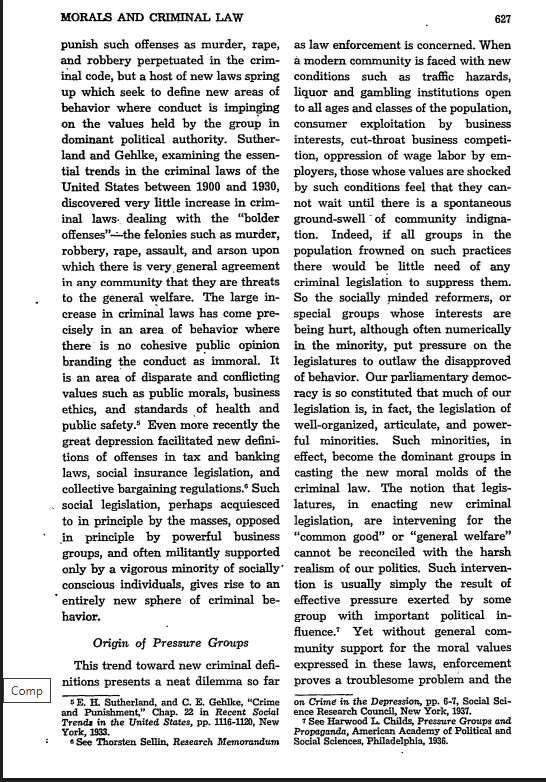
When looking at Fullers' assertion I can say that I agree with his concept. Fuller claims that people in industrialized societies, such as cities, have many different beliefs and or moral codes. As a result of this many people from this society have a hard time agreeing on what's right from wrong but the criminal laws keep on growing. Not allowing for individuals to come together to come to a consensus. "The large increase in criminal laws has come precisely in area of behavior where there is no cohesive public opinion branding the conduct as immoral. It is an area of disparate and conflicting values such as public morals, business ethics, and standards of health and public safety."(p.627). This goes along with his assertion claiming that our large increase in criminal laws, but our public opinion is so diverse, and individuals have different opinions on what is morally correct that it is hard to agree on what is right or wrong. The quote also supports on how law and our public morality could create problems for enforcing our laws in our American society. Laws that don't have widespread support can be harder to enforce because people may not be willing to follow this law. Within our society individuals with different moral codes or values may not be enticed to follow laws from other individuals moral code because it doesn't follow their moral codes. In conclusion Fullers assertion is that the disconnection that we have with law, and our public morality can create strain on our enforcement. The issue isn't about the law breaking it's more of the lack of shared moral consensus that can make our laws ineffective.
Fuller, R. C. (1942). Morals and the criminal law.Journal of Criminal Law and Criminology, 32(6),624-630.
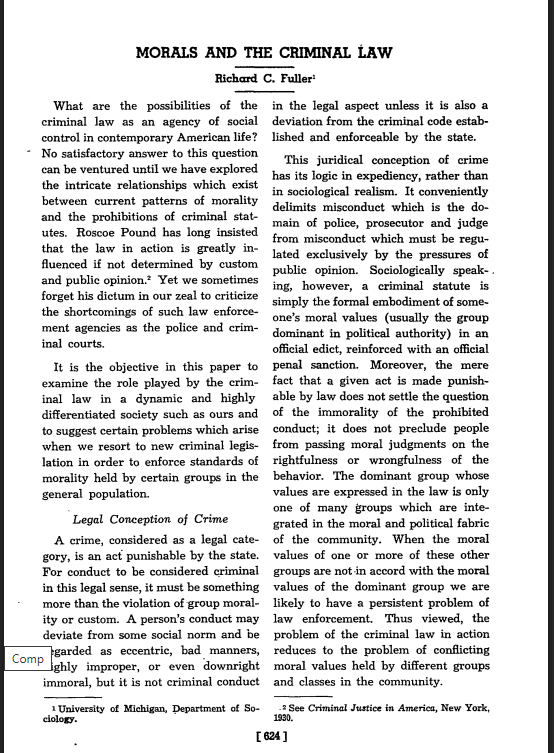
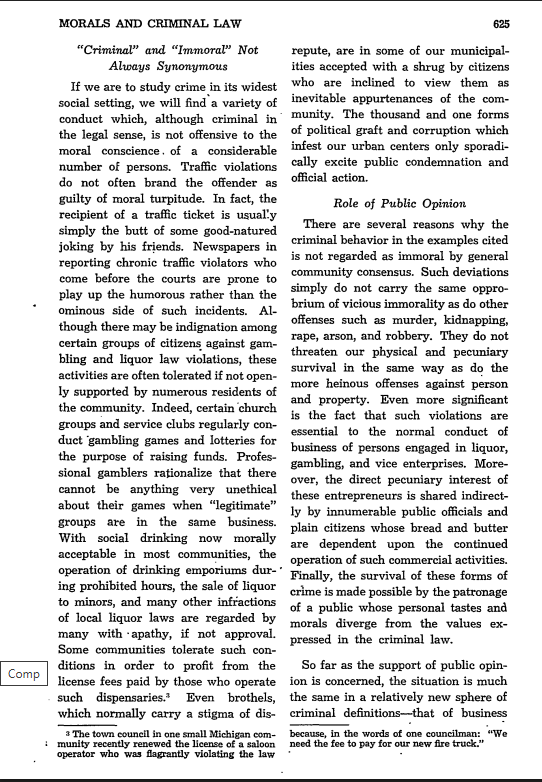
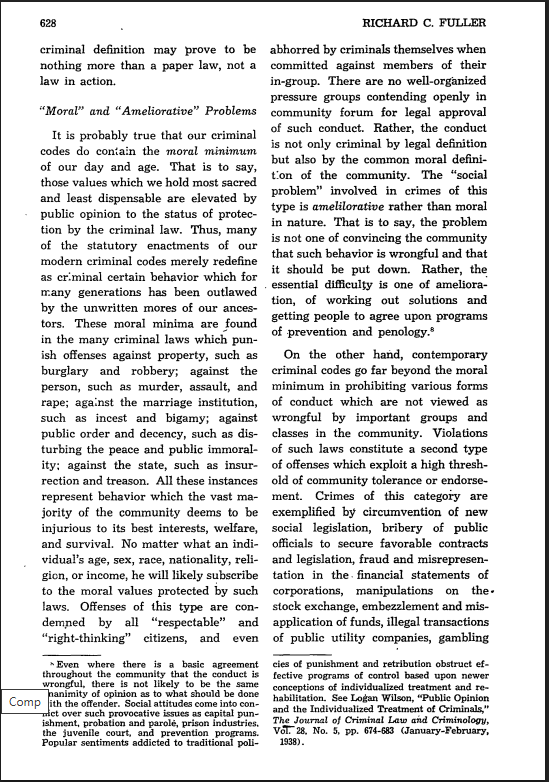
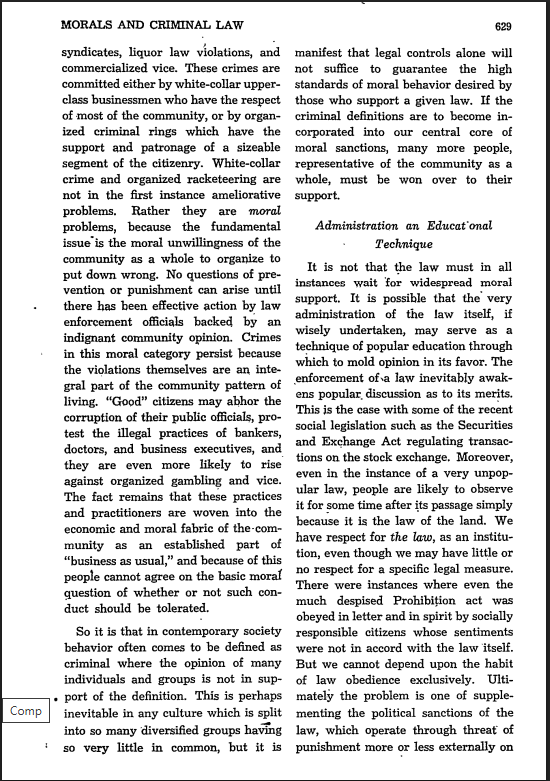
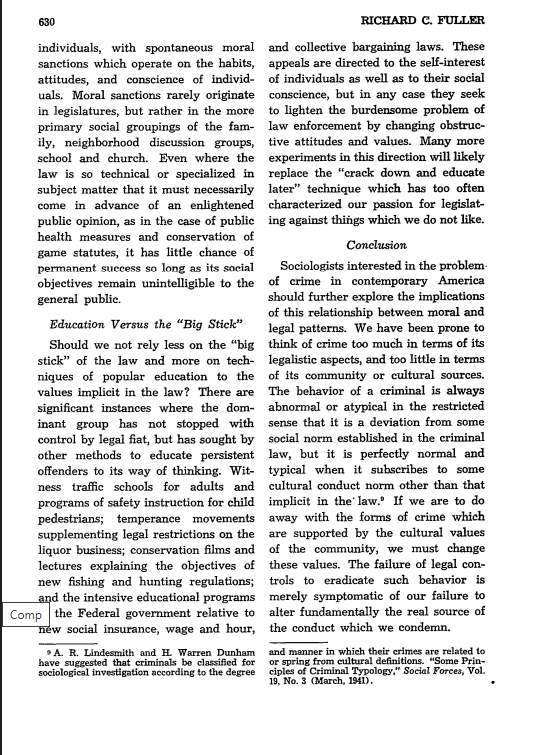
Journal of Criminal Law and Criminology Volume 32 | Issue 6 Article 3 1942 Morals and the Criminal Law Richard C. Fuller Follow this and additional works at: https://scholarlycommons.law.northwestern.edu/jclc Part of the Criminal Law Commons, Criminology Commons, and the Criminology and Criminal Justice Commons Comp hended Citation Richard C. Fuller, Morals and the Criminal Law, 32 J. Crim. L. Criminology 624 (1941-1942) This Article is brought to you for free and open access by Northwestern University School of Law Scholarly Commons. It has been accepted for inclusion in Journal of Criminal Law and Criminology by an authorized editor of Northwestern University School of Law Scholarly Commons.MORALS AND THE CRIMINAL LAW Richard , Fuller' What are the possibilities of the criminal law as an agency of social control in contemporary American life? No satisfactory answer to this question can be ventured until we have explored the intricate relationships which exist between current patterns of morality and the prohibitions of criminal stat- utes. Roscoe Pound has long insisted that the law in action is greatly in- fluenced if not determined by custom and public opinion.* Yet we sometimes forget his dictum in our zeal to criticize the shortcomings of such law enforce- ment agencies as the police and crim- inal courts. It is the objective in this paper to examine the role played by the crim- inal law in a dynamic and highly differentiated society such as ours and to suggest certain problems which arise when we resort to new criminal legis- lation in order to enforce standards of morality held by certain groups in the general population. 'Legal Conception of Crime A crime, considered as a legal cate- gory, is an act punishable by the state. For conduct to be considered criminal in this legal sense, it must be something more than the violation of group moral- ity or custom. A person's conduct may deviate from some social norm and be garded as eccentric, bad manners, ghly improper, or even downright immoral, but it is not criminal conduct University of Michigan, Department of So- elology. in the legal aspect unless it is also a deviation from the criminal code estab- lished and enforceable by the state. This juridical conception of crime has its logic in expediency, rather than in sociological realism. It conveniently delimits misconduct which is the do- main of police, prosecutor and judge from misconduct which must be regu- lated exelusively by the pressures of public opinion. Sociologically speak-. ing, however, a criminal statute is simply the formal embodiment of some- one's moral values (usually the group dominant in political authority) in an official edict, reinforced with an official penal sanction. Moreover, the mere fact that a given act is made punish- able by law does not settle the question of the immorality of the prohibited conduct; it does not preclude people from passing moral judgments on the tightfulness or wrongfulness of the behavior. The dominant group whose values are expressed in the law is only one of many groups which are inte- grated in the moral and political fabric of the community. When the moral values of one or more of these other groups are notin accord with the moral values of the dominant group we are likely to have a persistent problem of law enforcement, Thus viewed, the problem of the criminal law in action reduces to the problem of conflicting moral values held by different groups and classes in the community. -2 See Criminal Justice in America, New York, 1530. [624] MORALS AND CRIMINAL LAW \"Criminal\" and \"Immoral\" Not Always Synonymous Ii we are to study crime in its widest social setting, we will find a variety of conduct which, although criminal in the legal sense, is mot offensive to the moral conscience. of a considerable number of persons. Traffic violations do not often brand the offender as guilty of moral turpitude. In fact, the recipient of a traffic ticket is usual'y simply the butt of some good-natured joking by his friends. Newspapers in reporting chronic traffic violators who eome before the courts are prone to play up the humorous rather than the ominous side of such incidents.
Step by Step Solution
There are 3 Steps involved in it
1 Expert Approved Answer
Step: 1 Unlock
Question Has Been Solved by an Expert!
Get step-by-step solutions from verified subject matter experts








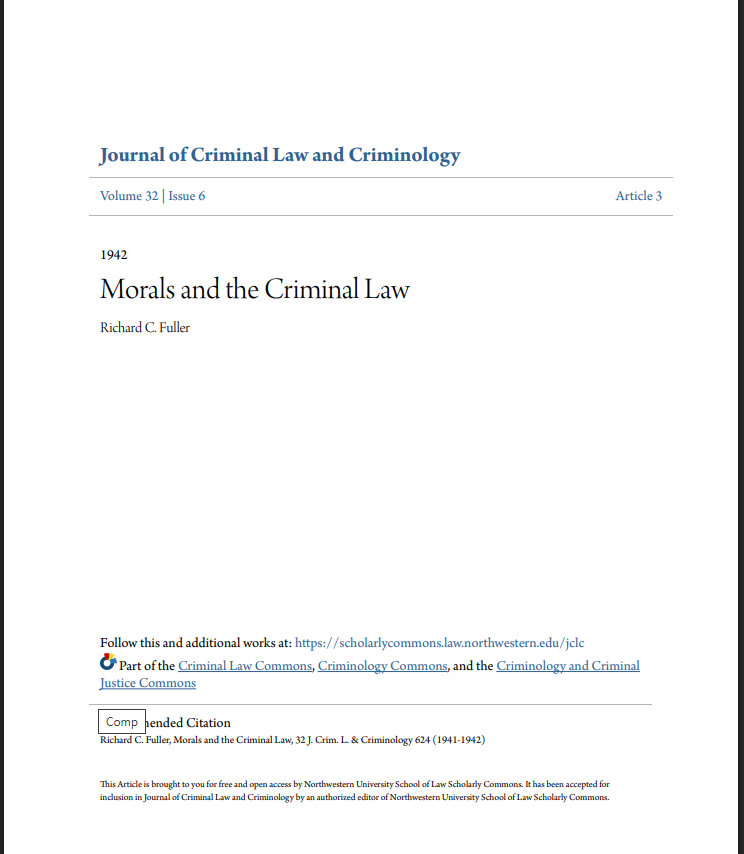
 Journal of Criminal Law and Criminology Volume 32 | Issue 6 Article 3 1942 Morals and the Criminal Law Richard C. Fuller Follow this and additional works at: https://scholarlycommons.law.northwestern.edu/jclc Part of the Criminal Law Commons, Criminology Commons, and the Criminology and Criminal Justice Commons Comp hended Citation Richard C. Fuller, Morals and the Criminal Law, 32 J. Crim. L.
 Study Help