







Question: Fun with Polynomial approximations (3) total: 60 points A finite sum can be written as: M an = dotatay tu tay-1 + ON 1. (1
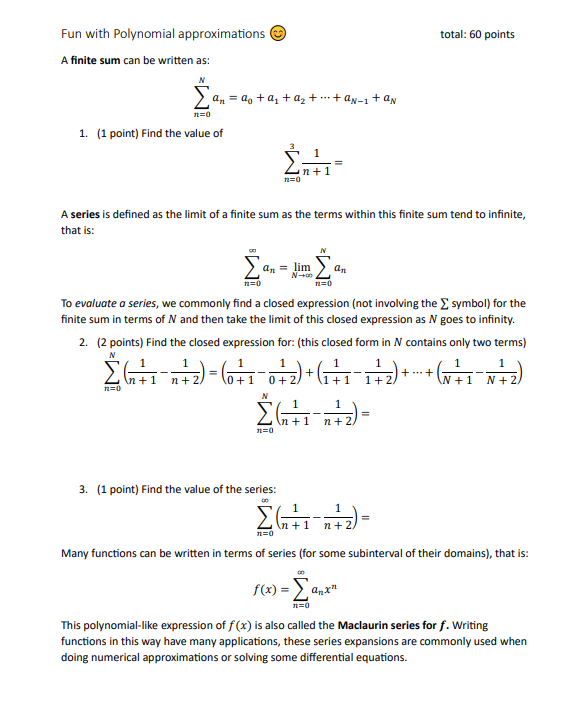
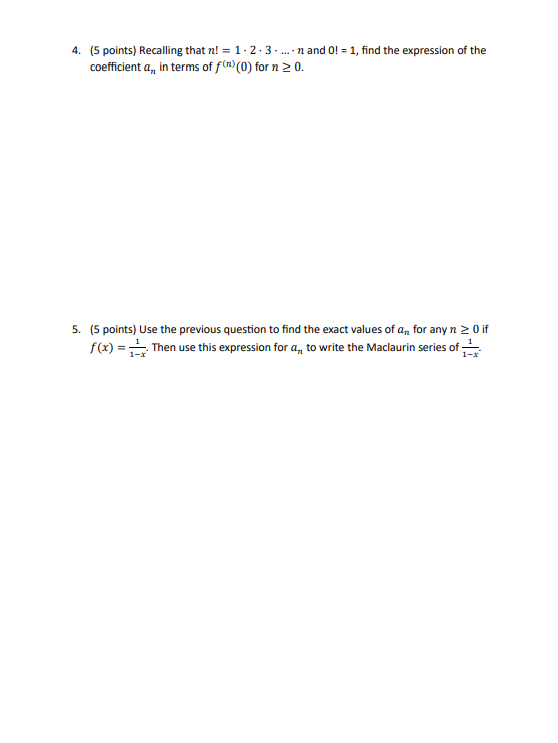
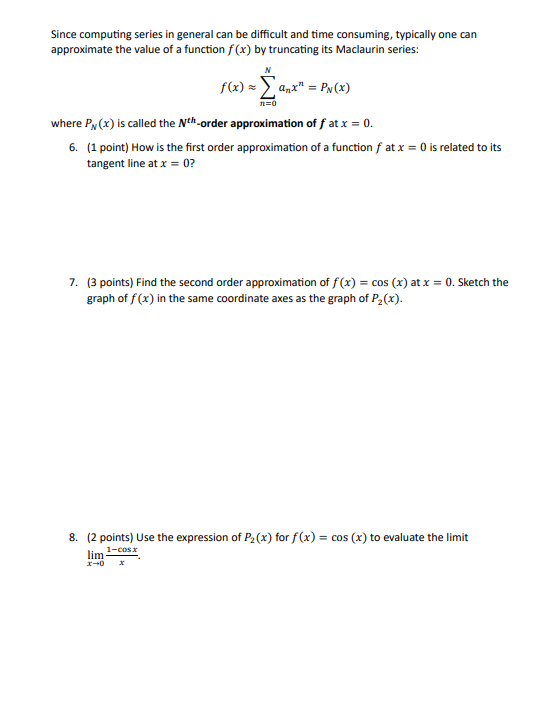
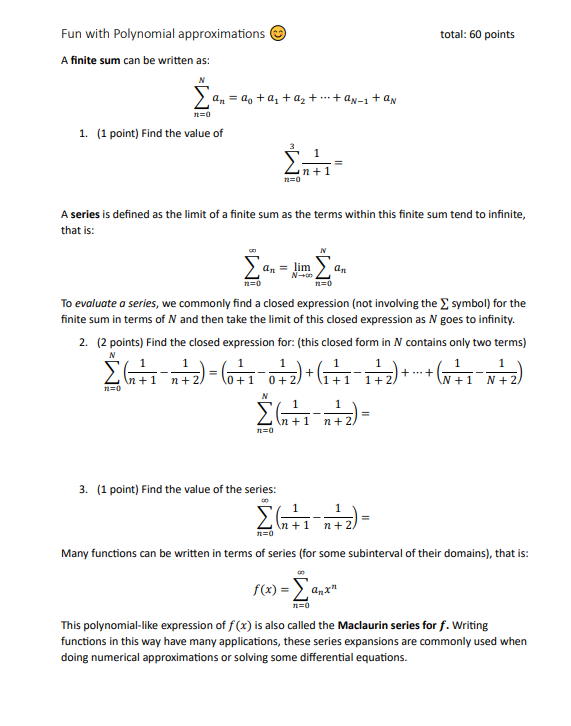
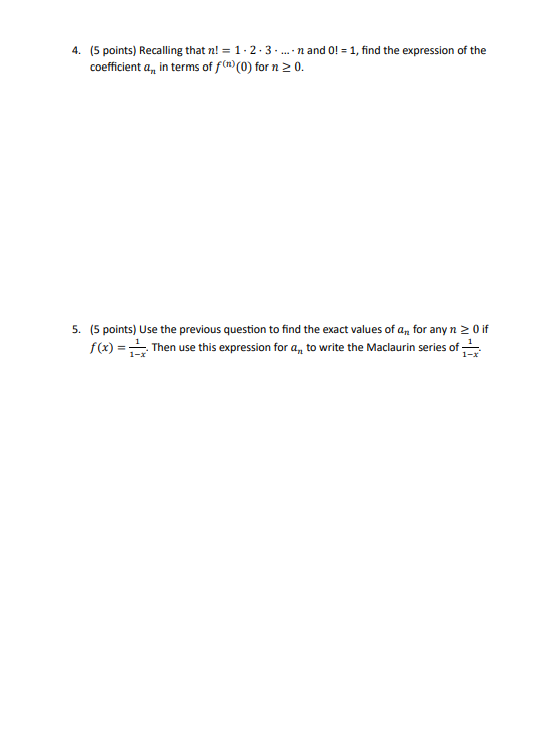
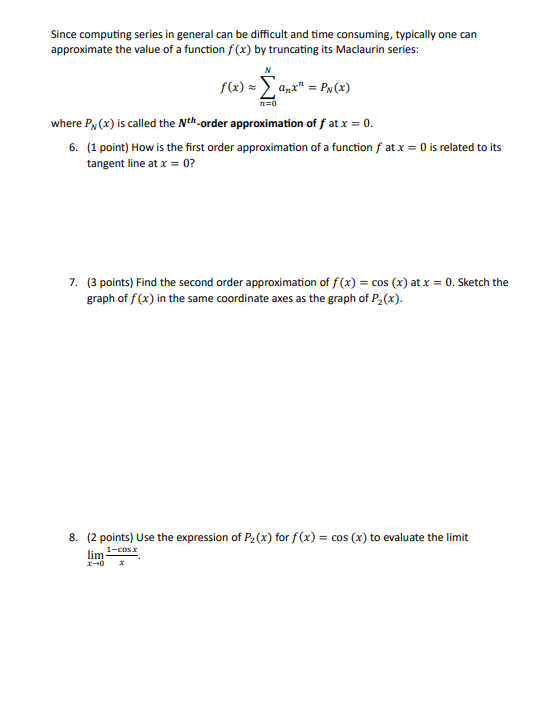
Fun with Polynomial approximations (3) total: 60 points A finite sum can be written as: M an = dotatay tu tay-1 + ON 1. (1 point) Find the value of n+1 1=0 A series is defined as the limit of a finite sum as the terms within this finite sum tend to infinite, that is: Jan = lim To evaluate a series, we commonly find a closed expression (not involving the ) symbol) for the finite sum in terms of / and then take the limit of this closed expression as N goes to infinity. 2. (2 points) Find the closed expression for: (this closed form in N contains only two terms) n+ 2) 0+1 0+2) +(1+1 1+2) + + (N+ I N+2) [(+I n+2) 1=0 3. (1 point) Find the value of the series: Many functions can be written in terms of series (for some subinterval of their domains), that is: f(x) = 1=0 This polynomial-like expression of f (x) is also called the Maclaurin series for f. Writing functions in this way have many applications, these series expansions are commonly used when doing numerical approximations or solving some differential equations.\fSince computing series in general can be difficult and time consuming, typically one can approximate the value of a function f(x) by truncating its Maclaurin series: f(x ) = M anx" = PN(x) where Py (x) is called the Ath-order approximation of f at x = 0. 6. (1 point) How is the first order approximation of a function f at x = 0 is related to its tangent line at x = 0? 7. (3 points) Find the second order approximation of / (x) = cos (x) at x = 0. Sketch the graph of f (x) in the same coordinate axes as the graph of Pz (x). 8. (2 points) Use the expression of P_ (x) for f (x) = cos (x) to evaluate the limit lim -cos x
Step by Step Solution
There are 3 Steps involved in it

Get step-by-step solutions from verified subject matter experts
 Study Help