







Question: Fuzzy Logic - Based Fake News Detection Example Fuzzy Logic - Based Fake News Detection Example Suppose we have a news article with the following
Fuzzy LogicBased Fake News Detection Example Fuzzy LogicBased Fake News Detection Example
Suppose we have a news article with the following features that you use to determine whether the article
is likely to be fake news:
Word Count: The total number of words in the article.
Emotional Tone: A score indicating the article's emotional tone positive negative, or neutral
Source Reliability: A rating on a scale of to representing how reliable the news source is
To describe the qualitative characteristics of the above features and represent its inherently vague or
imprecise, we use these linguistic variables:
Word Count: Low, Medium, High
Emotional Tone: Negative, Neutral, Positive
Source Reliability: Low, Medium, High
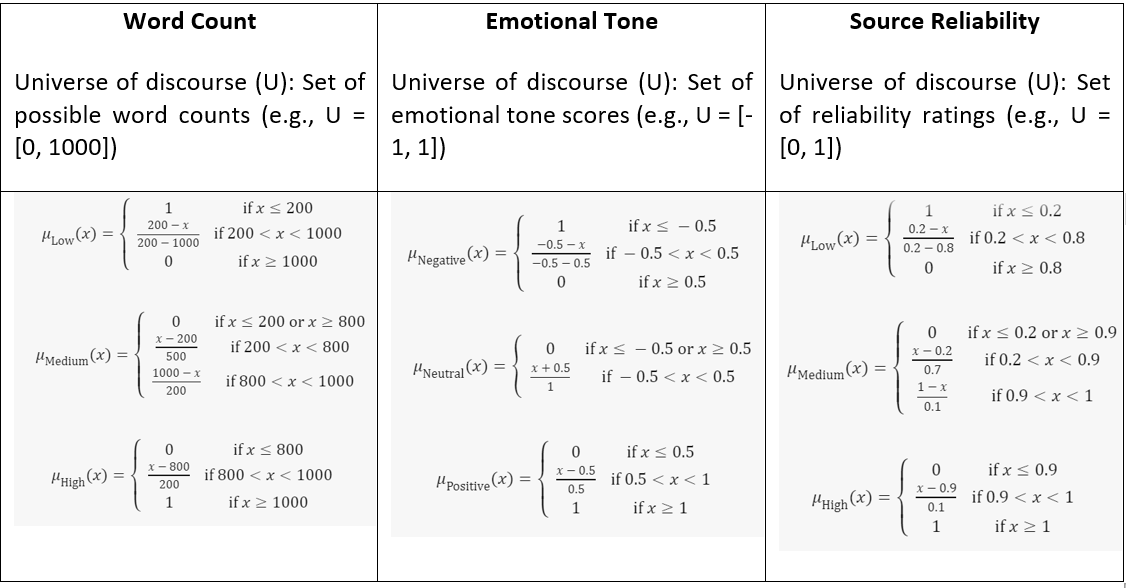
These membership functions represent each feature.
Consulting a group of experts, they suggest that to classify an article as fake news, we must follow two
basic rules:
If the Word Count is High AND the Emotional Tone is Negative, the article is likely fake.
If Source Reliability is Low, then the article is likely fake.
The final step is the defuzzification process. It is based on a threshold defined for the problem. In the
current process, the crips value resulting from the defuzzification process is more significant than and then the article will be considered fake news.
We use a MAX aggregation function and a centroid method COG to find this crisp value. The defuzzied
value COG can be calculated using this formula.
Where:
the degree of membership for the ith fuzzy set.
is the representative value often the centroid of the iiith fuzzy set.
Using the previous model, calculate whether the following articles could be considered fake. Answer if
the article is fake or not!
Demonstrating the calculus is required.
Fuzzification Process: Participants demonstrate the calculation to infer the fuzzy value through the
crisp one's existence in the problem formulation.
Defuzzification Process: Participants demonstrate the calculation to infer the crisp value
through the aggregation and application of the COG function.
Calculations: The calculations do not have any mistakes wrong calculus
The calculations are precise the equations are correctly applied
Result: The Participants cites if the paper is fake or not!
Suppose we have a news article with the following features that you use to determine whether the article is likely to be fake news:
Word Count: The total number of words in the article.
Emotional Tone: A score indicating the article's emotional tone positive negative, or neutral
Source Reliability: A rating on a scale of to representing how reliable the news source is
To describe the qualitative characteristics of the above features and represent its inherently vague or imprecise, we use these linguistic variables:
Word Count: Low, Medium, High
Emotional Tone: Negative, Neutral, Positive
Source Reliability: Low, Medium, High
These membership functions represent each feature.
Consulting a group of experts, they suggest that to classify an article as fake news, we must follow two basic rules:
If the Word Count is High AND the Emotional Tone is Negative, the article is likely fake.
If Source Reliability is Low, then the article is likely fake.
The final step is the defuzzification process. It is based on a threshold defined for the problem. In the current process, the crips value resulting from the defuzzification process is more significant than and then the article will be considered fake news.
We use a MAX aggregation function and a centroid method COG to find this crisp value. The defuzzied value COG can be calculated using this formula.
xfakemu i x ximu i
Where:
i the degree of membership for the ith fuzzy set.
xi is the representative value often the centroid of the iiith fuzzy set.
Using the previous model, calculate whether the following articles could be considered fake. Answer if the article is fake or not!
Demonstrating the calculus is required.
Article Word Count: Emotional Tone: and Source Reliability:
Fuzzification Process: Participants demonstrate the calculation to infer the fuzzy value through the crisp ones existence in the problem formulation.
Defuzzification Process: Participants demonstrate the calculation to infer the crisp value through the aggregation and application of the COG function.
Calculations: The calculations do not have any mistakes wrong calculus
The calculations are precise the equations are correctly applied
Result: The Participants cites if the paper is fake or not!
Step by Step Solution
There are 3 Steps involved in it
1 Expert Approved Answer
Step: 1 Unlock

Question Has Been Solved by an Expert!
Get step-by-step solutions from verified subject matter experts
Step: 2 Unlock
Step: 3 Unlock
 Study Help