







Question: FUZZY LOGIC The following table illustrate the linguistic sets & its membership degree corresponding to each interval, suppose that the number of intervals are 21.
FUZZY LOGIC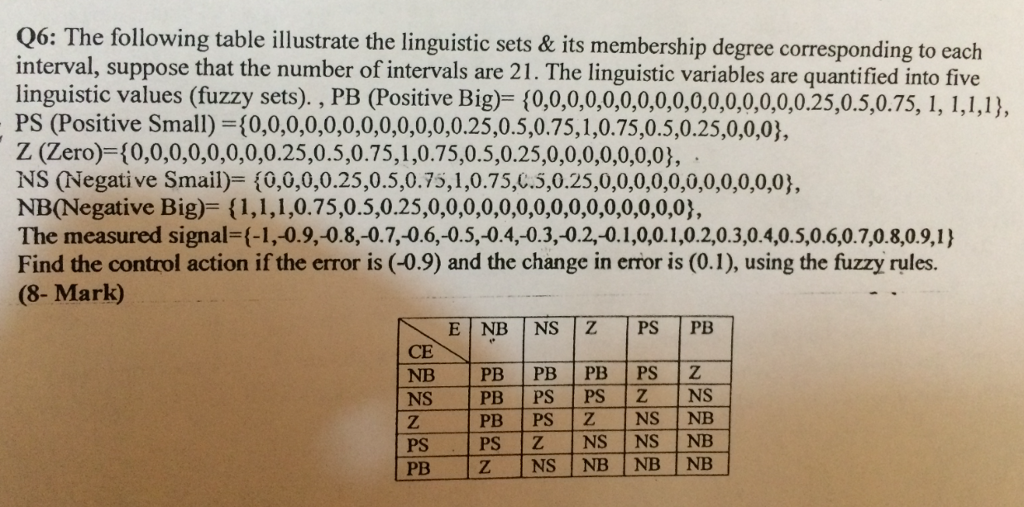
The following table illustrate the linguistic sets & its membership degree corresponding to each interval, suppose that the number of intervals are 21. The linguistic values are quantified into five linguistic values (fuzzy sets). PB (Positive Big) = {0,0,0,0,0,0,0,0,0,0,0,0,0,0,0,0.25,0.5,0.75, 1, 1,1,1}, PS (Positive Small) = {0,0,0,0,0,0,0,0,0,0,0,0.25,0.5,0.75,1,0.75,0.5,0.25,0,0,0}, Z (Zero) = {0,0,0,0,0,0,0,0.25,0.5,0.75,1,0.75,0.5,0.25,0,0,0,0,0,0,0}, NS (Negative Small) = {0,0,0,0.25,0.5,0.75,1,0.75,0.5,0.25,0,0,0,0,0,0,0,0,0,0,0}, NB(Negative Big) = {1,1,1,0.75,0.5,0.25,0,0,0,0,0,0,0,0,0,0,0,0,0,0,0}, The measured signal = {-1,-0.9,-0.8,-0.7,-0.6,-0.5,-0.4,-0.3,-0.2,-0.1,0,0.1,0.2,0.3,0.4,0.5,0.6,0.7,0.8,0.9,1} Find the control action if the error is (-0.9) and the change in error is (0.1), using the fuzzy rules. The following table illustrate the linguistic sets & its membership degree corresponding to each interval, suppose that the number of intervals are 21. The linguistic values are quantified into five linguistic values (fuzzy sets). PB (Positive Big) = {0,0,0,0,0,0,0,0,0,0,0,0,0,0,0,0.25,0.5,0.75, 1, 1,1,1}, PS (Positive Small) = {0,0,0,0,0,0,0,0,0,0,0,0.25,0.5,0.75,1,0.75,0.5,0.25,0,0,0}, Z (Zero) = {0,0,0,0,0,0,0,0.25,0.5,0.75,1,0.75,0.5,0.25,0,0,0,0,0,0,0}, NS (Negative Small) = {0,0,0,0.25,0.5,0.75,1,0.75,0.5,0.25,0,0,0,0,0,0,0,0,0,0,0}, NB(Negative Big) = {1,1,1,0.75,0.5,0.25,0,0,0,0,0,0,0,0,0,0,0,0,0,0,0}, The measured signal = {-1,-0.9,-0.8,-0.7,-0.6,-0.5,-0.4,-0.3,-0.2,-0.1,0,0.1,0.2,0.3,0.4,0.5,0.6,0.7,0.8,0.9,1} Find the control action if the error is (-0.9) and the change in error is (0.1), using the fuzzy rules
Step by Step Solution
There are 3 Steps involved in it

Get step-by-step solutions from verified subject matter experts
 Study Help