


Question: f(x) Question 1 Jobs arrive at a workshop, which has two work centers (A and B) in series, at an exponential rate of 5 per
f(x) Question 1 Jobs arrive at a workshop, which

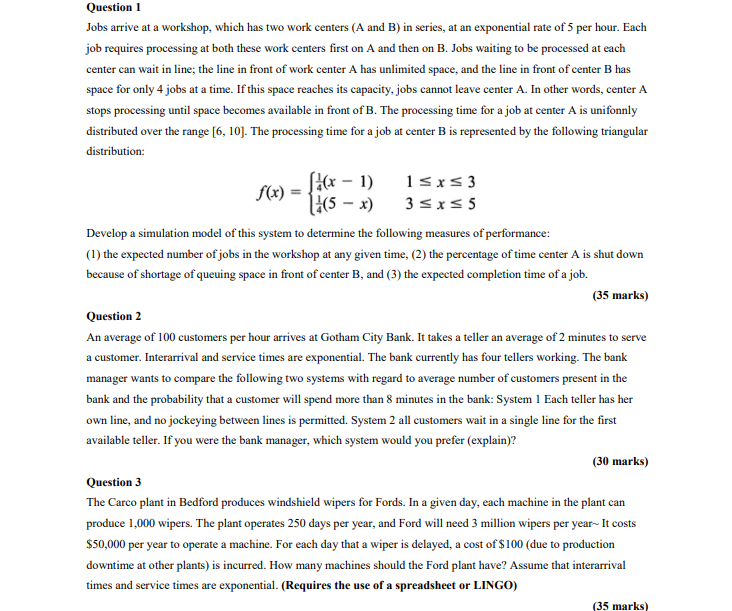
f(x) Question 1 Jobs arrive at a workshop, which has two work centers (A and B) in series, at an exponential rate of 5 per hour. Each job requires processing at both these work centers first on A and then on B. Jobs waiting to be processed at each center can wait in line, the line in front of work center A has unlimited space, and the line in front of center B has space for only 4 jobs at a time. If this space reaches its capacity, jobs cannot leave center A. In other words, center A stops processing until space becomes available in front of B. The processing time for a job at center A is unifonnly distributed over the range [6, 10). The processing time for a job at center B is represented by the following triangular distribution: (x - 1) 15x53 (5 - x) 3 SXs5 Develop a simulation model of this system to determine the following measures of performance: (1) the expected number of jobs in the workshop at any given time, (2) the percentage of time center A is shut down because of shortage of queuing space in front of center B, and (3) the expected completion time of a job. (35 marks) Question 2 An average of 100 customers per hour arrives at Gotham City Bank. It takes a teller an average of 2 minutes to serve a customer. Interarrival and service times are exponential. The bank currently has four tellers working. The bank manager wants to compare the following two systems with regard to average number of customers present in the bank and the probability that a customer will spend more than 8 minutes in the bank: System 1 Each teller has her own line, and no jockeying between lines is permitted. System 2 all customers wait in a single line for the first available teller. If you were the bank manager, which system would you prefer (explain)? (30 marks) Question 3 The Carco plant in Bedford produces windshield wipers for Fords. In a given day, each machine in the plant can produce 1,000 wipers. The plant operates 250 days per year, and Ford will need 3 million wipers per year. It costs $50,000 per year to operate a machine. For each day that a wiper is delayed, a cost of $100 (due to production downtime at other plants) is incurred. How many machines should the Ford plant have? Assume that interarrival times and service times are exponential. (Requires the use of a spreadsheet or LINGO) (35 marks) a

Step by Step Solution

There are 3 Steps involved in it

1 Expert Approved Answer
Step: 1 Unlock blur-text-image

Question Has Been Solved by an Expert!

Get step-by-step solutions from verified subject matter experts

Step: 2 Unlock
Step: 3 Unlock

Students Have Also Explored These Related General Management Questions!