



Question: f(x). Subsequently, we used that fact to compare the value of the integral with the value of an antiderivative obtained by using integration rules.
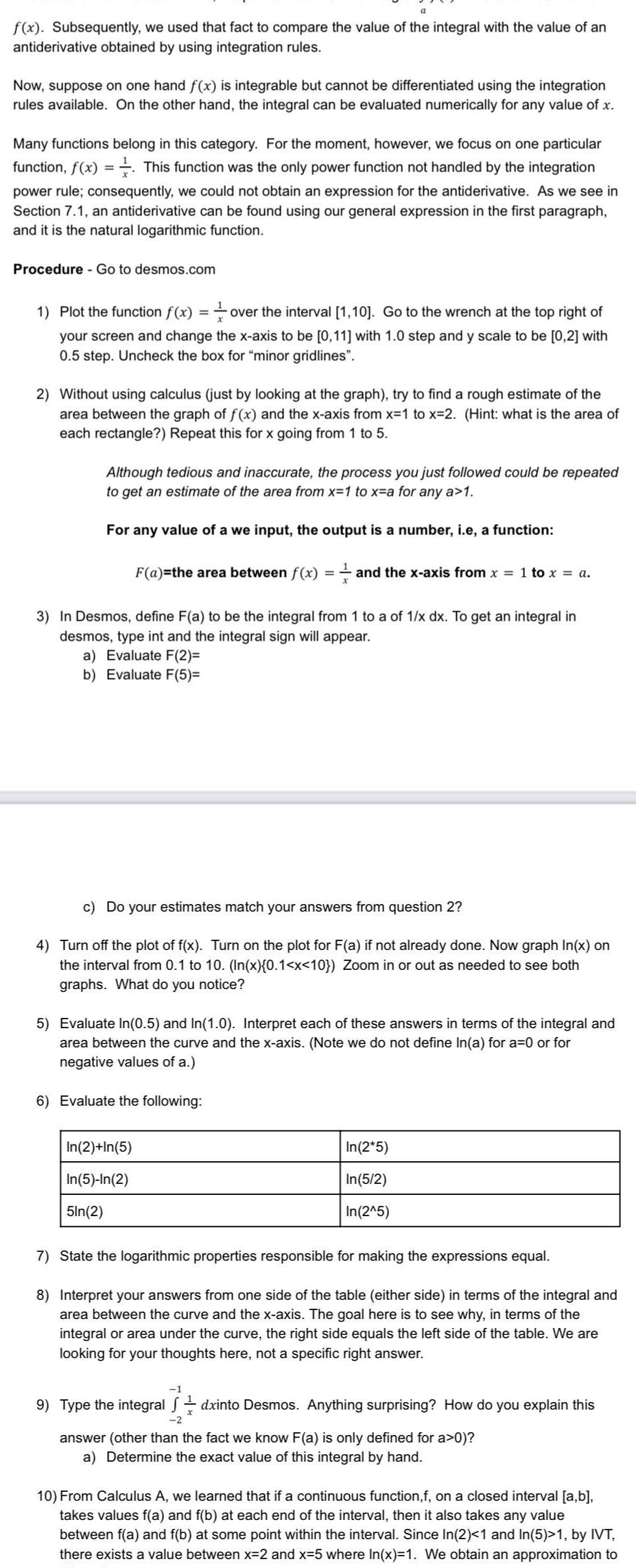
f(x). Subsequently, we used that fact to compare the value of the integral with the value of an antiderivative obtained by using integration rules. Now, suppose on one hand f(x) is integrable but cannot be differentiated using the integration rules available. On the other hand, the integral can be evaluated numerically for any value of x. Many functions belong in this category. For the moment, however, we focus on one particular function, f(x) = This function was the only power function not handled by the integration power rule; consequently, we could not obtain an expression for the antiderivative. As we see in Section 7.1, an antiderivative can be found using our general expression in the first paragraph, and it is the natural logarithmic function. Procedure - Go to desmos.com 1) Plot the function f(x) = 1 over the interval [1,10]. Go to the wrench at the top right of your screen and change the x-axis to be [0,11] with 1.0 step and y scale to be [0,2] with 0.5 step. Uncheck the box for "minor gridlines". 2) Without using calculus (just by looking at the graph), try to find a rough estimate of the area between the graph of f(x) and the x-axis from x=1 to x=2. (Hint: what is the area of each rectangle?) Repeat this for x going from 1 to 5. Although tedious and inaccurate, the process you just followed could be repeated to get an estimate of the area from x=1 to x=a for any a>1. For any value of a we input, the output is a number, i.e, a function: F(a)=the area between f(x) = 1 and the x-axis from x = 1 to x = a. 3) In Desmos, define F(a) to be the integral from 1 to a of 1/x dx. To get an integral in desmos, type int and the integral sign will appear. a) Evaluate F(2)= b) Evaluate F(5)= c) Do your estimates match your answers from question 2? 4) Turn off the plot of f(x). Turn on the plot for F(a) if not already done. Now graph In(x) on the interval from 0.1 to 10. (In(x){0.1 0)? a) Determine the exact value of this integral by hand. 10) From Calculus A, we learned that if a continuous function,f, on a closed interval [a,b], takes values f(a) and f(b) at each end of the interval, then it also takes any value between f(a) and f(b) at some point within the interval. Since In(2) 1, by IVT, there exists a value between x=2 and x=5 where In(x)=1. We obtain an approximation to
Step by Step Solution
There are 3 Steps involved in it

Get step-by-step solutions from verified subject matter experts