







Question: G= 30 T=25 CA = 5 + 10E.P*/P - 0.2(Y-T) P=P* =1.0 E=E0 =1.5 Given the above information, the initial equilibrium value of domestic output
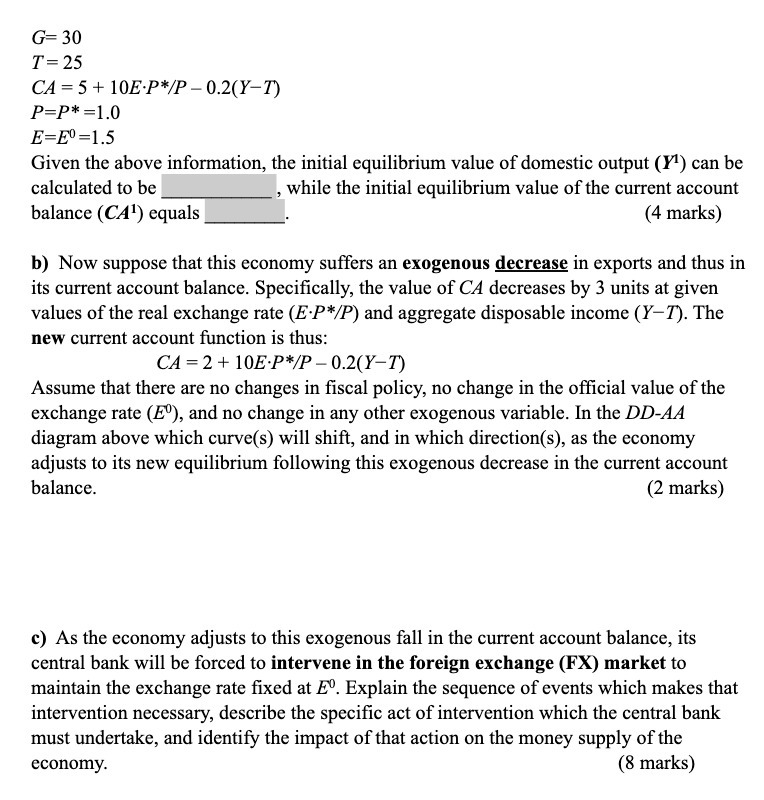
G= 30 T=25 CA = 5 + 10E.P*/P - 0.2(Y-T) P=P* =1.0 E=E0 =1.5 Given the above information, the initial equilibrium value of domestic output (1) can be calculated to be , while the initial equilibrium value of the current account balance (CA]) equals (4 marks) b) Now suppose that this economy suffers an exogenous decrease in exports and thus in its current account balance. Specifically, the value of CA decreases by 3 units at given values of the real exchange rate (E.P*/P) and aggregate disposable income (Y-7). The new current account function is thus: CA = 2 + 10E.P*/P - 0.2(Y-T) Assume that there are no changes in fiscal policy, no change in the official value of the exchange rate (E'), and no change in any other exogenous variable. In the DD-AA diagram above which curve(s) will shift, and in which direction(s), as the economy adjusts to its new equilibrium following this exogenous decrease in the current account balance. (2 marks) c) As the economy adjusts to this exogenous fall in the current account balance, its central bank will be forced to intervene in the foreign exchange (FX) market to maintain the exchange rate fixed at E'. Explain the sequence of events which makes that intervention necessary, describe the specific act of intervention which the central bank must undertake, and identify the impact of that action on the money supply of the economy. (8 marks)
Step by Step Solution
There are 3 Steps involved in it

Get step-by-step solutions from verified subject matter experts
 Study Help