







Question: a) Given a system whose transfer function (TF) is the following one, G(s) = 10 s (1+0.1.s) Using straight line approximations, draw a Bode
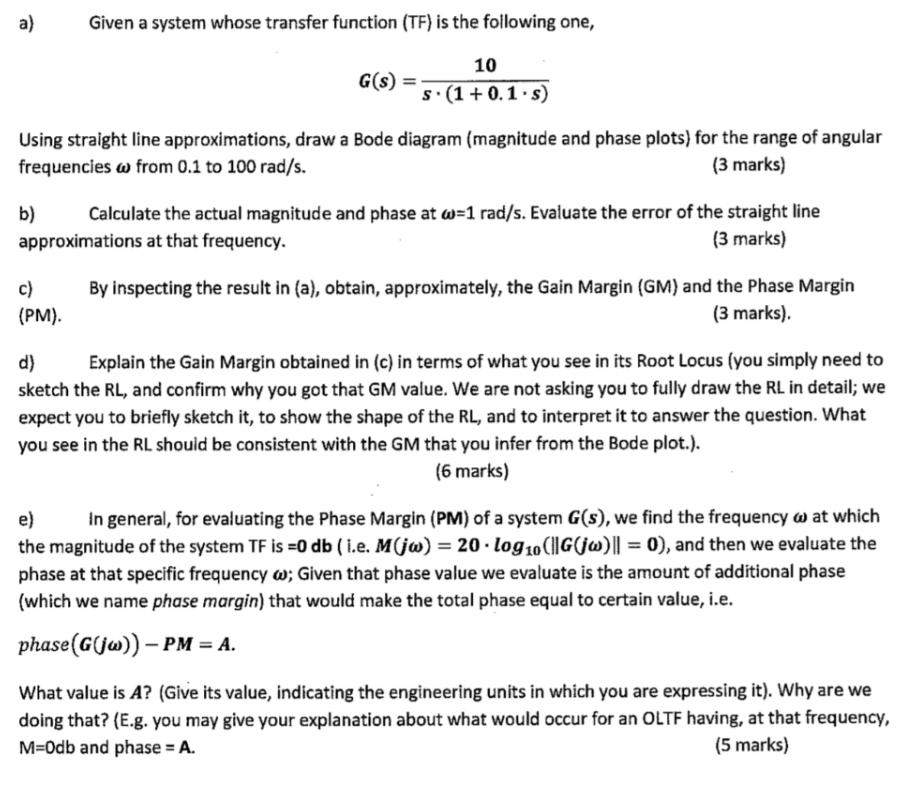
a) Given a system whose transfer function (TF) is the following one, G(s) = 10 s (1+0.1.s) Using straight line approximations, draw a Bode diagram (magnitude and phase plots) for the range of angular frequencies from 0.1 to 100 rad/s. (3 marks) c) (PM). b) Calculate the actual magnitude and phase at w=1 rad/s. Evaluate the error of the straight line approximations at that frequency. (3 marks) By inspecting the result in (a), obtain, approximately, the Gain Margin (GM) and the Phase Margin (3 marks). d) Explain the Gain Margin obtained in (c) in terms of what you see in its Root Locus (you simply need to sketch the RL, and confirm why you got that GM value. We are not asking you to fully draw the RL in detail; we expect you to briefly sketch it, to show the shape of the RL, and to interpret it to answer the question. What you see in the RL should be consistent with the GM that you infer from the Bode plot.). (6 marks) e) In general, for evaluating the Phase Margin (PM) of a system G(s), we find the frequency w at which the magnitude of the system TF is =0 db ( i.e. M(jw) = 20 log0 (||G(jw) || = 0), and then we evaluate the phase at that specific frequency w; Given that phase value we evaluate is the amount of additional phase (which we name phase margin) that would make the total phase equal to certain value, i.e. phase (G(jw)) - PM = A. What value is A? (Give its value, indicating the engineering units in which you are expressing it). Why are we doing that? (E.g. you may give your explanation about what would occur for an OLTF having, at that frequency, M=Odb and phase = A. (5 marks)
Step by Step Solution
3.46 Rating (153 Votes )
There are 3 Steps involved in it

Get step-by-step solutions from verified subject matter experts
 Study Help