







Question: G. Consider the linear program min y + 2 + 3ys s.t. 21 2 1 (4) 32 + 3y 23 -2-1 Dr. S. 20
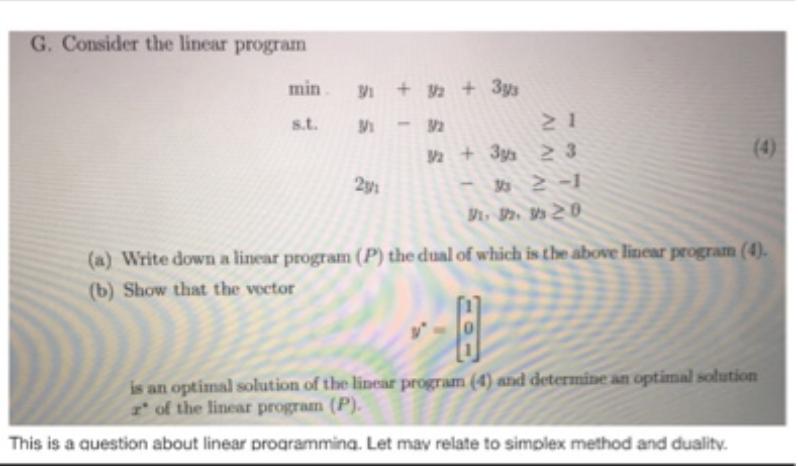
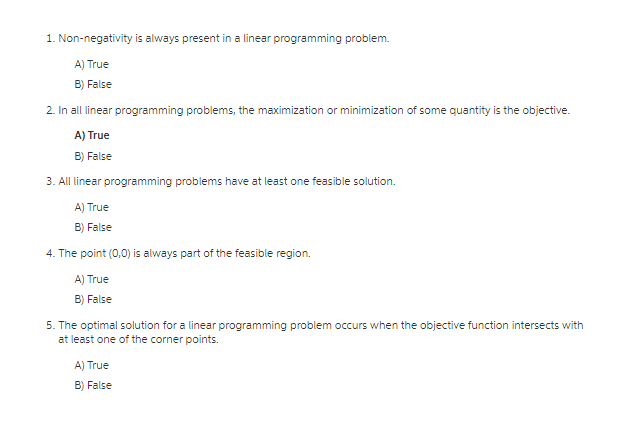
G. Consider the linear program min y + 2 + 3ys s.t. 21 2 1 (4) 32 + 3y 23 -2-1 Dr. S. 20 (a) Write down a linear program (P) the dual of which is the above linear program (4). (b) Show that the vector is an optimal solution of the linear program (4) and determine an optimal solution r of the linear program (P). This is a question about linear programming. Let may relate to simplex method and duality. 1. Non-negativity is always present in a linear programming problem. A) True B) False 2. In all linear programming problems, the maximization or minimization of some quantity is the objective. A) True B) False 3. All linear programming problems have at least one feasible solution. A) True B) False 4. The point (0,0) is always part of the feasible region. A) True B) False 5. The optimal solution for a linear programming problem occurs when the objective function intersects with at least one of the corner points. A) True B) False G. Consider the linear program min y + 2 + 3ys s.t. 21 2 1 (4) 32 + 3y 23 -2-1 Dr. S. 20 (a) Write down a linear program (P) the dual of which is the above linear program (4). (b) Show that the vector is an optimal solution of the linear program (4) and determine an optimal solution r of the linear program (P). This is a question about linear programming. Let may relate to simplex method and duality. 1. Non-negativity is always present in a linear programming problem. A) True B) False 2. In all linear programming problems, the maximization or minimization of some quantity is the objective. A) True B) False 3. All linear programming problems have at least one feasible solution. A) True B) False 4. The point (0,0) is always part of the feasible region. A) True B) False 5. The optimal solution for a linear programming problem occurs when the objective function intersects with at least one of the corner points. A) True B) False
Step by Step Solution
3.34 Rating (154 Votes )
There are 3 Steps involved in it
Yes thats correct All of your statements about linear programming problems are true 1 Nonnegativity is always present in a linear programming problem True Linear programming problems deal with allocat... View full answer

Get step-by-step solutions from verified subject matter experts
 Study Help