







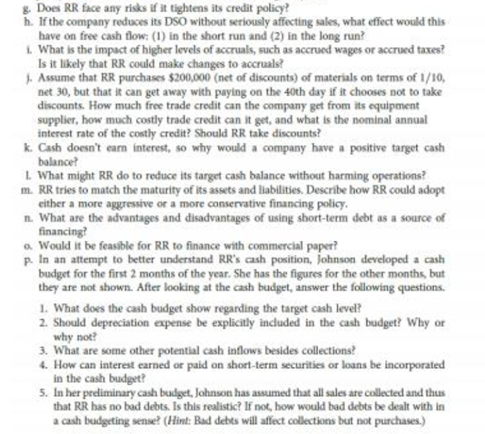
Question: g . Does RR face any risks if it tightens its credit policy? h . If the company reduces its DSO without seriously affecting sales,
g Does RR face any risks if it tightens its credit policy?
h If the company reduces its DSO without seriously affecting sales, what effect would this
have on free cash flow; in the short run and in the long run?
i What is the impact of higher levels of accruals, such as accrued wages or accrued taxes?
Is it likely that RR could make changes to accruals?
Assume that RR purchases $net of discounts of materials on terms of
net but that it can get away with paying on the th day if it chooses not to take
discounts. How much free trade credit can the company get from its equipment
supplier, how much costly trade credit can it get, and what is the nominal annual
interest rate of the costly credit? Should RR take discounts?
k Cash doesn't earn interest, so why would a company have a positive target cash
balance?
L What might RR do to reduce its target cash balance without harming operations?
RR tries to match the maturity of its assets and liabilities. Describe how RR could adopt
either a more aggressive or a more conservative financing policy.
What are the advantages and disadvantages of using shortterm debt as a source of
financing?
a Would it be feasible for RR to finance with commercial paper?
p In an attempt to better understand RRs cash position, Johnson developed a cash
budget for the first months of the year. She has the figures for the other months, but
they are not shown. After looking at the cash budget, answer the following questions.
What does the cash budget show regarding the target cash level?
Should depreciation expense be explicitly included in the cash budget? Why of
why nok?
What are some other potential cash inflows besides collections?
How can interest earned or paid on shortterm securities or loans be incorporated
in the cash budget?
In her pediminary cash budget, Johnson has assumed that all sales are collected and thus
that RR has no bad debts. Is this realistic? If not, how would bad debts be dealt with in
a cash budgeting sense? Hint: Bad debts will affect collections but not purchases.
Step by Step Solution
There are 3 Steps involved in it
1 Expert Approved Answer
Step: 1 Unlock

Question Has Been Solved by an Expert!
Get step-by-step solutions from verified subject matter experts
Step: 2 Unlock
Step: 3 Unlock
 Study Help