







Question: Galaxy Co . sells virtual reality ( VR ) goggles, particularly targeting customers who like to play video games. Galaxy procures each pair of goggles
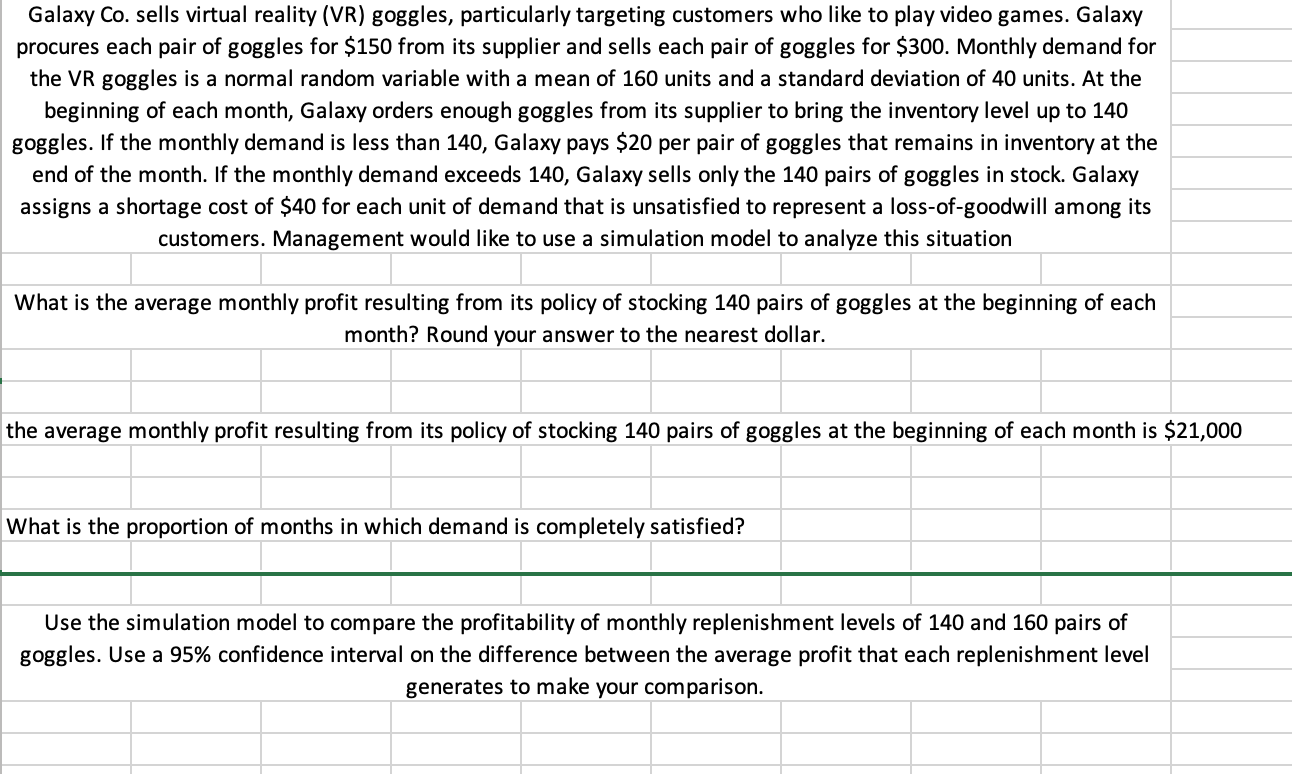
Galaxy Co sells virtual reality VR goggles, particularly targeting customers who like to play video games. Galaxy
procures each pair of goggles for $ from its supplier and sells each pair of goggles for $ Monthly demand for
the VR goggles is a normal random variable with a mean of units and a standard deviation of units. At the
beginning of each month, Galaxy orders enough goggles from its supplier to bring the inventory level up to
goggles. If the monthly demand is less than Galaxy pays $ per pair of goggles that remain in inventory at the
end of the month. If the monthly demand exceeds Galaxy sells only the pairs of goggles in stock. Galaxy
assigns a shortage cost of $ for each unit of demand that is unsatisfied to represent a lossofgoodwill among its
customers. Management would like to use a simulation model to analyze this situation.
What is the average monthly profit resulting from its policy of stocking pairs of goggles at the beginning of each
month? Round your answer to the nearest dollar.
What is the proportion of months in which demand is completely satisfied?
Use the simulation model to compare the profitability of monthly replenishment levels of and pairs of
goggles. Use a confidence interval on the difference between the average profit that each replenishment level
generates to make your comparison.
Step by Step Solution
There are 3 Steps involved in it
1 Expert Approved Answer
Step: 1 Unlock

Question Has Been Solved by an Expert!
Get step-by-step solutions from verified subject matter experts
Step: 2 Unlock
Step: 3 Unlock
 Study Help