







Question: Galaxy Corp. has to choose between two mutually exclusive projects. If it chooses project A, Galaxy Corp. will have the opportunity to make a similar
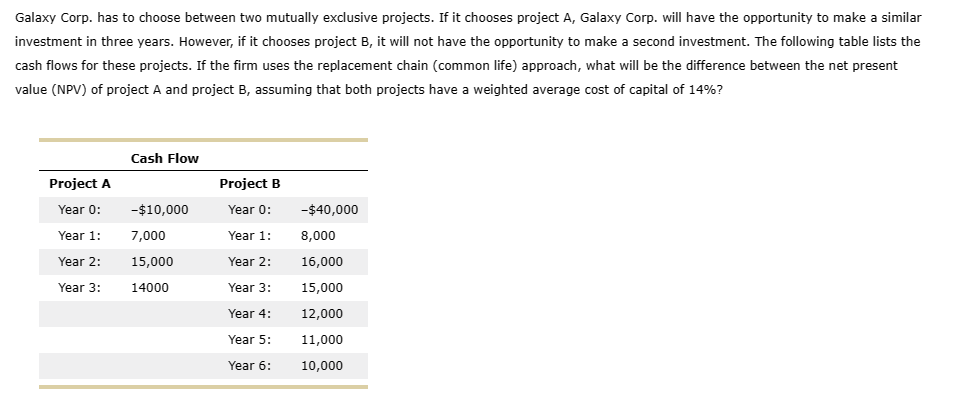
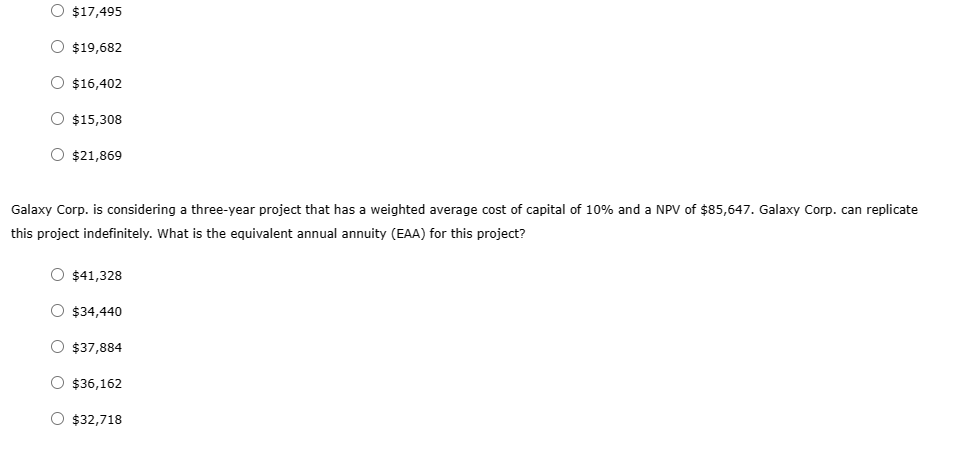
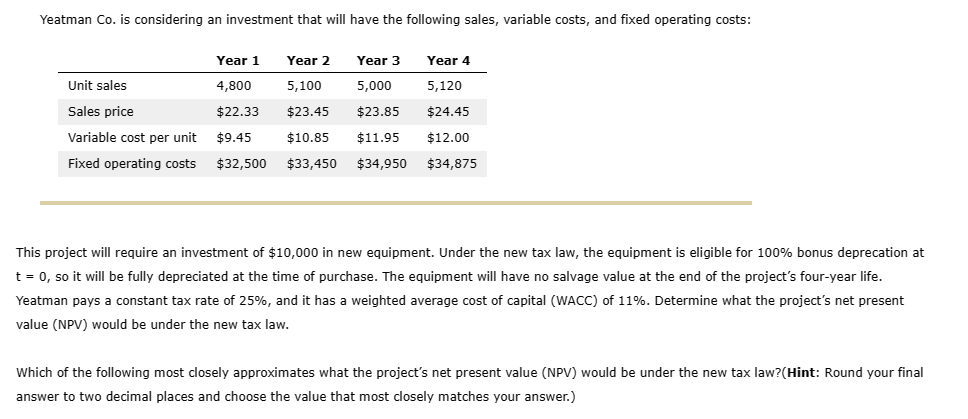
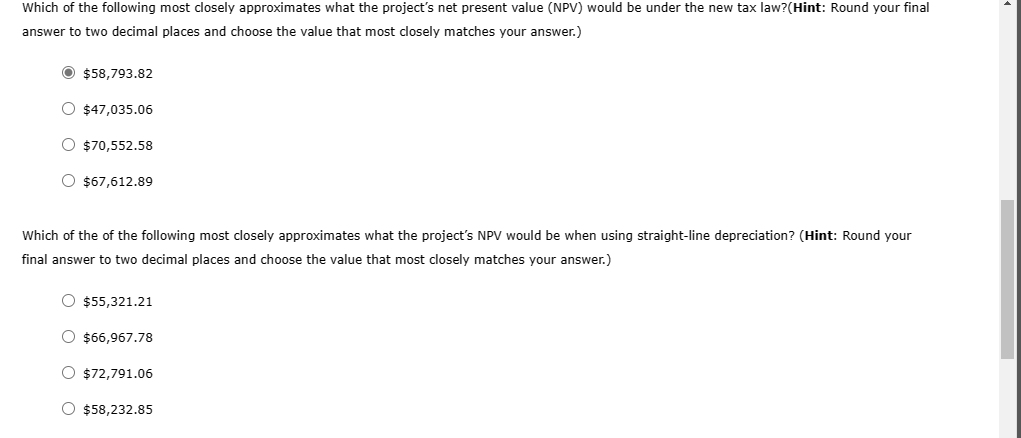
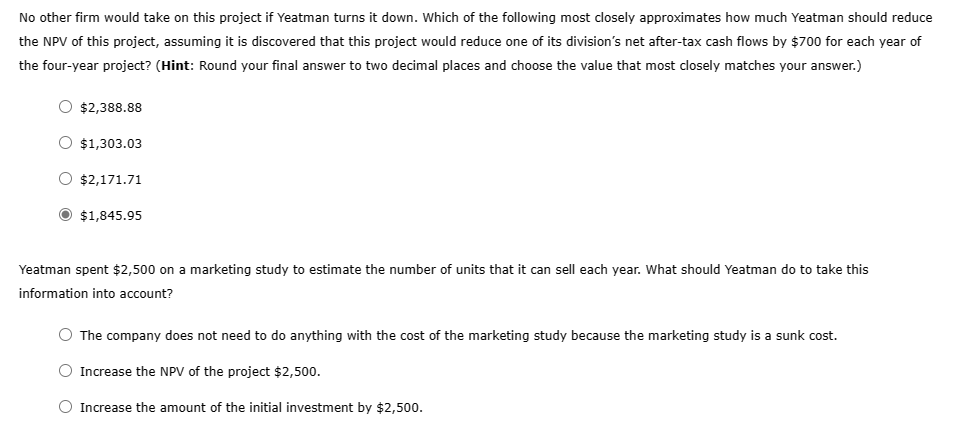
Galaxy Corp. has to choose between two mutually exclusive projects. If it chooses project A, Galaxy Corp. will have the opportunity to make a similar investment in three years. However, if it chooses project B, it will not have the opportunity to make a second investment. The following table lists the cash flows for these projects. If the firm uses the replacement chain (common life) approach, what will be the difference between the net present value (NPV) of project A and project B, assuming that both projects have a weighted average cost of capital of 14% ? $17,495$19,682$16,402$15,308$21,869 Galaxy Corp. is considering a three-year project that has a weighted average cost of capital of 10% and a NPV of $85,647. Galaxy Corp. can replicate this project indefinitely. What is the equivalent annual annuity (EAA) for this project? $41,328$34,440$37,884$36,162$32,718 Yeatman Co. is considering an investment that will have the following sales, variable costs, and fixed operating costs: This project will require an investment of $10,000 in new equipment. Under the new tax law, the equipment is eligible for 100% bonus deprecation at t=0, so it will be fully depreciated at the time of purchase. The equipment will have no salvage value at the end of the project's four-year life. Yeatman pays a constant tax rate of 25%, and it has a weighted average cost of capital (WACC) of 11%. Determine what the project's net present value (NPV) would be under the new tax law. Which of the following most closely approximates what the project's net present value (NPV) would be under the new tax law?(Hint: Round your final answer to two decimal places and choose the value that most closely matches your answer.) Which of the following most closely approximates what the project's net present value (NPV) would be under the new tax law?(Hint: Round your final answer to two decimal places and choose the value that most closely matches your answer.) $58,793.82$47,035.06$70,552.58$67,612.89 Which of the of the following most closely approximates what the project's NPV would be when using straight-line depreciation? (Hint: Round your final answer to two decimal places and choose the value that most closely matches your answer.) $55,321.21$66,967.78$72,791.06$58,232.85 No other firm would take on this project if Yeatman turns it down. Which of the following most closely approximates how much Yeatman should reduce the NPV of this project, assuming it is discovered that this project would reduce one of its division's net after-tax cash flows by $700 for each year of the four-year project? (Hint: Round your final answer to two decimal places and choose the value that most closely matches your answer.) $2,388.88$1,303.03$2,171.71$1,845.95 Yeatman spent $2,500 on a marketing study to estimate the number of units that it can sell each year. What should Yeatman do to the information into account? The company does not need to do anything with the cost of the marketing study because the marketing study is a sunk cost. Increase the NPV of the project $2,500. Increase the amount of the initial investment by $2,500
Step by Step Solution
There are 3 Steps involved in it

Get step-by-step solutions from verified subject matter experts
 Study Help