Question: Galbraith star model application The star model, proposed by Jay Galbraith in the 1960s, provides the basis on which a company bases its design decisions.
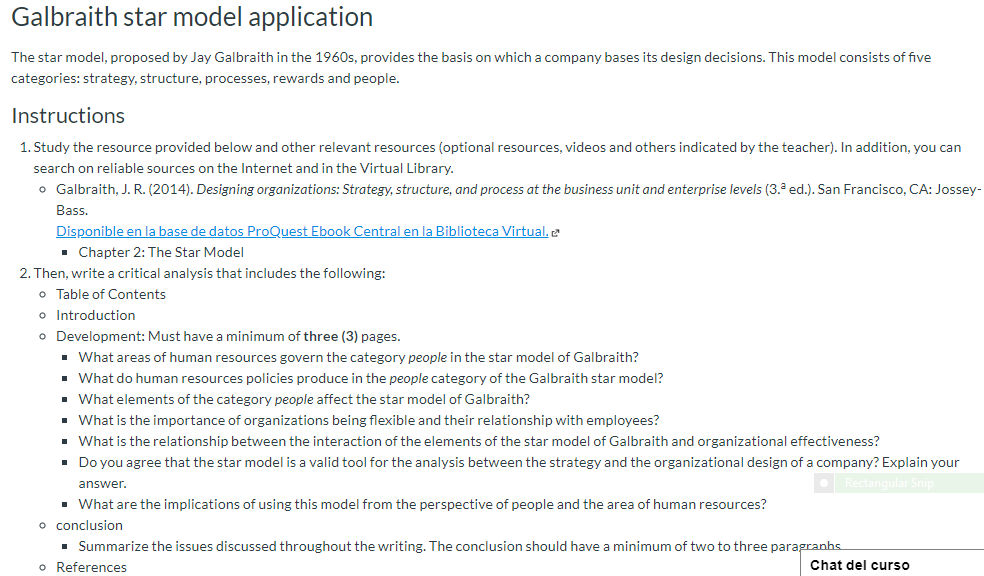
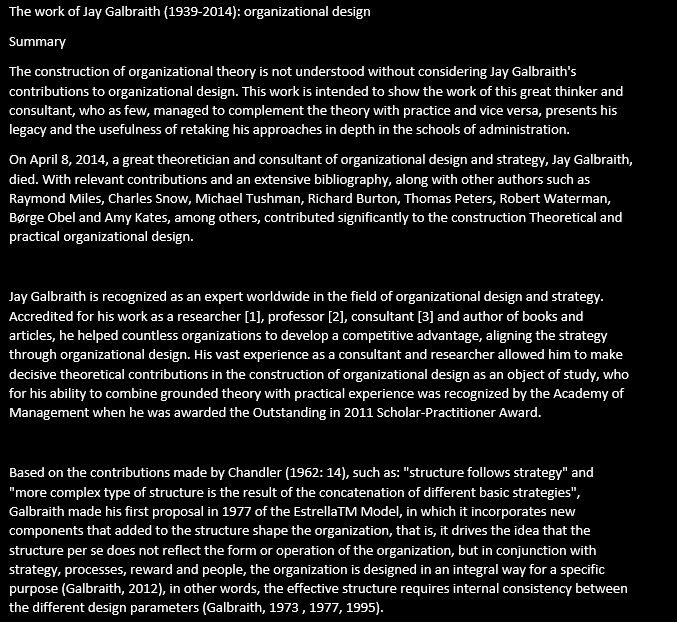
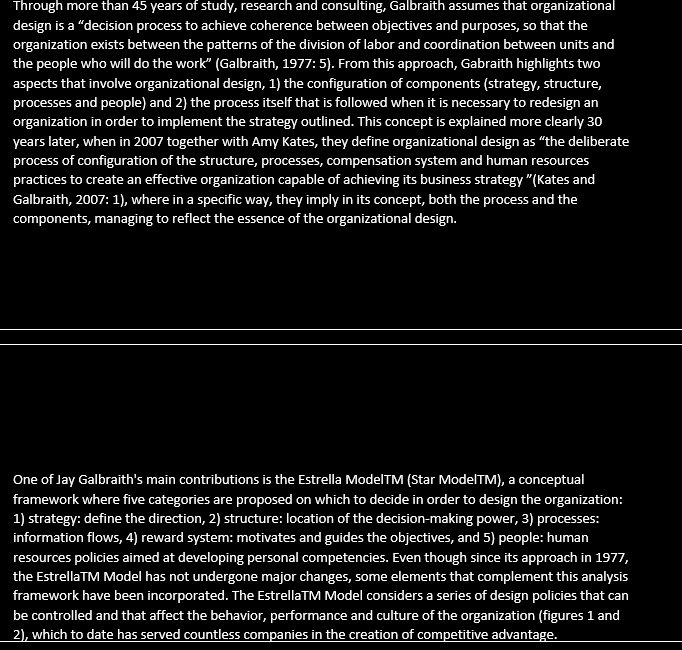
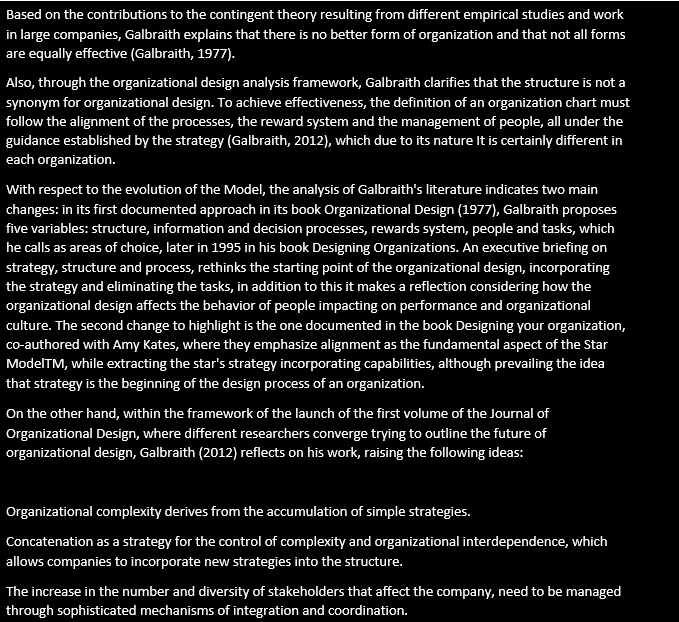
Galbraith star model application The star model, proposed by Jay Galbraith in the 1960s, provides the basis on which a company bases its design decisions. This model consists of five categories: strategy, structure, processes, rewards and people. Instructions 1. Study the resource provided below and other relevant resources (optional resources, videos and others indicated by the teacher). In addition, you can search on reliable sources on the Internet and in the Virtual Library. o Galbraith, J. R. (2014). Designing organizations: Strategy, structure, and process at the business unit and enterprise levels (3. ed.). San Francisco, CA: Jossey- Bass. Disponible en la base de datos ProQuest Ebook Central en la Biblioteca Virtual.c Chapter 2: The Star Model 2. Then, write a critical analysis that includes the following: o Table of Contents o Introduction o Development: Must have a minimum of three (3) pages. What areas of human resources govern the category people in the star model of Galbraith? What do human resources policies produce in the people category of the Galbraith star model? . What elements of the category people affect the star model of Galbraith? What is the importance of organizations being flexible and their relationship with employees? What is the relationship between the interaction of the elements of the star model of Galbraith and organizational effectiveness? Do you agree that the star model is a valid tool for the analysis between the strategy and the organizational design of a company? Explain your answer. What are the implications of using this model from the perspective of people and the area of human resources? o conclusion Summarize the issues discussed throughout the writing. The conclusion should have a minimum of two to three parapranhs o References Chat del curso The work of Jay Galbraith (1939-2014): organizational design Summary The construction of organizational theory is not understood without considering Jay Galbraith's contributions to organizational design. This work is intended to show the work of this great thinker and consultant, who as few, managed to complement the theory with practice and vice versa, presents his legacy and the usefulness of retaking his approaches in depth in the schools of administration. On April 8, 2014, a great theoretician and consultant of organizational design and strategy, Jay Galbraith, died. With relevant contributions and an extensive bibliography, along with other authors such as Raymond Miles, Charles Snow, Michael Tushman, Richard Burton, Thomas Peters, Robert Waterman, Brge Obel and Amy Kates, among others, contributed significantly to the construction Theoretical and practical organizational design. Jay Galbraith is recognized as an expert worldwide in the field of organizational design and strategy. Accredited for his work as a researcher [1], professor [2], consultant (3) and author of books and articles, he helped countless organizations to develop a competitive advantage, aligning the strategy through organizational design. His vast experience as a consultant and researcher allowed him to make decisive theoretical contributions in the construction of organizational design as an object of study, who for his ability to combine grounded theory with practical experience was recognized by the Academy of Management when he was awarded the Outstanding in 2011 Scholar-Practitioner Award. Based on the contributions made by Chandler (1962: 14), such as: "structure follows strategy" and "more complex type of structure is the result of the concatenation of different basic strategies", Galbraith made his first proposal in 1977 of the EstrellaTM Model, in which it incorporates new components that added to the structure shape the organization, that is, it drives the idea that the structure per se does not reflect the form or operation of the organization, but in conjunction with strategy, processes, reward and people, the organization is designed in an integral way for a specific purpose (Galbraith, 2012), in other words, the effective structure requires internal consistency between the different design parameters (Galbraith, 1973, 1977, 1995). Through more than 45 years of study, research and consulting, Galbraith assumes that organizational design is a "decision process to achieve coherence between objectives and purposes, so that the organization exists between the patterns of the division of labor and coordination between units and the people who will do the work" (Galbraith, 1977:5). From this approach, Gabraith highlights two aspects that involve organizational design, 1) the configuration of components (strategy, structure, processes and people) and 2) the process itself that is followed when it is necessary to redesign an organization in order to implement the strategy outlined. This concept is explained more clearly 30 years later, when in 2007 together with Amy Kates, they define organizational design as "the deliberate process of configuration of the structure, processes, compensation system and human resources practices to create an effective organization capable of achieving its business strategy "(Kates and Galbraith, 2007:1), where in a specific way, they imply in its concept, both the process and the components, managing to reflect the essence of the organizational design. One of Jay Galbraith's main contributions is the Estrella ModelTM (Star ModelTM), a conceptual framework where five categories are proposed on which to decide in order to design the organization: 1 strategy: define the direction, 2) structure: location of the decision-making power, 3) processes: information flows, 4) reward system: motivates and guides the objectives, and 5) people: human resources policies aimed at developing personal competencies. Even though since its approach in 1977, the EstrellaTM Model has not undergone major changes, some elements that complement this analysis framework have been incorporated. The EstrellaTM Model considers a series of design policies that can be controlled and that affect the behavior, performance and culture of the organization (figures 1 and 2), which to date has served countless companies in the creation of competitive advantage. Based on the contributions to the contingent theory resulting from different empirical studies and work in large companies, Galbraith explains that there is no better form of organization and that not all forms are equally effective (Galbraith, 1977). Also, through the organizational design analysis framework, Galbraith clarifies that the structure is not a synonym for organizational design. To achieve effectiveness, the definition of an organization chart must follow the alignment of the processes, the reward system and the management of people, all under the guidance established by the strategy (Galbraith, 2012), which due to its nature It is certainly different in each organization. With respect to the evolution of the Model, the analysis of Galbraith's literature indicates two main changes: in its first documented approach in its book Organizational Design (1977), Galbraith proposes five variables: structure, information and decision processes, rewards system, people and tasks, which he calls as areas of choice, later in 1995 in his book Designing Organizations. An executive briefing on strategy, structure and process, rethinks the starting point of the organizational design, incorporating the strategy and eliminating the tasks, in addition to this it makes a reflection considering how the organizational design affects the behavior of people impacting on performance and organizational culture. The second change to highlight is the one documented in the book Designing your organization, co-authored with Amy Kates, where they emphasize alignment as the fundamental aspect of the Star ModelTM, while extracting the star's strategy incorporating capabilities, although prevailing the idea that strategy is the beginning of the design process of an organization, On the other hand, within the framework of the launch of the first volume of the Journal of Organizational Design, where different researchers converge trying to outline the future of organizational design, Galbraith (2012) reflects on his work, raising the following ideas: Organizational complexity derives from the accumulation of simple strategies. Concatenation as a strategy for the control of complexity and organizational interdependence, which allows companies to incorporate new strategies into the structure. The increase in the number and diversity of stakeholders that affect the company, need to be managed through sophisticated mechanisms of integration and coordination. New technologies fragment and segment markets, which results in greater organizational complexity due to diversity in units. The pillars of the structure are: business units, functions, regions, customers, products, brands, the Big Data being the future. These pillars are linked to the company's growth strategy resulting in structural complexity. The challenges of the environment are answered with an organizational design that incorporates new units, with a new and powerful coordination and integration mechanism that helps in the management of interdependence and organizational complexity. In its last years, in order to give continuity to the theoretical, empirical and methodological contributions of organizational design, Galbraith, together with other researchers, promotes as a member and founding president the Organizational Design Community, which seeks to increase research and learning of the organizational design, creating collaboration mechanisms at international level for the advancement of knowledge and practice in this area, being one of these mechanisms for the dissemination of knowledge the Journal of Organizational Design, an open access magazine, where the main exponents in this area, disseminate ideas and theoretical advances in organizational design. Even though Jay Galbraith's work is vast, useful and applicable in organizational dynamics, it is unfortunate that in some business schools in Mexico, organizational design issues are not addressed considering their theoretical and methodological contributions in a profound way. A theoretical option that accurately conveys Galbraith's ideas is the book entitled Designing Organizations, An executive briefing on strategy, structure, anda process (1995), while the practice can be learned based on the book Designing Dynamic Organizations: A Hands-on Guide for Leaders at All Levels (2002), which is a didactic guide for students of administrative disciplines to learn the design or redesign process in an organization with a specific purpose, orienting its components to the fulfillment of the strategy from the use of capabilities. Undoubtedly, the contributions to the organizational design of Jay Galbraith manage to combine different theoretical approaches in this matter, giving order to concepts, differentiating the structure, the organization and the design, clarifying that the structure is not the only thing, and that the complexity and Interdependence of companies are managed through an appropriate organizational design. Before dying, he contributed to the continuity of the study and research of the organizational design, collaborated in the creation of the technological platform for the grouping of thinkers interested in the dissemination of the subject, who will continue contributing to the evolution of Organizational Design as a science, and that as Simon (1996) affirmed, the science of design is part of the science of the artificial. References Chandler, A. D. (1990). Strategy and structure: Chapters in the history of the industrial enterprise. MIT press Galbraith, J. R. (1973). Designing complex organization. USA: Addison-Wesley. Galbraith, J. R. (1977). Organization Design USA: Addison-Wesley. Gailbraith, J. R. (1982). Designing the innovative organization. Organizational Dynamics, 10,5-25









 Study Help