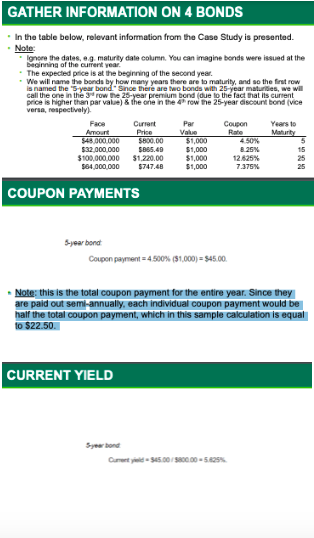
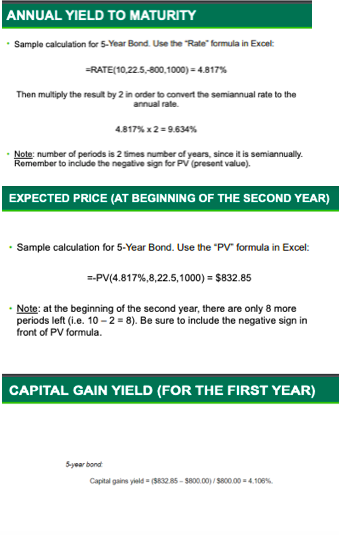
Question: GATHER INFORMATION ON 4 BONDS In the table below, relevant information from the Case Study is prasantad. . Note: Ignore the dates, a
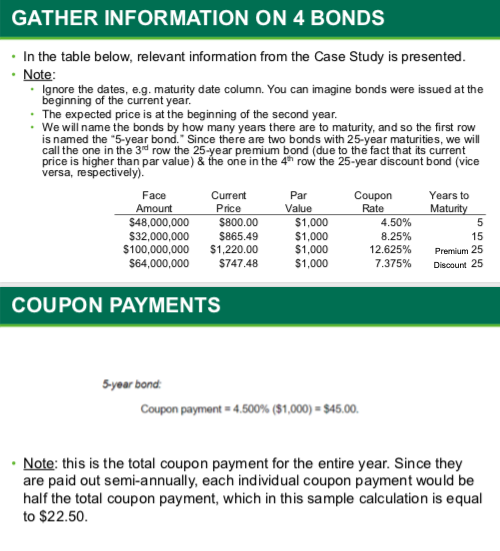
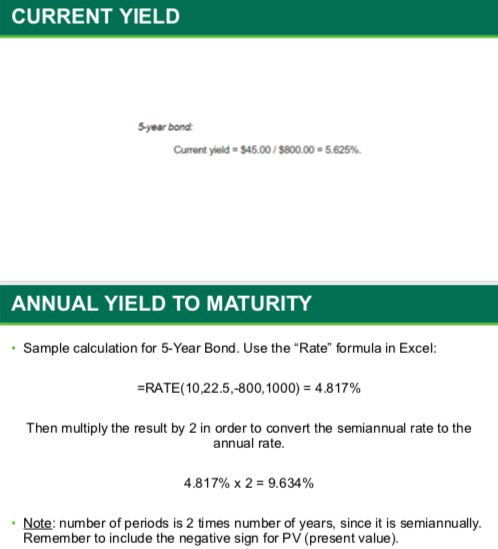
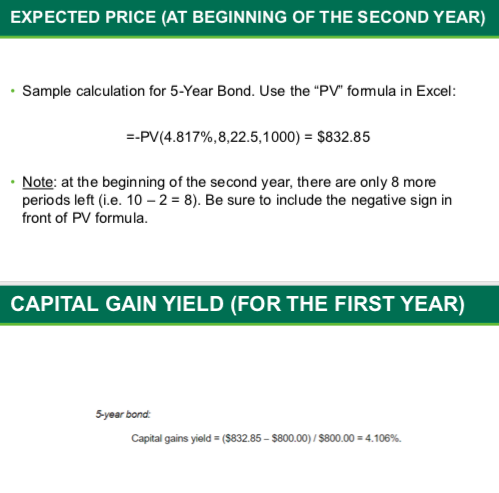
GATHER INFORMATION ON 4 BONDS " In the table below, relevant information from the Case Study is prasantad. . Note: " Ignore the dates, a g maturity date column, You can imagine bands were issued at the beginning of the current your. " The expected price is at the beginning of the second year. " We will name the bands by how many years there are to maturity, and so the first row is named the "5 year bond." Since there are two bonds with 25 year matundes, we wil call the one in the 3" row the 23-your premium bond (due to the fact that its current price is higher than par value) & the one in the & "row the 25-year discount bond (vice veron, respoctively Fica Current PAr Coupon Years is Price Valun Maturity $44 000 600 $800,00 $1,000 5 $32 000 000 $865.40 $1,000 15 $100.000 000 $1.220.00 $1,000 12.425% 25 804 000 000 $747.48 $1,000 25 COUPON PAYMENTS 5-year bond Coupon payment = 4.500% (31,000)= $45 00 . Note: this is the total coupon payment for the entire year. Since they are paid out semi-annually, each individual coupon payment would be half the total coupon payment, which in this sample calculation is equal 10 522 50. CURRENT YIELD Spear bondANNUAL YIELD TO MATURITY * Sample calculation for 5-Year Bond. Use the "Rate" formula in Excel: =RATE(10,22 5,-800,1000) = 4.817% Then multiply the result by 2 in order to convert the semiannual rate to the annual rate. 4.817% x 2 = 9.634% . Note: number of periods is 2 times number of years, since it is semiannually. Remember to include the negative sign for PV (present value). EXPECTED PRICE (AT BEGINNING OF THE SECOND YEAR) . Sample calculation for 5-Year Bond. Use the "PV" formula in Excel: =-PV(4.817%,8,22.5, 1000) = $832.85 . Note: at the beginning of the second year, there are only 8 more periods left (i.e. 10 -2 = 8). Be sure to include the negative sign in front of PV formula. CAPITAL GAIN YIELD (FOR THE FIRST YEAR) S-year bond Capital gains yield = ($632 85 -3800,00)/$800.00 = 4.108%GATHER INFORMATION ON 4 BONDS In the table below, relevant information from the Case Study is presented. Note: Ignore the dates, e.g. maturity date column. You can imagine bonds were issued at the beginning of the current year. The expected price is at the beginning of the second year. We will name the bonds by how many years there are to maturity, and so the first row is named the *5-year bond. " Since there are two bonds with 25-year maturities, we will call the one in the 3" row the 25-year premium bond (due to the fact that its current price is higher than par value) & the one in the 4" row the 25-year discount bond (vice versa, respectively). Face Current Par Coupon Years to Amount Price Value Rate Maturity $48,000,000 $800.00 $1,000 4.50% 5 $32,000,000 $865.49 $1,000 8.25% 15 $100,000,000 $1,220.00 $1,000 12.625% Premium 25 $64,000,000 $747.48 $1,000 7.375% Discount 25 COUPON PAYMENTS 5-year band: Coupon payment = 4.500% ($1,000) = $45.00. Note: this is the total coupon payment for the entire year. Since they are paid out semi-annually, each individual coupon payment would be half the total coupon payment, which in this sample calculation is equal to $22.50.CURRENT YIELD 5-year bond Current yold = $45.00 / $800.00 = 5.625%. ANNUAL YIELD TO MATURITY . Sample calculation for 5-Year Bond. Use the "Rate" formula in Excel: =RATE(10,22.5,-800, 1000) = 4.817% Then multiply the result by 2 in order to convert the semiannual rate to the annual rate. 4.817% x 2 = 9.634% Note: number of periods is 2 times number of years, since it is semiannually. Remember to include the negative sign for PV (present value).EXPECTED PRICE (AT BEGINNING OF THE SECOND YEAR) . Sample calculation for 5-Year Bond. Use the "PV" formula in Excel: =-PV(4.817%,8,22.5,1000) = $832.85 Note: at the beginning of the second year, there are only 8 more periods left (i.e. 10 - 2 = 8). Be sure to include the negative sign in front of PV formula. CAPITAL GAIN YIELD (FOR THE FIRST YEAR) 5-year bond Capital gains yield = ($832.85 - $800.00) / $800.00 = 4.106%
Step by Step Solution
There are 3 Steps involved in it
1 Expert Approved Answer
Step: 1 Unlock
Question Has Been Solved by an Expert!
Get step-by-step solutions from verified subject matter experts
Step: 2 Unlock
Step: 3 Unlock
Students Have Also Explored These Related Finance Questions!









 Study Help