







Question: Gaussian random values. Experiment with the following function for generating random variables from the Gaussian distribution, which is based on generating a random point in
Gaussian random values. Experiment with the following function for generating random variables from the Gaussian distribution, which is based on generating a random point in the unit circle and using a form of the Box-Muller formula (see Exercise 1.2.24)
def gaussian(): r = 0.0 while (r >= 1.0) or (r == 0.0): x = -1.0 + 2.0 * random.random() y = -1.0 + 2.0 * random.random() r = x*x + y*y return x * math.sqrt(-2.0 * math.log(r) / r)
Take a command-line argument n and generate n random numbers, using an array a [ ] of 20 integers to count the numbers generated that fall between i * .05 and (i+1) * .05 for i from 0 to 19. Then use stddraw to plot the values and to compare your result with the normal bell curve.
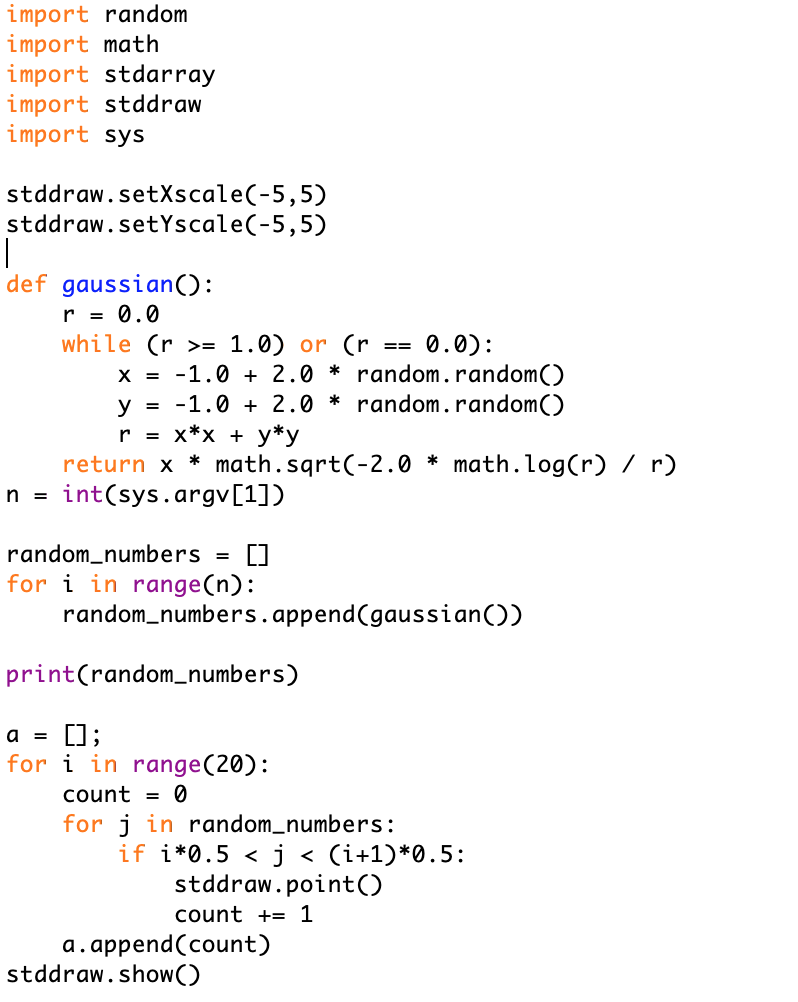
The picture is the code I have so far, I don't have anything in the graphing part yet because I'm not sure how to figure out the x axis variable for each one. I saw other people asking this question but the answers didn't use stddraw at all, it is a book module function. I tried using numpy and installing it with pip a few different ways but my computer still isn't recognizing it.
import random import math import stdarray import stddraw import sys stddraw.setXscale(-5,5) stddraw.setyscale(-5,5) | def gaussian(): r = 0.0 while (r >= 1.0) or (r 0.0): X = -1.0 + 2.0 * random.random() y = -1.0 + 2.0 * random.random() r = x*x + y*y return x * math.sqrt(-2.0 * math.log(r) / r) int(sys.argv[1]) == n = random_numbers for i in range(n): random_numbers.append(gaussian()) print(random_numbers) a = []; for i in range(20): count = 0 for j in random_numbers: if i*0.5 = 1.0) or (r 0.0): X = -1.0 + 2.0 * random.random() y = -1.0 + 2.0 * random.random() r = x*x + y*y return x * math.sqrt(-2.0 * math.log(r) / r) int(sys.argv[1]) == n = random_numbers for i in range(n): random_numbers.append(gaussian()) print(random_numbers) a = []; for i in range(20): count = 0 for j in random_numbers: if i*0.5
Step by Step Solution
There are 3 Steps involved in it

Get step-by-step solutions from verified subject matter experts
 Study Help