







Question: Give a solution to the problem that is deterministically correct. That is, the solution you give must not approximate the answer, but give the exact
Give a solution to the problem that is deterministically correct. That is, the solution you give must not approximate the answer, but give the exact answer.
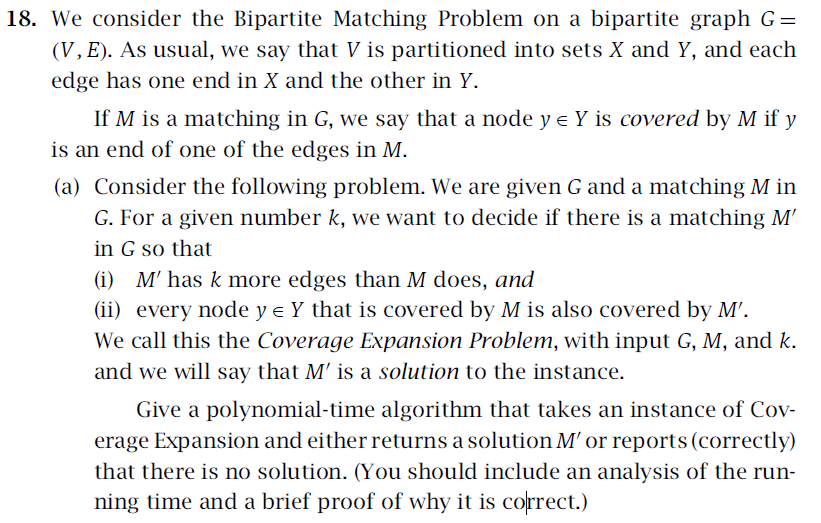
18. We consider the Bipartite Matching Problem on a bipartite graph G (V, E). As usual, we say that V is partitioned into sets X and Y, and each edge has one end in X and the other in Y. If M is a matching in G, we say that a node y e Y is covered by M if y is an end of one of the edges in M. (a) Consider the following problem. We are given G and a matching M in G. l'or a given number kv we wani io dc(id(' il, i here is a mai ching M' in G so that i) M' has k more edges than M does, and (i) every node y e Y that is covered by M is also covered by M We call this the Coverage Expansion Problem, with input G, M, and k. and we will say thal M is son o lhe inslanc Give a polynomial-time algorithm that takes an instance of Cov- erage Expansion and either returns a solution M'or reports (correctly) that there is no solution. (You should include an analysis of the run- ning time and a brief proof of why it is correct.)
Step by Step Solution
There are 3 Steps involved in it

Get step-by-step solutions from verified subject matter experts
 Study Help