





Question: Give the answer with brief explanation E Lines Normal No Spacing Heading 1 Question 1 refers to this scenario and poster: This poster was mistakenly

Give the answer with brief explanation
Give the answer with brief explanation E Lines
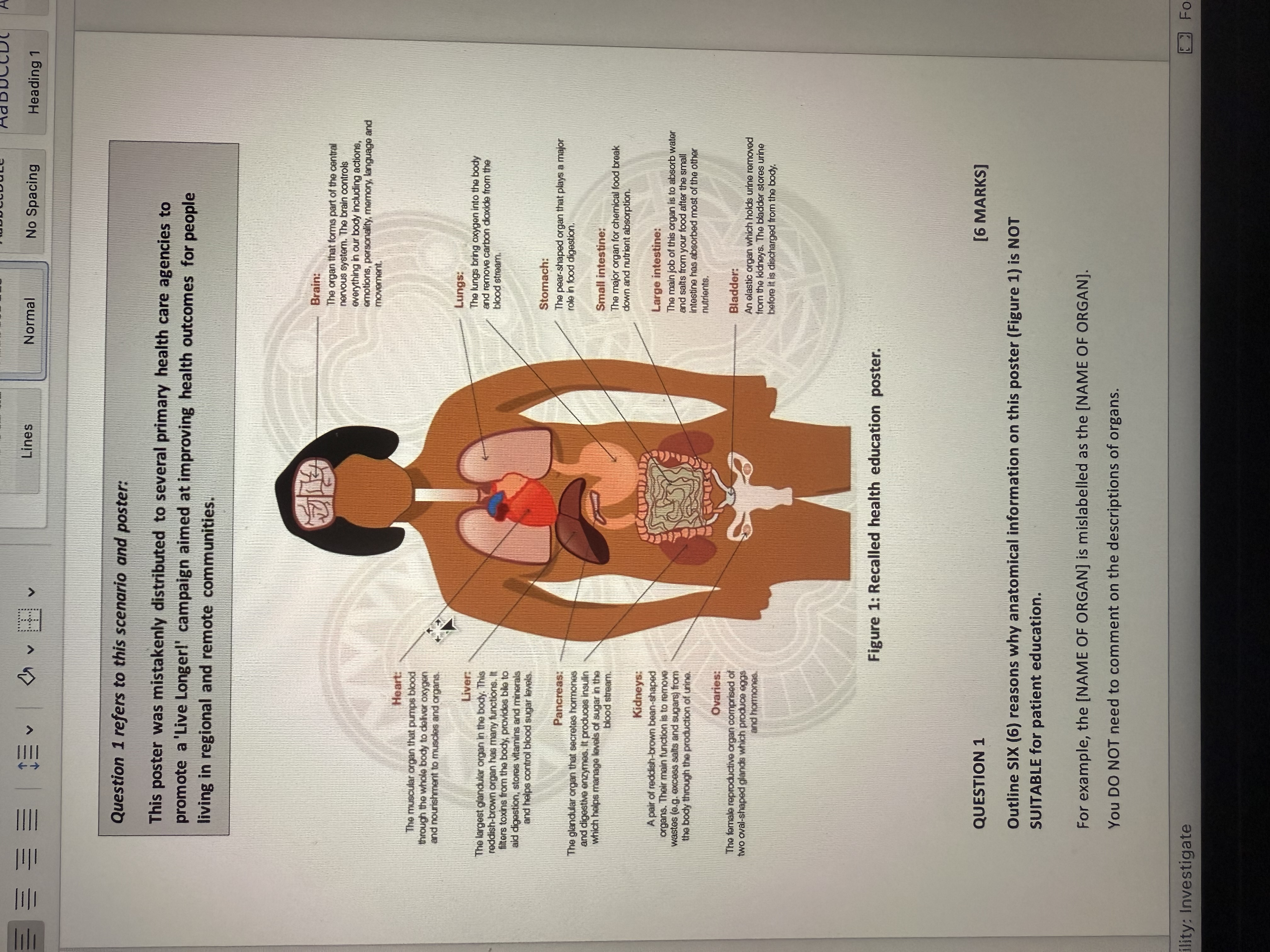
E Lines Normal No Spacing Heading 1 Question 1 refers to this scenario and poster: This poster was mistakenly distributed to several primary health care agencies to promote a 'Live Longer!' campaign aimed at improving health outcomes for people living in regional and remote communities. Brain: The organ that forms part of the central nervous system. The brain controls everything in our body including actions, emotions, personality, memory, language and movement. Heart: The muscular organ that pumps blood through the whole body to deliver oxygen and nourishment to muscles and organis Lungs: Liver The lungs bring oxygen into the body The largest glandular organ in the body. This and remove carbon dioxide from the reddish-brown organ has many functions. It blood stream. filters toxins from the body, provides bile to aid digestion, stores vitamins and minerals and helps control blood sugar levels Stomach: Pancreas: The pear-shaped organ that plays a major The glandular organ that secretes hormones role in food digestion. and digestive enzymes. It produces insulin which helps manage levels of sugar in the Small intestine: blood stream. The major organ for chemical food break down and nutrient absorption. Kidneys A pair of reddish-brown bean-shaped Large intestine: organs. Their main function is to remove The main job of this organ is to absorb water wastes (e.g, excess salts and sugars) from and salts from your food after the small the body through the production of urine. intestine has absorbed most of the other nutrients. Ovaries: The female reproductive organ comprised of Bladder: wo oval-shaped glands which produce eggs An elastic organ which holds urine removed and hormones. from the kidneys. The bladder stores urine before it is discharged from the body. Figure 1: Recalled health education poster. QUESTION 1 [6 MARKS] Outline SIX (6) reasons why anatomical information on this poster (Figure 1) is NOT SUITABLE for patient education. For example, the [NAME OF ORGAN] is mislabelled as the [NAME OF ORGAN]. You DO NOT need to comment on the descriptions of organs. ility: Investigate EFO

Step by Step Solution

There are 3 Steps involved in it

1 Expert Approved Answer
Step: 1 Unlock blur-text-image

Question Has Been Solved by an Expert!

Get step-by-step solutions from verified subject matter experts

Step: 2 Unlock
Step: 3 Unlock

Students Have Also Explored These Related Accounting Questions!