







Question: Given a bit string of length n, the shift-left-cyclic operation places the first bit at the end, leaving the rest of the bits unchanged. For
Given a bit string of length n, the shift-left-cyclic operation places the first bit at the end, leaving the rest of the bits unchanged. For example, SLC (100110) = 001101.
(i) Build a Mealy machine with input and output alphabet ( 0 I $ } such that for any bit string x when we input the n + 1 bits x$, we get as output the n + 1 bit string $ SLC(x). (ii) Explain why this cannot be done without a $.
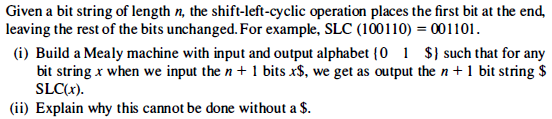
Given a bit string of length n, the shift-left-cyclic operation places the first bit at the end, leaving the rest of the bits unchanged. For example, SLC (100110) 001101 (i) Build a Mealy machine with input and output alphabet { 0 1 $} such that for any bit string x when we input the n+1 bits S, we get as output the bit string $ SLC(x) (ii) Explain why this cannot be done without a S
Step by Step Solution
There are 3 Steps involved in it

Get step-by-step solutions from verified subject matter experts
 Study Help