







Question: Given a graph (-( V, E), suppose each edge E E is labelled with a label ?(u,u) from a finite set of labels, and assigned
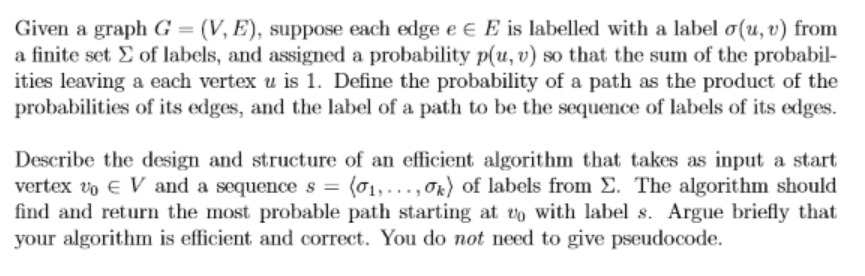
Given a graph (-( V, E), suppose each edge E E is labelled with a label ?(u,u) from a finite set of labels, and assigned a probability p(u, v) so that the sum of the probabil- ities leaving a each vertex u is 1. Define the probability of a path as the product of the probabilities of ts edges, and the label of a path to be the seqence of labels of its edges. Describe the design and structure of an efficient algorithm that takes as input a start vertex to V and a sequence s-(a, ,?) of labels from ? The algorithm should find and return the most probable path starting at with label s. Argue briefly that your algorithm is efficient and correct. You do not need to give pseudocode. Given a graph (-( V, E), suppose each edge E E is labelled with a label ?(u,u) from a finite set of labels, and assigned a probability p(u, v) so that the sum of the probabil- ities leaving a each vertex u is 1. Define the probability of a path as the product of the probabilities of ts edges, and the label of a path to be the seqence of labels of its edges. Describe the design and structure of an efficient algorithm that takes as input a start vertex to V and a sequence s-(a, ,?) of labels from ? The algorithm should find and return the most probable path starting at with label s. Argue briefly that your algorithm is efficient and correct. You do not need to give pseudocode
Step by Step Solution
There are 3 Steps involved in it

Get step-by-step solutions from verified subject matter experts
 Study Help