







Question: Given a positive integer n between 1 and 9, generate the #permuations of the set {1, 2, 3, 4, , n} using the Johnson-Trotter algorithm
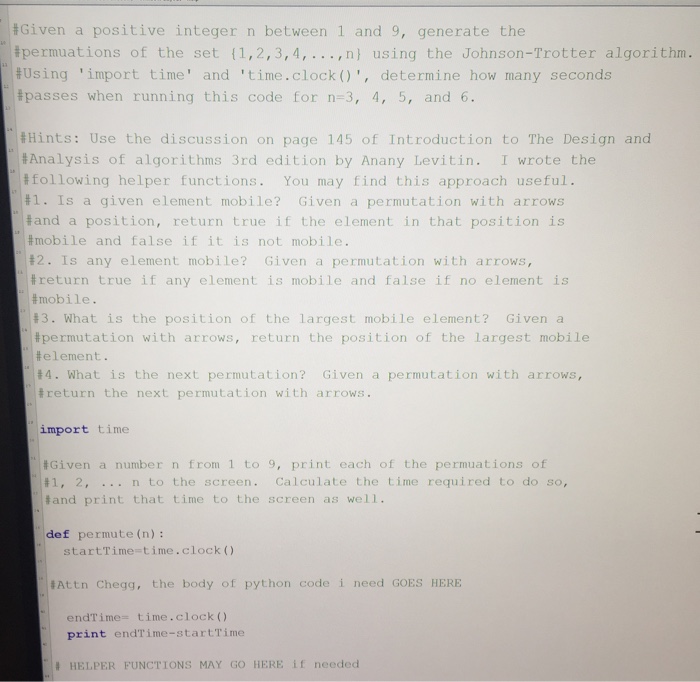
Given a positive integer n between 1 and 9, generate the #permuations of the set {1, 2, 3, 4, , n} using the Johnson-Trotter algorithm #Using 'import time ' and 'time . clock()", determine how many seconds passes when running this code for n-3, 4, 5, and 6. #Aints: Use the discussion on page 145 of Introduction to The Design and #Analysis of algorithms 3rd edition by Anany Levitin. I wrote the following helper functions. You may find this approach useful. #1. Is a given element mobile? Given a permutation with arrows and a position, return true if the element in that position is tmobile and false if it is not mobile 82. Is any element mobile? Given a permutation with arrows, #return true if any element is mobile and false if no element is #mobile #3. What is the position of the largest mobile element? Given a permutation with arrows, return the position of the largest mobile element. What is the next permutation? Given a permutation with arrows, return the next permutation with arrows import time Given a number n from 1 to 9, print each of the permuations of #1, 2, n to the screen. Calculate the time required to do so, #and print that time to the screen as well def permute (n): startTime-time.clock( #Attn Chegg, the body of python code i need GOES HERE endTime= time . clock ( ) print endTime-startTime HELPER FUNCTIONS MAY GO HERE if needed
Step by Step Solution
There are 3 Steps involved in it

Get step-by-step solutions from verified subject matter experts
 Study Help