







Question: Given an undirected graph G (V, E), we want to find the shortest cycle, where length of the cycle is the number of edges in
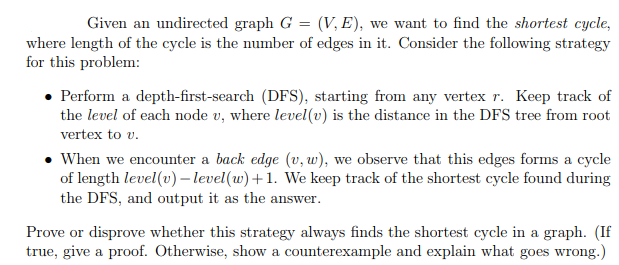
Given an undirected graph G (V, E), we want to find the shortest cycle, where length of the cycle is the number of edges in it. Consider the following strategy for this problem: . Perform a depth-first-search (DFS), starting from any vertex r. Keep track of the level of each node v, where level (v) is the distance in the DFS tree from root vertex to v. When we encounter a back edge (v, ), we observe that this edges forms a cycle of length level(v) - level (w) +1. We keep track of the shortest cycle found during the DFS, and output it as the answer Prove or disprove whether this strategy always finds the shortest cycle in a graph. (If true, give a proof. Otherwise, show a counterexample and explain what goes wrong.)
Step by Step Solution
There are 3 Steps involved in it

Get step-by-step solutions from verified subject matter experts
 Study Help