







Question: Given an unspanned memory organisation, fixed record length, a blocking factor of 2, and five records with the following primary keys: 14, 20, 25, 32,
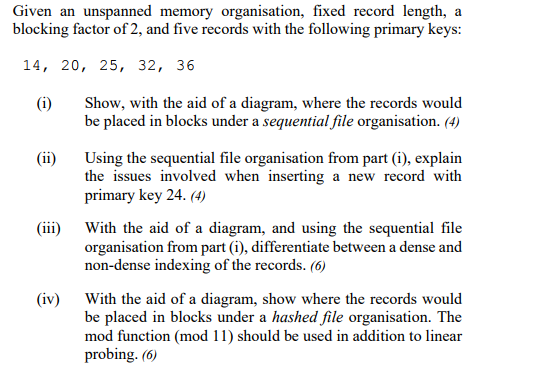
Given an unspanned memory organisation, fixed record length, a blocking factor of 2, and five records with the following primary keys: 14, 20, 25, 32, 36 Show, with the aid of a diagram, where the records would be placed in blocks under a sequential file organisation. (4) (i) i) Using the sequential file organisation from part (i), explain the issues involved when inserting a new record with primary key 24. (4) ii) With the aid of a diagram, and using the sequential file organisation from part (i), differentiate between a dense and non-dense indexing of the records. (6) iv With the aid of a diagram, show where the records would be placed in blocks under a hashed file organisation. The mod function (mod 11) should be used in addition to linear probing. (6) Given an unspanned memory organisation, fixed record length, a blocking factor of 2, and five records with the following primary keys: 14, 20, 25, 32, 36 Show, with the aid of a diagram, where the records would be placed in blocks under a sequential file organisation. (4) (i) i) Using the sequential file organisation from part (i), explain the issues involved when inserting a new record with primary key 24. (4) ii) With the aid of a diagram, and using the sequential file organisation from part (i), differentiate between a dense and non-dense indexing of the records. (6) iv With the aid of a diagram, show where the records would be placed in blocks under a hashed file organisation. The mod function (mod 11) should be used in addition to linear probing. (6)
Step by Step Solution
There are 3 Steps involved in it

Get step-by-step solutions from verified subject matter experts
 Study Help