







Question: Given Answer in Python Code: Pls given full answer not code outline or guide. Investigate the difference in the time dependent autocorrelation function of velocities,
Given Answer in Python Code: Pls given full answer not code outline or guide. Investigate the difference in the time dependent autocorrelation function of velocities, t of LennardJones systems with N with periodic boundary conditions at densities. The system are initiated with the atoms placed in the sites of a facecenteredcubic fcc lattice consistent with a a a The temperature to equilibrate the systems will be around T Follow the same requirements as the image concerning the system parameters. Consider the system of homework with atoms interacting via the LennardJones
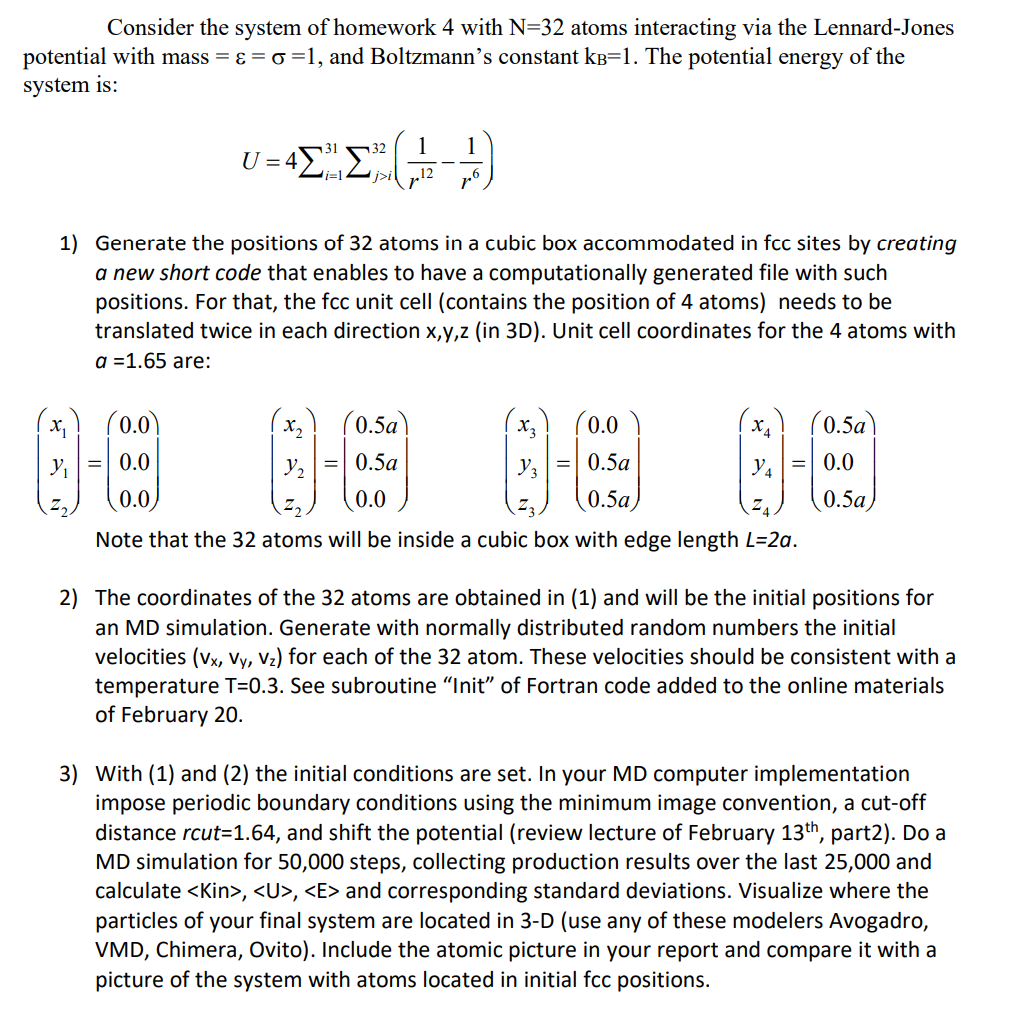
potential with mass and Boltzmann's constant The potential energy of the
system is:
Generate the positions of atoms in a cubic box accommodated in fcc sites by creating
a new short code that enables to have a computationally generated file with such
positions. For that, the fcc unit cell contains the position of atoms needs to be
translated twice in each direction in D Unit cell coordinates for the atoms with
are:
Note that the atoms will be inside a cubic box with edge length
The coordinates of the atoms are obtained in and will be the initial positions for
an MD simulation. Generate with normally distributed random numbers the initial
velocities for each of the atom. These velocities should be consistent with a
temperature See subroutine "Init" of Fortran code added to the online materials
of February
With and the initial conditions are set. In your MD computer implementation
impose periodic boundary conditions using the minimum image convention, a cutoff
distance cut and shift the potential review lecture of February part Do a
MD simulation for steps, collecting production results over the last and
calculate Kin : and corresponding standard deviations. Visualize where the
particles of your final system are located in D use any of these modelers Avogadro,
VMD Chimera, Ovito Include the atomic picture in your report and compare it with a
picture of the system with atoms located in initial fcc positions.
Step by Step Solution
There are 3 Steps involved in it
1 Expert Approved Answer
Step: 1 Unlock

Question Has Been Solved by an Expert!
Get step-by-step solutions from verified subject matter experts
Step: 2 Unlock
Step: 3 Unlock
 Study Help