







Question: Given any propositional boolean formula, one can always convert it into CNF by using the following three rules: (a= -b) Ha Vb) (a V-b) (a
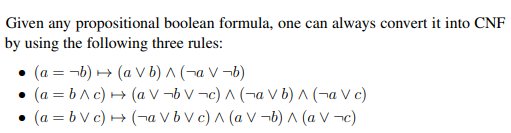

Given any propositional boolean formula, one can always convert it into CNF by using the following three rules: (a= -b) Ha Vb) (a V-b) (a = b^c) (a V-6 V-) A (Vb)(-a Vc) (a = b Vc) + (na VbVc) ^ (a V-b) ^ (a V -c) Show each step how unit propagation rule applies to the following formula (21 V 23 V-14) A(-23 V-24V 12) (21 V-12V-25) Assume z is assigned to 0 and 24 is assigned to 1. Given any propositional boolean formula, one can always convert it into CNF by using the following three rules: (a= -b) Ha Vb) (a V-b) (a = b^c) (a V-6 V-) A (Vb)(-a Vc) (a = b Vc) + (na VbVc) ^ (a V-b) ^ (a V -c) Show each step how unit propagation rule applies to the following formula (21 V 23 V-14) A(-23 V-24V 12) (21 V-12V-25) Assume z is assigned to 0 and 24 is assigned to 1
Step by Step Solution
There are 3 Steps involved in it

Get step-by-step solutions from verified subject matter experts
 Study Help