







Question: Given f:R->R and g:R->R , we define the sum f+g by (f+g)(x)= f(x)+g(x) and the product fg by (fg)(x)=f(x)*g(x) for all xinR . Find counterexamples
Given
f:R->Rand
g:R->R, we define the sum
f+gby
(f+g)(x)=
f(x)+g(x)and the product
fgby
(fg)(x)=f(x)*g(x)for all
xinR. Find counterexamples for the following.\ (a) If
fand
gare bijective, then the sum
f+gis bijective.\ (b) If
fand
gare bijective, then the product
fgis bijective.
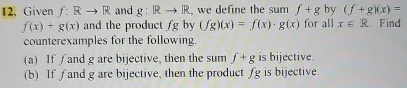
2. Given f:RR and g:RR, we define the sum f+g by (f+g)(x)= f(x)+g(x) and the product fg by (fg)(x)=f(x)g(x) for all xR. Find counterexamples for the following. (a) If f and g are bijective, then the sum f+g is bijective. (b) If f and g are bijective, then the product fg is bijective
Step by Step Solution
There are 3 Steps involved in it
1 Expert Approved Answer
Step: 1 Unlock

Question Has Been Solved by an Expert!
Get step-by-step solutions from verified subject matter experts
Step: 2 Unlock
Step: 3 Unlock
 Study Help