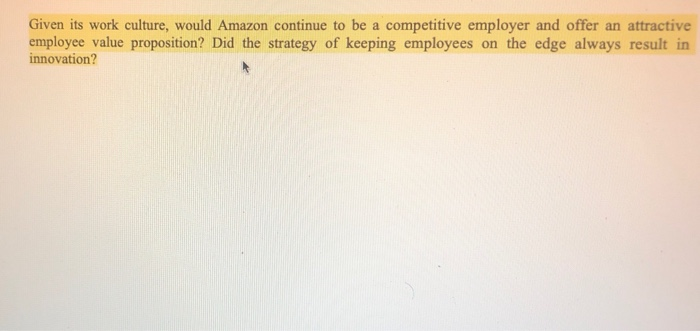
Question: Given its work culture, would Amazon continue to be a competitive employer and offer an attractive employee value proposition? Did the strategy of keeping employees
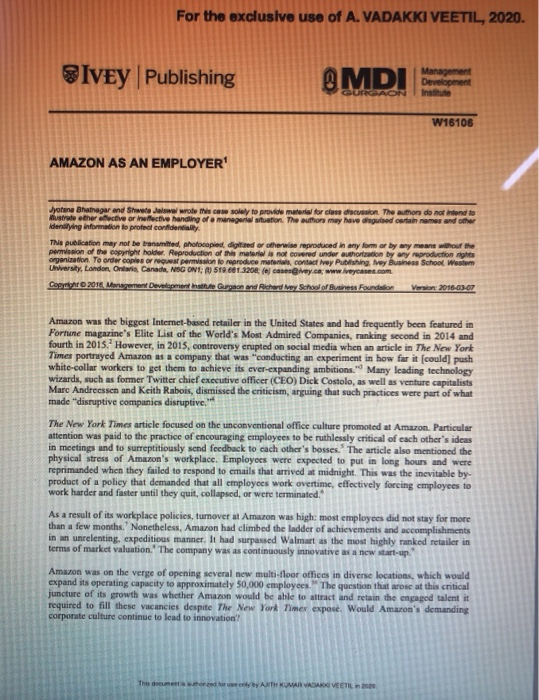
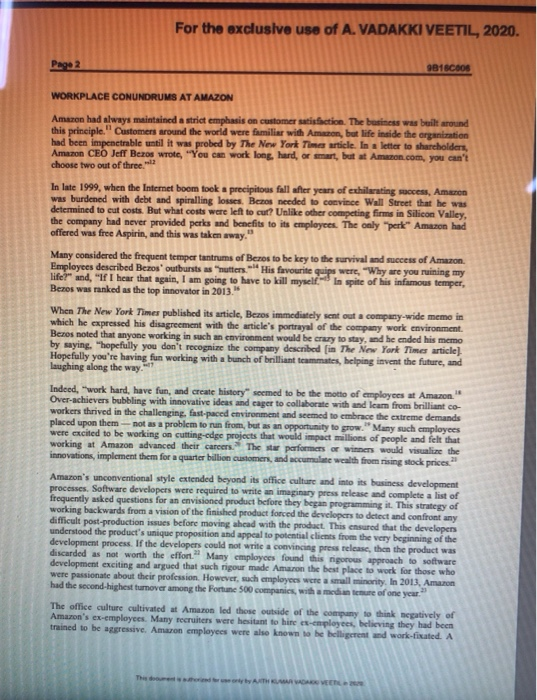
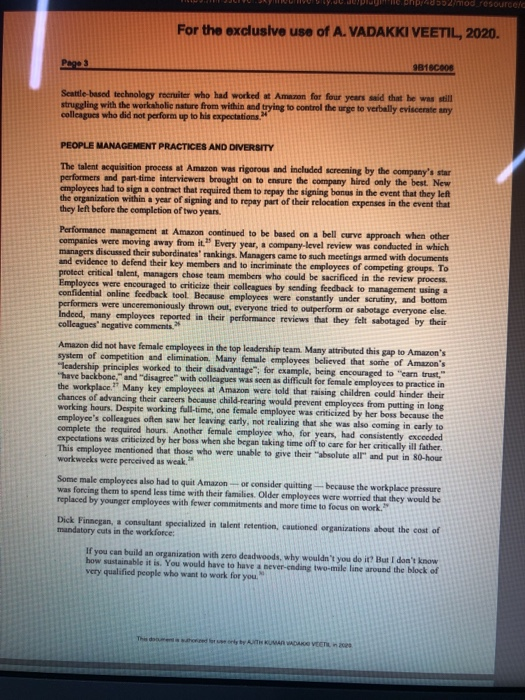
Given its work culture, would Amazon continue to be a competitive employer and offer an attractive employee value proposition? Did the strategy of keeping employees on the edge always result in innovation? For the exclusive use of A. VADAKKI VEETIL, 2020. Ivey | Publishing OMDI Management Development GURGAON W16106 AMAZON AS AN EMPLOYER Jyotsna Bhatnagar and Swete Jelswel wrote this case solely to provide material forces de son. The authors do not intend to Australe other fective or ineffective handling of a managerial on. The authors may have had certainemes and other Identlying information to proteel confidentiality This publication may not be transmitted photocopied, died or otherwise reproduced in any form or by any means without the permission of the copyright holder Reproduction of the material is not covered under authorization by any reproduction nights organization. To order copies or request permission to reproduce materials, contact ry Publishing, Ivy Business School Western University, London, Ontario, Canada, NSG ONT:) 51.687.3.200 ( cases@ey. www.iveycases.com Copyright 2016 Mariagement Development on and Richard Stof Business Foundation Version: 2016-03-07 Amazon was the biggest Internet-based retailer in the United States and had frequently been featured in Fortune magazine's Elite List of the World's Most Admired Companies, ranking second in 2014 and fourth in 2015. However, in 2015, controversy erupted on social media when an article in The New York Times portrayed Amazon as a company that was conducting an experiment in how far it could) push white-collar workers to get them to achieve its ever-expanding ambitions." Many leading technology wizards, such as former Twitter chief executive officer (CEO) Dick Costolo, as well as venture capitalists Marc Andreessen and Keith Rabois, dismissed the criticism, arguing that such practices were part of what made "disruptive companics disruptive." The New York Times article focused on the unconventional office culture promoted at Amazon. Particular attention was paid to the practice of encouraging employees to be ruthlessly critical of each other's ideas in meetings and to surreptitiously send feedback to cach other's bosses. The article also mentioned the physical stress of Amazon's workplace. Employees were expected to put in long hours and were reprimanded when they failed to respond to emails that arrived at midnight. This was the inevitable by- product of a policy that demanded that all employees work overtime, effectively forcing employees to work harder and faster until they quit, collapsed, or were terminated. As a result of its workplace policies, turnover at Amazon was high: most employees did not stay for more than a few months. Nonetheless, Amazon had climbed the ladder of achievements and accomplishments in an unrelenting, expeditious manner. It had surpassed Walmart as the most highly ranked retailer in terms of market valuation. The company was as continuously innovative as a new start-up. Amazon was on the verge of opening several new multi-floor offices in diverse locations, which would expand its operating capacity to approximately 50,000 employees. The question that arose at this critical juncture of its growth was whether Amazon would be able to attract and retain the engaged talent it required to fill these vacancies despite the New York Times expos. Would Amaron's demanding corporate culture continue to lead to innovation This deathered for AATH KUMAR VADANOG VEETILI For the exclusive use of A. VADAKKI VEETIL, 2020. Page 2 9816COS WORKPLACE CONUNDRUMS AT AMAZON Amazon had always maintained a strict emphasis on customer satisfaction. The business was built around this principle." Customers around the world were familiar with Amazon, but life inside the organization had been impenetrable until it was probed by The New York Times article. In letter to shareholders, Amazon CEO Jeff Bezos wrote, "You can work long, hard, or smart, but at Amazon.com, you can't choose two out of three." In late 1999, when the Internet boom took a precipitous fall after years of exhilarating success, Amazon was burdened with debt and spiralling losses Bezos needed to convince Wall Street that he was determined to cut costs. But what costs were left to cut? Unlike other competing firms in Silicon Valley, the company had never provided perks and benefits to its employees. The only "perk" Amazon had offered was free Aspirin, and this was taken away." Many considered the frequent temper tantrums of Bezos to be key to the survival and success of Amazon. Employees described Bezos'outbursts as "nutters. His favourite quips were, "Why are you ruining my lifer" and, "If I hear that again, I am going to have to kill myself. In spite of his infamous temper, Bezos was ranked as the top innovator in 2013." When The New York Times published its article, Bezos immediately sent out a company-wide memo in which he expressed his disagreement with the article's portrayal of the company work environment. Bezos noted that anyone working in such an environment would be crary to stay, and he ended his memo by saying, "hopefully you don't recognize the company described in The New York Times article] Hopefully you're having fun working with a bunch of brilliant teammates, helping invent the future, and laughing along the way? 18 Indeed, "work hard, have fun, and create history seemed to be the motto of employees at Amazon. Over-achievers bubbling with innovative ideas and eager to collaborate with and leam from brilliant co- workers thrived in the challenging, fast-paced environment and seemed to embrace the extreme demands placed upon them - not as a problem to run from, but as an opportunity to grow. Many such employees were excited to be working on cutting-edge projects that would impact millions of people and felt that working at Amazon advanced their careers. The star performers or winners would visualize the innovations, implement them for a quarter billion customers, and accumulate wealth from rising stock prices." Amazon's unconventional style extended beyond its office culture and into its business development processes. Software developers were required to write an imaginary press release and complete a list of frequently asked questions for an envisioned product before they began programming it. This strategy of working backwards from a vision of the finished product forced the developers to detect and confront any difficult post-production issues before moving ahead with the product. This ensured that the developers understood the product's unique proposition and appeal to potential clients from the very beginning of the development process. If the developers could not write a convincing press release, then the product was discarded as not worth the effort. Many employees found this rigorous approach to software development exciting and argued that such rigour made Amazon the best place to work for those who were passionate about their profession. However, such employees were a small minority. In 2013, Amaron had the second-highest turnover among the Fortune 500 companies, with a median temure of one year." The office culture cultivated at Amazon led those outside of the company to think negatively of Amazon's ex-employees. Many recruiters were hesitant to hire ex-employees, believing they had been trained to be aggressive. Amazon employees were also known to be helligerent and work-fixated. A Pupa od resource For the exclusive use of A. VADAKKI VEETIL, 2020. Page 3 9B16C008 Seattle-based technology recruiter who had worked at Amazon for four years said that he was still struggling with the workaholic nature from within and trying to control the urge to verbally eviscerate any colleagues who did not perform up to his expectations." PEOPLE MANAGEMENT PRACTICES AND DIVERSITY The talent acquisition process at Amazon was rigorous and included screening by the company's star performers and part-time interviewers brought on to ensure the company hired only the best. New employees had to sign a contract that required them to repay the signing bones in the event that they left the organization within a year of signing and to repay part of their relocation expenses in the event that they left before the completion of two years. Performance management at Amaron continued to be based on a bell curve approach when other companies were moving away from it." Every year, a company-level review was conducted in which managers discussed their subordinates' rankings. Managers came to such meetings armed with documents and evidence to defend their key members and to incriminate the employees of competing groups. To protect critical talent managers chose team members who could be sacrificed in the review process Employees were encouraged to criticize their colleagues by sending feedback to management using a confidential online feedback tool Because employees were constantly under scrutiny, and bottom performers were unceremoniously thrown out, everyone tried to outperform or sabotage everyone else. Indeed, many employees reported in their performance reviews that they felt sabotaged by their colleagues negative comments Amazon did not have female employees in the top leadership team. Many attributed this gap to Amazon's system of competition and elimination. Many female employees believed that some of Amazon's "leadership principles worked to their disadvantage", for example, being encouraged to "earn trust." "have backbone." and "disagree with colleagues was seen as difficult for female employees to practice in the workplace. Many key employees at Amazon were told that raising children could hinder their chances of advancing their careers because child-rearing would prevent employees from putting in long working hours. Despite working full-time, one female employee was criticized by her boss because the employee's colleagues often saw her leaving early, not realizing that she was also coming in carly to complete the required hours. Another female employee who, for years, had consistently exceeded expectations was criticired by her boss when she began taking time off to care for her critically ill father, This employee mentioned that those who were unable to give their "absolute all" and put in 80-hour workweeks were perceived as weak." Some male employees also had to quit Amazon or consider quitting because the workplace pressure was forcing them to spend less time with their families. Older employees were worried that they would be replaced by younger employees with fewer commitments and more time to focus on work. Dick Finnegan, a consultant specialized in talent retention, cautioned organizations about the cost of mandatory cuts in the workforce If you can build an organization with zero deadwoods, why wouldn't you do it? But I don't know how sustainable it is. You would have to have a never-ending two-mile line around the block of very qualified people who want to work for you. ory by KUWA MADAKO VEEL For the excluslve use of A. VADAKKI VEETIL, 2020. Page 4 9816C006 AMAZON WORKPLACE: FUTURE DIRECTION In 2014, Harvard Business Review ranked Bezos as the top CEO." Yet, just 12 months later, his ranking fell to the 87th position largely because, in 2015, CEOs were evaluated not just on the basis of their financial success but also on the basis of their performance with respect to social responsibility criteria However, with topline growth and controlled spending, Amazon stock prices had more than doubled." In response to The New York Times article, Bezos sent the following message to Amazon employees: The article doesn't describe the Amazon I know or the caring Amazonians I work with every day. But if you know of any stories like those reported, I want you to escalate (them) to HR. You can also email me directly at jeff@amazon.com. Even if it's rare or isolated, our tolerance for any such lack of empathy needs to be rero. Given its work culture, would Amazon continue to be a competitive employer and offer an attractive employee value proposition? Did the strategy of keeping employees on the edge always result in innovation? The KWA ADARVEL









 Study Help