Question: Given p7.cxx ****************************** #include #include #include #include using namespace std; //------ struct card { enum class suit { club, spade, diamond, heart }; enum {
Given p7.cxx ******************************
#include #include #include #include using namespace std;
//------
struct card { enum class suit { club, spade, diamond, heart }; enum { ace=1, jack=10, queen=11, king=12 }; using number = int;
number num_; suit suit_; };
bool operator ==(card const& a, card const& b) { return a.num_ == b.num_ && a.suit_ == b.suit_; }
bool operator
istream& operator >>(istream& is, card& c) { // number followed by the suit (CSHD)... is >> c.num_;
char ch; if (is >> ch) { switch (ch) { case 'C': c.suit_ = card::suit::club; break; case 'S': c.suit_ = card::suit::spade; break; case 'H': c.suit_ = card::suit::heart; break; case 'D': c.suit_ = card::suit::diamond; break; default: is.setstate(ios::failbit); break; } } else is.setstate(ios::badbit); return is; }
ostream& operator
switch (c.suit_) { // card::suit allows us to access suit // suit::club allows us to access club // thus, card::suit::club lets us access club case card::suit::club: os
case card::suit::spade: os
case card::suit::diamond: os
case card::suit::heart: os
return os; }
//------
struct cards { vector cs_;
void sort_by_lt() { // [ first, last ) -- half-open interval sort( cs_.begin(), cs_.end() // OR: begin(cs_), end(cs_) ); } };
ostream& operator
istream& operator >>(istream& is, cards& mycards) { size_t sz; if (is >> sz) { mycards.cs_ = vector{}; // assign an empty vector to mycards.cs_
for (size_t i=0; i != sz; ++i) { card c; if (is >> c) mycards.cs_.push_back(c); else { is.setstate(ios::badbit); break; } } } return is; }
int main() { cards mycards; if (cin >> mycards) { mycards.sort_by_lt(); cout
card d{ 15, card::suit::heart };
auto pos = find( begin(mycards.cs_), // start here end(mycards.cs_), // go up to by not including this position d ); auto pos2 = find( pos, end(mycards.cs_), card{ 10, card::suit::club } );
#if 1 copy(pos, pos2, ostream_iterator(cout, " ")); #else for (; pos != pos2; ++pos) cout **************************
Given r1.cxx*******************************\
#include
using namespace std;
int main() { // map of (number, num of times number occurs)... map freqhist;
int i; while (cin >> i) ++freqhist[i];
cout
*************************
Given r2.cxx************************
#include
using namespace std;
int main() { // map of (number, num of times number occurs)... map freqhist;
string i; while (cin >> i) ++freqhist[i];
cout
********************************************
Given r3.cxx*******************************
#include
using namespace std;
int main() { // map of (number, num of times number occurs)... map freqhist;
string i; while (cin >> i) { auto[pos,is_added] = freqhist.insert({i,1}); if (!is_added) ++pos->second; }
cout
***************************************
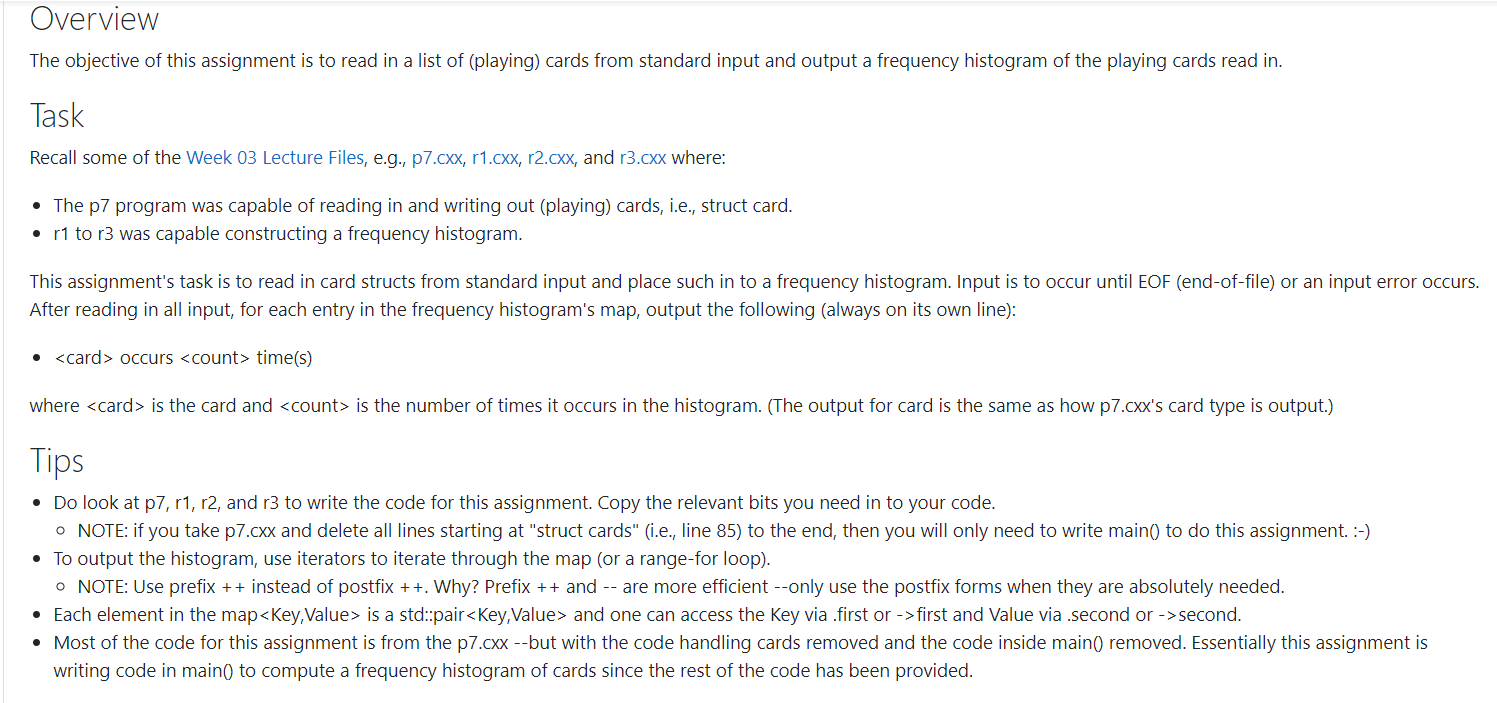
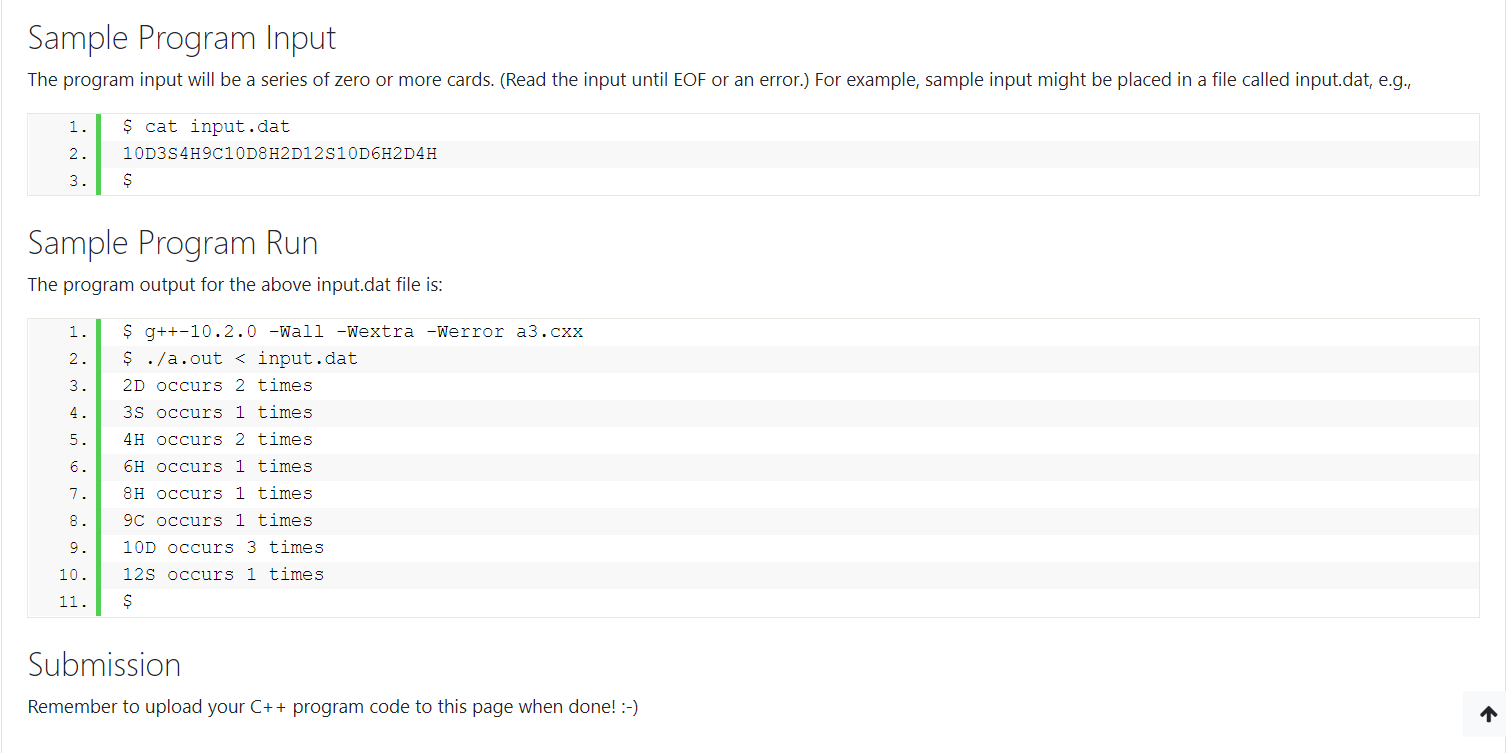
Overview The objective of this assignment is to read in a list of (playing) cards from standard input and output a frequency histogram of the playing cards read in. Task Recall some of the Week 03 Lecture Files, e.g., p7.cxx, r1.cxx, r2.cxx, and r3.cxx where: The p7 program was capable of reading in and writing out (playing) cards, i.e., struct card. r1 to r3 was capable constructing a frequency histogram. This assignment's task is to read in card structs from standard input and place such in to a frequency histogram. Input is to occur until EOF (end-of-file) or an input error occurs. After reading in all input, for each entry in the frequency histogram's map, output the following (always on its own line): . occurs time(s) where is the card and is the number of times it occurs in the histogram. (The output for card is the same as how p7.cxx's card type is output.) Tips Do look at p7, r1, r2, and r3 to write the code for this assignment. Copy the relevant bits you need in to your code. O NOTE: if you take p7.cxx and delete all lines starting at "struct cards" (i.e., line 85) to the end, then you will only need to write main() to do this assignment. :-) To output the histogram, use iterators to iterate through the map (or a range-for loop). O NOTE: Use prefix + + instead of postfix ++. Why? Prefix ++ and -- are more efficient --only use the postfix forms when they are absolutely needed. Each element in the map is a std::pair and one can access the key via first or ->first and Value via second or ->second. Most of the code for this assignment is from the p7.cxx--but with the code handling cards removed and the code inside main() removed. Essentially this assignment is writing code in main() to compute a frequency histogram of cards since the rest of the code has been provided. Sample Program Input The program input will be a series of zero or more cards. (Read the input until EOF or an error.) For example, sample input might be placed in a file called input.dat, e.g., 1. 2. $ cat input.dat 10D3S4H9C10D8H2D12S10D6H2D4H $ 3. Sample Program Run The program output for the above input.dat file is: 1. 2. 3. 4. 5. $ g++-10.2.0 -Wall - Wextra -Werror a3.cxx $ ./a.out occurs time(s) where is the card and is the number of times it occurs in the histogram. (The output for card is the same as how p7.cxx's card type is output.) Tips Do look at p7, r1, r2, and r3 to write the code for this assignment. Copy the relevant bits you need in to your code. O NOTE: if you take p7.cxx and delete all lines starting at "struct cards" (i.e., line 85) to the end, then you will only need to write main() to do this assignment. :-) To output the histogram, use iterators to iterate through the map (or a range-for loop). O NOTE: Use prefix + + instead of postfix ++. Why? Prefix ++ and -- are more efficient --only use the postfix forms when they are absolutely needed. Each element in the map is a std::pair and one can access the key via first or ->first and Value via second or ->second. Most of the code for this assignment is from the p7.cxx--but with the code handling cards removed and the code inside main() removed. Essentially this assignment is writing code in main() to compute a frequency histogram of cards since the rest of the code has been provided. Sample Program Input The program input will be a series of zero or more cards. (Read the input until EOF or an error.) For example, sample input might be placed in a file called input.dat, e.g., 1. 2. $ cat input.dat 10D3S4H9C10D8H2D12S10D6H2D4H $ 3. Sample Program Run The program output for the above input.dat file is: 1. 2. 3. 4. 5. $ g++-10.2.0 -Wall - Wextra -Werror a3.cxx $ ./a.out









 Study Help