







Question: Given Qd = a bP2 Qs = -c + dP (a, b > 0) (c, d > 0) What is the meaning of the
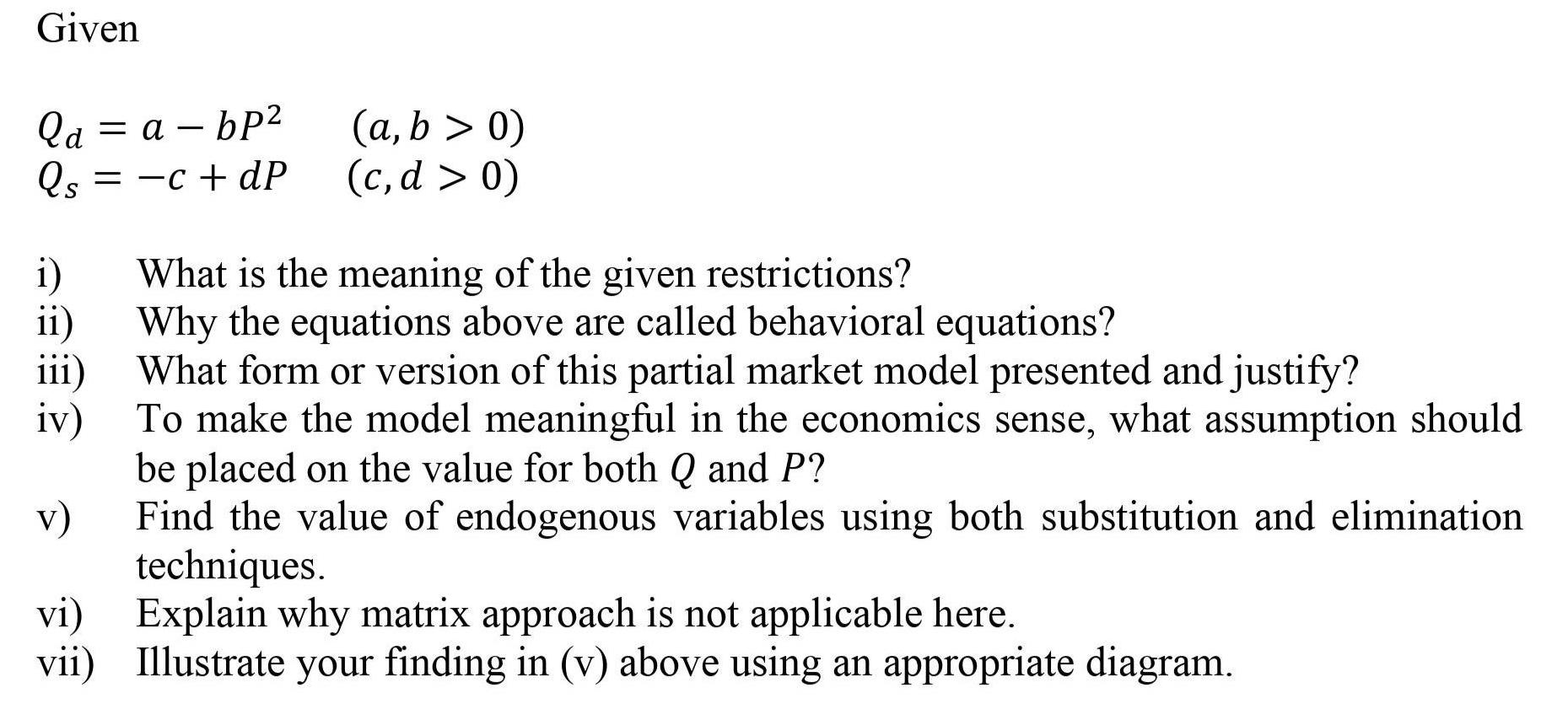
Given Qd = a bP2 Qs = -c + dP (a, b > 0) (c, d > 0) What is the meaning of the given restrictions? ii) i) Why the equations above are called behavioral equations? What form or version of this partial market model presented and justify? iii) iv) To make the model meaningful in the economics sense, what assumption should be placed on the value for both Q and P? v) Find the value of endogenous variables using both substitution and elimination techniques. vi) Explain why matrix approach is not applicable here. vii) Illustrate your finding in (v) above using an appropriate diagram.
Step by Step Solution
3.52 Rating (182 Votes )
There are 3 Steps involved in it
I The meaning of a 0 implies positive quantity is always demanded And b 0 implies quantity demanded is decreasing in prices The implication d 0 states ... View full answer

Get step-by-step solutions from verified subject matter experts
 Study Help