







Question: Given the background and diagrams to write a java program that is an implementation of the diagrams created below. Background: CSMACD stands for carrier Sense,
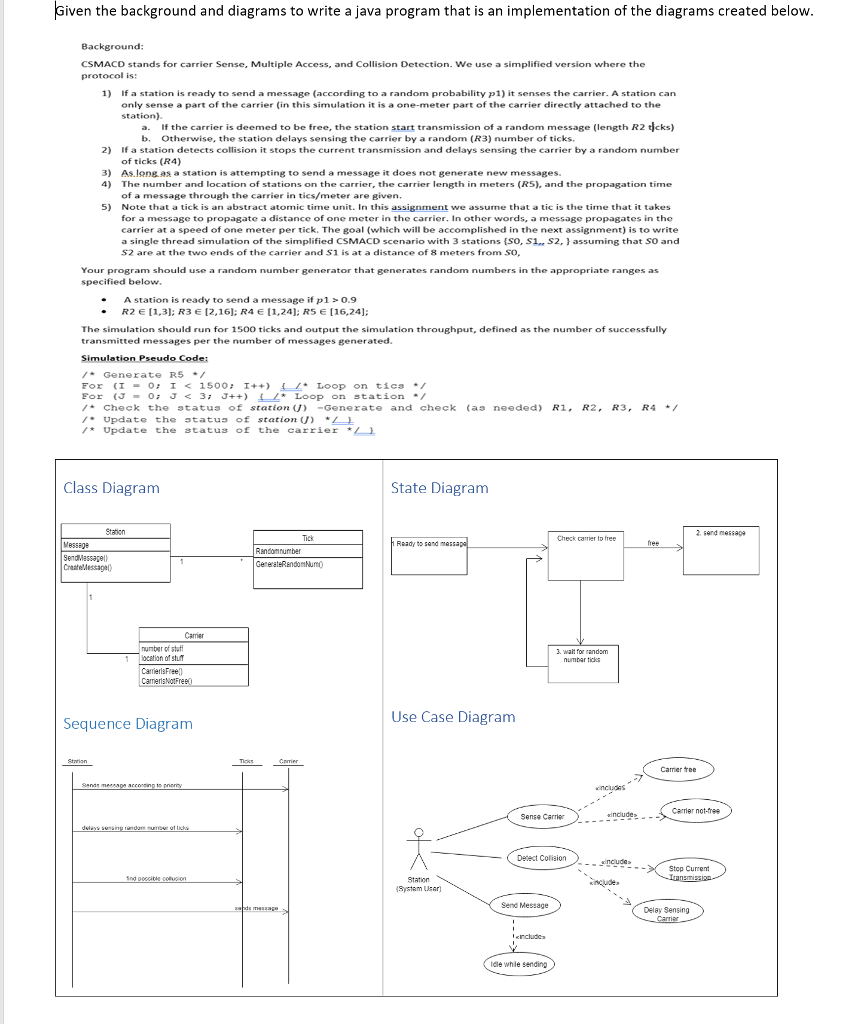
Given the background and diagrams to write a java program that is an implementation of the diagrams created below. Background: CSMACD stands for carrier Sense, Multiple Access, and Collision Detection. We use a simplified version where the protocol is: If a station is ready to send a message (according to a random probability p1) it senses the carrier. A station can only sense a part of the carrier (in this simulation it is a one-meter part of the carrier directly attached to the station). a. If the carrier is deemed to be free, the station start transmission of a random message (length R2 ticks) b. Otherwise, the station delays sensing the carrier by a random (R3) number of ticks. If a station detects collision it stops the current transmission and delays sensing the carrier by a random number of ticks (R4) As long as a station is attempting to send a message it does not generate new messages. The number and location of stations on the carrier, the carrier length in meters (RS), and the propagation time of a message through the carrier in tics/meter are given. Note that a tick is an abstract atomic time unit. In this assignment we assume that a tic is the time that it takes for a message to propagate a distance of one meter in the carrier. In other words, a message propagates in the carrier at a speed of one meter per tick. The goal (which will be accomplished in the next assignment) is to write a single thread simulation of the simplified CSMACD scenario with 3 stations {S0, S1, S2, } assuming that S0 and S2 are at the two ends of the carrier and S1 is at a distance of 8 meters from S0, Your program should use a random number generator that generates random numbers in the appropriate ranges as specified below. A station is ready to send a message if p1 > 0.9 R2 elementof [1, 3]: R3 elementof [2, 16]: R4 elementof [1, 24]: R5 elementof [16, 24]: The simulation should run for 1500 ticks and output the simulation throughput, defined as the number of successfully transmitted messages per the number of messages generated. Simulation Pseudo Code: /* Generate RS */ For (I = 0: I
Step by Step Solution
There are 3 Steps involved in it

Get step-by-step solutions from verified subject matter experts
 Study Help