







Question: Given the following Boolean equivalence: ab' + c = (a + c)(b + c) Which three of the following are correct? (Hint: choose three. Do
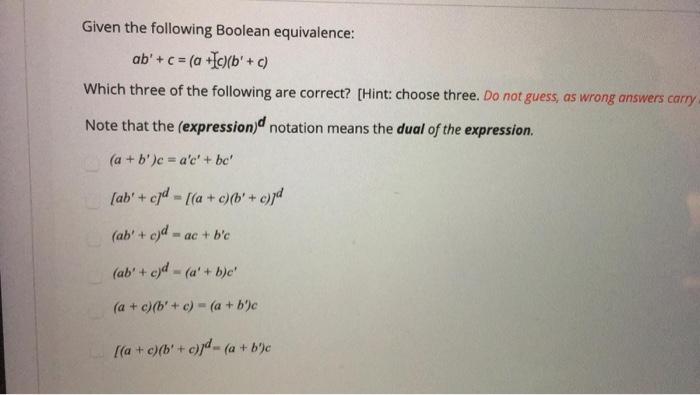
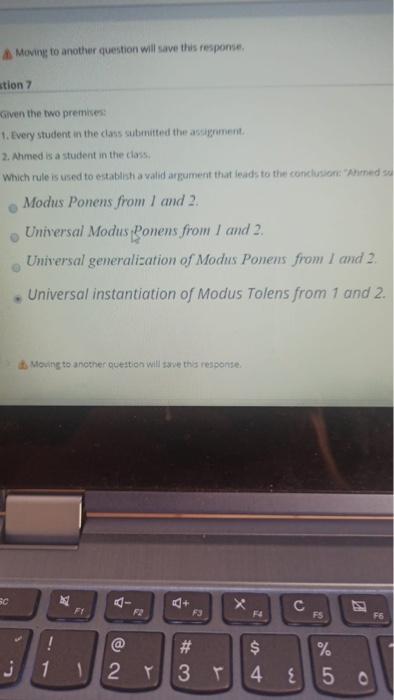
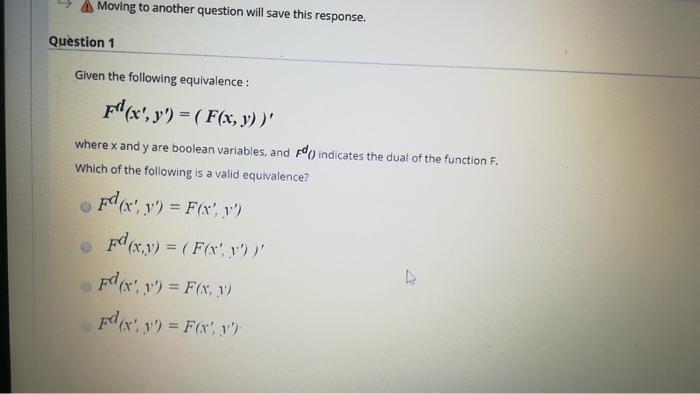
Given the following Boolean equivalence: ab' + c = (a + c)(b + c) Which three of the following are correct? (Hint: choose three. Do not guess, as wrong answers carry Note that the expression) notation means the dual of the expression. (a + b)e = a'c' + bc' [ab' + cpd - [(a + c)(b + od (ab' + ejd - ac+b'c (ab' + cd (a + b)c' (a + c)(b + c) = (a + b)c [(a + c)(b + c)-(a+b%e Moving to another question will save this response stion 7 Given the two premises 1. Every student in the class submitted the assignment 2. Ahmed is a student in the class Which rule is used to establish a valid argument that leads to the conclusion med su Modus Ponens from 1 and 2 Universal Modus Ponens from I and 2. Universal generalisation of Modus Ponens from I and 2. Universal instantiation of Modus Tolens from 1 and 2. Mowing to another question will save the response 4+ X FY 54 FS FE a # 1 2 3 3 j 1 $ 4 % 5 { 0 Moving to another question will save this response. Question 1 Given the following equivalence : F"(x', y') = ( F(x, y))' where x and y are boolean variables, and do indicates the dual of the function F. Which of the following is a valid equivalence? FOX' v') = F(X", ) F(x,y) = ( F(x! ) Fday") = F(x, y) Fly') = F(x
Step by Step Solution
There are 3 Steps involved in it

Get step-by-step solutions from verified subject matter experts
 Study Help