







Question: Given the following database instance, answer questions 3.1 through 3.3: Employee emp code EC14 ECIS EC16 EC17 EC20 emp Iname Rudell McDade Ruellardo Smith Smith
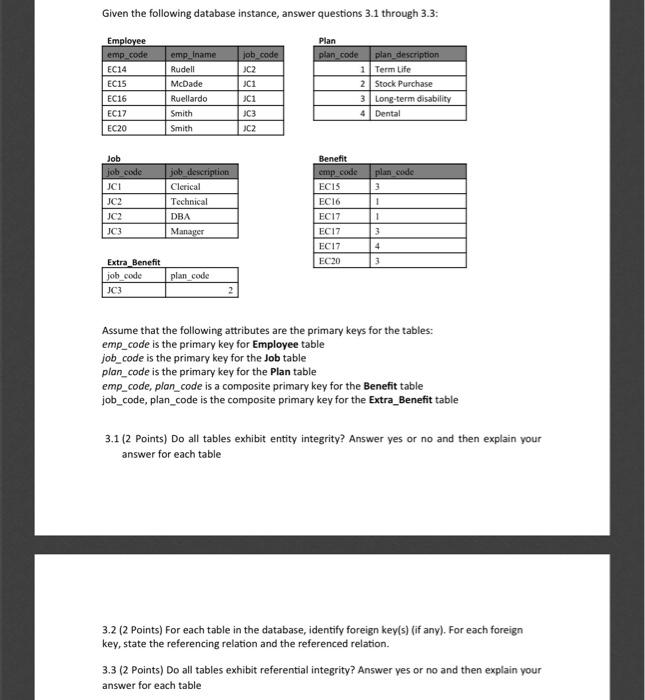
Given the following database instance, answer questions 3.1 through 3.3: Employee emp code EC14 ECIS EC16 EC17 EC20 emp Iname Rudell McDade Ruellardo Smith Smith job code JC2 3C1 C1 JC3 C2 Plan plan_code plan_description 1 Term Life 2 Stock Purchase 3 Long-term disability 4 Dental Job job code JCI JC2 JC2 JC3 job description Clerical Technical DBA Manager Benefit emp code ECIS EC16 EC17 EC17 EC17 EC20 plan code 3 1 1 3 4 3 Extra Benefit job code JC3 plan code Assume that the following attributes are the primary keys for the tables: emp_code is the primary key for Employee table job_code is the primary key for the Job table plan_code is the primary key for the Plan table emp_code, plan_code is a composite primary key for the Benefit table job_code, plan_code is the composite primary key for the Extra_Benefit table 3.1 (2 points) Do all tables exhibit entity integrity? Answer yes or no and then explain your answer for each table 3.2 (2 Points) For each table in the database, identify foreign key(s) (if any). For each foreign key, state the referencing relation and the referenced relation. 3.3 (2 Points) Do all tables exhibit referential integrity? Answer yes or no and then explain your answer for each table
Step by Step Solution
There are 3 Steps involved in it

Get step-by-step solutions from verified subject matter experts
 Study Help