







Question: Given the following function f(A.B,C, D) = (B.C -D)+ (A -B-D) + (A -B-C) + (A- B-C) a straight forward implementation would use exactly one
Given the following function f(A.B,C, D) = (B.C -D)+ (A -B-D) + (A -B-C) + (A- B-C) a straight forward implementation would use exactly one four-input LUT. Unfortunately, your FPGA architecture contains (two-input LUTS) Show how this function can be realized using only three (3) two-input LUTs. Complements of input signals are not available. Give the truth table implemented in each LUT. You will probably need to perform some minimization of the function.
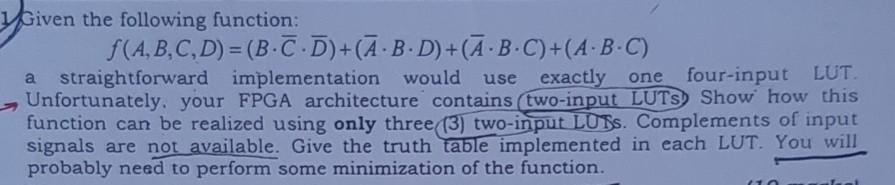
i must implement this equation using three (3) two-input lookup tables only. first use truth table then the design ... help please
Given the following function: f(A,B,C,D) = (B-CD)+(A-B-D)+(A-B-C)+(A-B-C) a straightforward implementation would use exactly one four-input LUT. Unfortunately, your FPGA architecture contains two-input LUTS) Show how this function can be realized using only three (3) two-input LUTS. Complements of input signals are not available. Give the truth table implemented in each LUT. You will probably need to perform some minimization of the function
Step by Step Solution
There are 3 Steps involved in it

Get step-by-step solutions from verified subject matter experts
 Study Help