





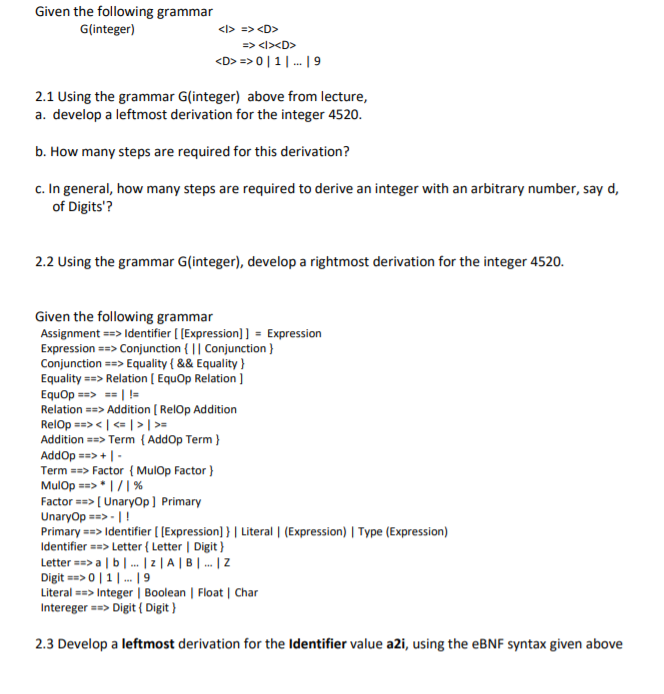
Question: Given the following grammar G(integer) >0 19 2.1 Using the grammar G(integer) above from lecture, a. develop a leftmost derivation for the integer 4520 b.
 Given the following grammar G(integer) >0 19 2.1 Using the grammar

G(integer) above from lecture, a. develop a leftmost derivation for the integer

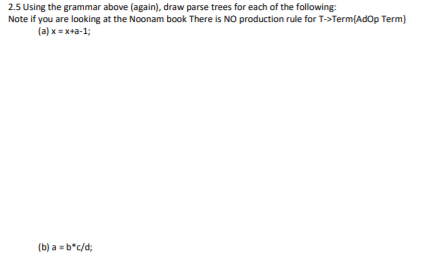
Given the following grammar G(integer) >0 19 2.1 Using the grammar G(integer) above from lecture, a. develop a leftmost derivation for the integer 4520 b. How many steps are required for this derivation? C. In general, how many steps are required to derive an integer with an arbitrary number, say d, of Digits'? 2.2 Using the grammar G(integer), develop a rightmost derivation for the integer 4520. Given the following grammar Assignment>Identifier [[Expression]Expression Expression >ConjunctionI1 Conjunction Conjunction>Equality&&Equality ) Equality>Relation [ Equop Relation ] Relation>Addition [RelOp Addition Addition :-> Term (Addop Term } TermFactor MulOp Factor Factor>UnaryOp] Primany UnaryOp! Primary> Identifier[Expression]) Literal (Expression) Type (Expression) IdentifierLetterLetter Digit) Letter > alb z IA B I.1Z Digit >01 9 Literal> Integer Boolean | Float| Char Intereger Digit Digit) 2.3 Develop a leftmost derivation for the Identifier value a2i, using the eBNF syntax given above 2.5 Using the grammar above (again), draw parse trees for each of the following: Note if you are looking at the Noonam book There is NO production rule for T->Term Adop Term) (a) xs x+a-1; (b) a b c/d

Step by Step Solution

There are 3 Steps involved in it

1 Expert Approved Answer
Step: 1 Unlock blur-text-image
Question Has Been Solved by an Expert!

Get step-by-step solutions from verified subject matter experts

Step: 2 Unlock
Step: 3 Unlock

Students Have Also Explored These Related Databases Questions!