







Question: Given the following problem and solution, what would the running time be? Back in the euphoric early days of the Web, people liked to claim
Given the following problem and solution, what would the running time be?
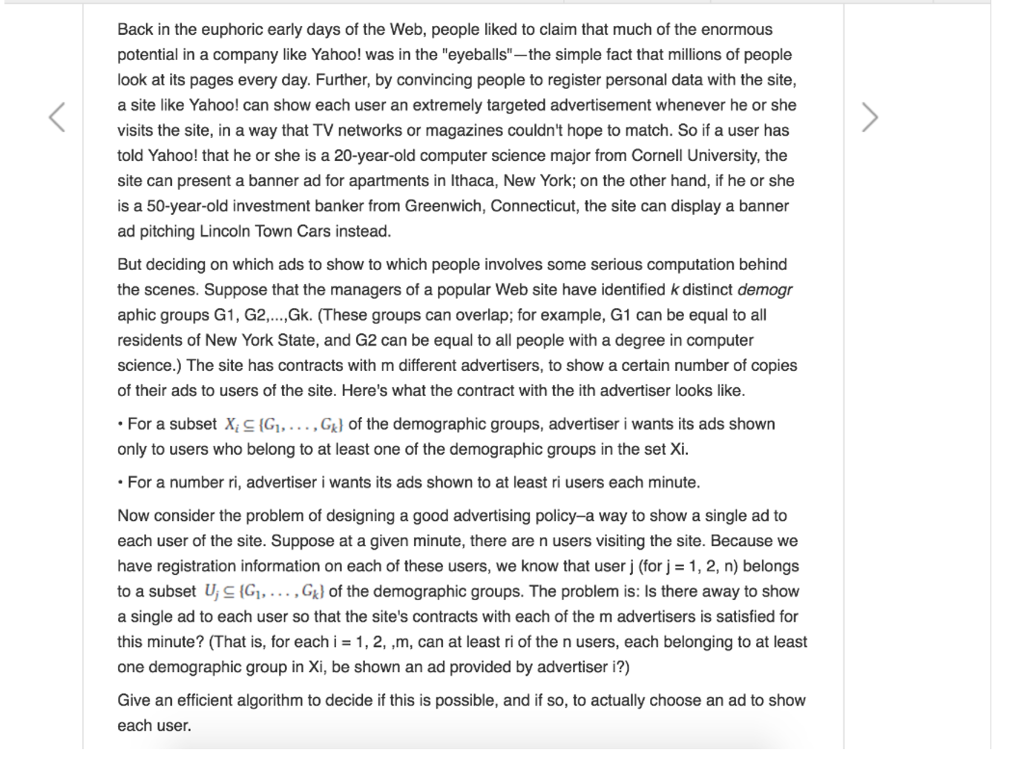

Back in the euphoric early days of the Web, people liked to claim that much of the enormous potential in a company like Yahoo! was in the "eyeballs the simple fact that millions of people look at its pages every day. Further, by convincing people to register personal data with the site a site like Yahoo! can show each user an extremely targeted advertisement whenever he or she visits the site, in a way that TV networks or magazines couldn't hope to match. So if a user has told Yahoo! that he or she is a 20-year-old computer science major from Cornell University, the site can present a banner ad for apartments in Ithaca, New York, on the other hand, if he or she is a 50-year-old investment banker from Greenwich, Connecticut, the site can display a banner ad pitching Lincoln Town Cars instead. But deciding on which ads to show to which people involves some serious computation behind the scenes. Suppose that the managers of a popular Web site have identified k distinct demogr aphic groups G1, G2 Gk. IThese groups can overlap, for example, G1 can be equal to a residents of New York State, and G2 can be equal to all people with a degree in computer science.) The site has contracts with m different advertisers, to show a certain number of copies of their ads to users of the site. Here's what the contract with the ith advertiser looks like For a subset Xi S (G1 Gk) of the demographic groups, advertiser i wants its ads shown only to users who belong to at least one of the demographic groups in the set Xi. For a number ri, advertiser i wants its ads shown to at least ri users each minute. Now consider the problem of designing a good advertising policy-a way to show a single ad to each user of the site. Suppose at a given minute, there are n users visiting the site. Because we have registration information on each of these users, we know that user j (for j 1, 2, n) belongs to a subset Ui S (G Gk) of the demographic groups. The problem is: ls there away to show a single ad to each user so that the site's contracts with each of the m advertisers is satisfied for 1, 2, ,m, can at least ri of the n users, each belonging to at least one demographic group in Xi, be shown an ad provided by advertiser i?) Give an efficient algorithm to decide if this is possible, and if so, to actually choose an ad to show each user
Step by Step Solution
There are 3 Steps involved in it

Get step-by-step solutions from verified subject matter experts
 Study Help