







Question: Given the following sort void sortRec(std::vector>& A, int n ) { if (n==1) return; sortRec (A,n1); int i; int tmp=A[n1]; i=n1; while (i>0 && A[i1]>tmp
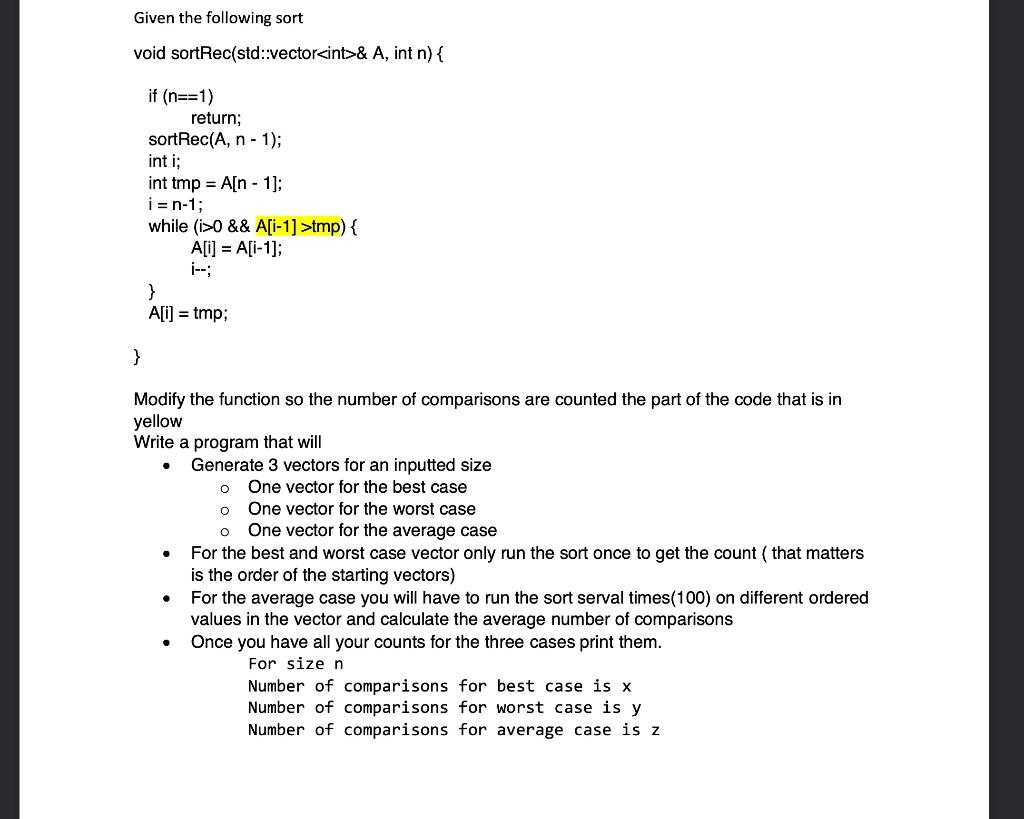
Given the following sort void sortRec(std::vector>& A, int n ) \{ if (n==1) return; sortRec (A,n1); int i; int tmp=A[n1]; i=n1; while (i>0 \&\& A[i1]>tmp ) \{ A[i]=A[i1]; i; \} A[i]=tmp; \} Modify the function so the number of comparisons are counted the part of the code that is in yellow Write a program that will - Generate 3 vectors for an inputted size - One vector for the best case - One vector for the worst case - One vector for the average case - For the best and worst case vector only run the sort once to get the count ( that matters is the order of the starting vectors) - For the average case you will have to run the sort serval times(100) on different ordered values in the vector and calculate the average number of comparisons - Once you have all your counts for the three cases print them. For size n Number of comparisons for best case is x Number of comparisons for worst case is y Number of comparisons for average case is z
Step by Step Solution
There are 3 Steps involved in it

Get step-by-step solutions from verified subject matter experts
 Study Help